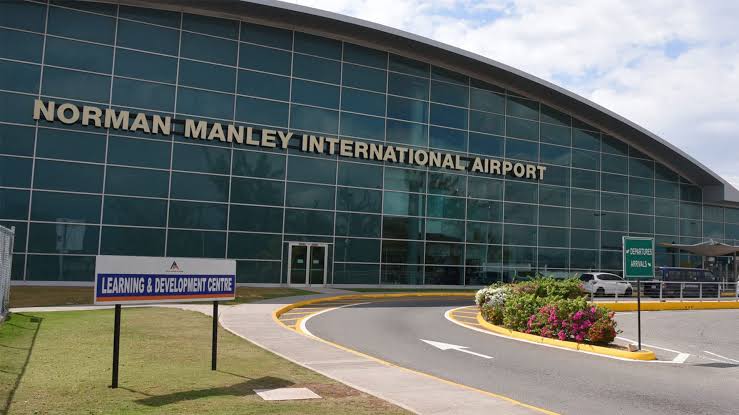
A 300-metre runway extension would normally suggest more capacity: additional aircraft movements, longer take-offs or heavier departures. At Norman Manley International Airport in Kingston, however, that is not the primary reason for the work now under way.
The project, valued at approximately US$72 million, is being developed to meet runway-safety requirements through the implementation of a Runway End Safety Area (RESA). Scheduled for completion in July 2027, it requires Jamaica to create additional space at the western end of an airport whose geography leaves little room for conventional expansion.
For Norman Manley, complying with an international safety standard has therefore become a major coastal-engineering project.
A runway extension driven by safety
A RESA is designed to reduce the consequences of an aircraft overrunning a runway or touching down before its threshold.
ICAO standards call for a safety area beyond the runway strip, with a minimum of 90 metres for certain runway categories and a recommendation extending to 240 metres where practicable.
At Kingston, the solution involves a physical extension of approximately 300 metres. But the project’s main justification is safety compliance rather than an immediate shortage of runway capacity.
The distinction is important.
Norman Manley’s existing runway is approximately 2,716 metres long. Grupo Aeroportuario del Pacífico (GAP), which operates the airport under concession, reports a declared capacity of around 40 aircraft movements per hour.
Peak demand in 2025 reached approximately 10 movements per hour.
That gap indicates that the airport is not currently extending the runway because its hourly movement capacity has been exhausted. Instead, the investment addresses the safety margins surrounding those movements.
The safety requirement is simple. Finding the land is not.
Norman Manley occupies an unusually constrained site on the Palisadoes peninsula, between Kingston Harbour and the Caribbean Sea.
There is no large reserve of land beyond the runway end where a conventional safety area can simply be constructed. The Airports Authority of Jamaica examined alternatives at both ends of the runway. One option involved extending eastwards towards Harbour View. The other pushed the project westwards into Kingston Harbour.
The western solution was selected. According to the authority, the calmer waters inside Kingston Harbour make construction more practical than on the more exposed side of the peninsula. That choice illustrates how different airport infrastructure planning becomes when land runs out.
At a coastal airport, a runway project may depend as much on marine conditions, shoreline engineering and environmental constraints as on aviation demand.
Building the safety margin into Kingston Harbour
Creating the additional space requires land reclamation.
Material dredged from Kingston Harbour is being used as part of the works needed to build the new platform. The airport is, in effect, creating the land required to accommodate the runway extension and associated safety infrastructure.
That has also brought environmental concerns into the project.
Norman Manley sits within the environmentally sensitive Palisadoes and Port Royal area, with protected coastal and marine environments close to the airport.
The Airports Authority of Jamaica says technical, scientific and environmental studies conducted for the project indicate that the works should not significantly increase water levels, tidal activity or flood exposure for nearby communities. Those remain conclusions presented by the authority, but they highlight the additional burden faced by coastal airports.
A requirement originating in aviation safety can quickly expand into questions of:
- dredging and reclamation;
- drainage and tidal behaviour;
- coastal resilience;
- environmental protection;
- and community exposure.
The physical space beyond the runway may be intended to remain empty during normal operations. Creating that space is anything but simple.
A project more than a decade in the making
The RESA requirement at Norman Manley is not new.
The Airports Authority traces the issue back to 2012, while environmental work associated with a runway extension at the site dates back even further.
An earlier version of the project was included in Jamaica’s first attempt to concession the airport in 2014. That concept envisaged an extension of around 500 metres, but the initial concession process did not proceed to completion.
The project was later redesigned at approximately 300 metres before Jamaica relaunched the transaction. GAP was awarded the concession in 2018 and assumed operational control of Norman Manley in October 2019.
The runway extension and RESA subsequently became part of the mandatory works attached to the concession agreement. GAP states that the RESA project entered construction in 2024.
That sequence provides a useful illustration of how international aviation standards translate into physical infrastructure:
safety requirement → national planning → concession obligation → private investment → construction.
Safety requirements can reshape concession economics
The financing story is also important.
The RESA project itself represents an estimated US$72 million investment, making it one of the largest individual safety-related projects undertaken at Norman Manley.
Jamaica has also adjusted aspects of the airport concession’s economics over time, including its concession-fee structure, in part to facilitate required capital works such as the runway extension and RESA.
That matters because safety infrastructure does not necessarily generate new revenue.
A terminal expansion can accommodate more passengers. Additional gates can support more aircraft. Commercial space can produce rental income.
A RESA is different. Its economic value lies largely in risk reduction and regulatory compliance.
For airport investors, such obligations are an important reminder that concession CAPEX is not solely about generating growth. Part of it may be required simply to maintain an airport’s ability to operate within international safety standards.
Expanding an active runway
The project also has to be delivered while Norman Manley remains operational. Some works have required carefully scheduled nighttime runway closures after the day’s passenger operations, allowing crews to modify runway infrastructure and carry out related electrical and RESA works.
That introduces another layer of complexity. At an operating airport, safety infrastructure cannot simply be built without regard for existing traffic. Construction has to be phased around airline schedules, runway availability and operational continuity.
The challenge is therefore not only to create a safer runway environment. It is to do so without unnecessarily reducing the airport capacity already available during construction.
Safety CAPEX does not require a capacity crisis
Kingston airport (Norman Manley) handled approximately 1.84 million passengers in 2025, continuing a gradual increase in traffic.
But the contrast between the airport’s declared 40 movements per hour and its 2025 peak of around 10 shows why traffic growth and runway-safety investment should not automatically be treated as the same issue.
An airport can have substantial operational headroom and still require major capital expenditure.
Some investment creates capacity. Some replaces ageing assets. Some improves passenger processing. And some exists because the consequences of a rare event could be severe. A runway-end safety area belongs primarily to the latter category. Its effectiveness is not measured by how frequently aircraft use it. Ideally, they never do.
A different infrastructure equation for coastal airports
Kingston airport ‘s experience has relevance across the Caribbean.
Many island airports occupy sites constrained by coastlines, urban development or environmentally sensitive land. Those limitations become increasingly significant when regulators require additional safety margins or operators need to upgrade infrastructure.
The standard may be international. The cost of complying with it is highly local.
At one airport, creating a RESA may require available land and relatively straightforward civil works. At another, it may require dredging, reclamation, environmental assessments, concession restructuring and years of engineering.
Kingston ‘s 300 metres demonstrate that distinction clearly. The most valuable part of the extension may rarely, if ever, be needed by an aircraft during normal operations.
That is precisely its purpose.
Its value lies in providing space when normal operations do not go according to plan — and in showing that airport infrastructure is not always built to accommodate more traffic. Sometimes it is built simply to create more room for error.
Sources: Airports Authority of Jamaica / Jamaica Information Service; Grupo Aeroportuario del Pacífico; ICAO; Ministry of Finance and the Public Service of Jamaica.