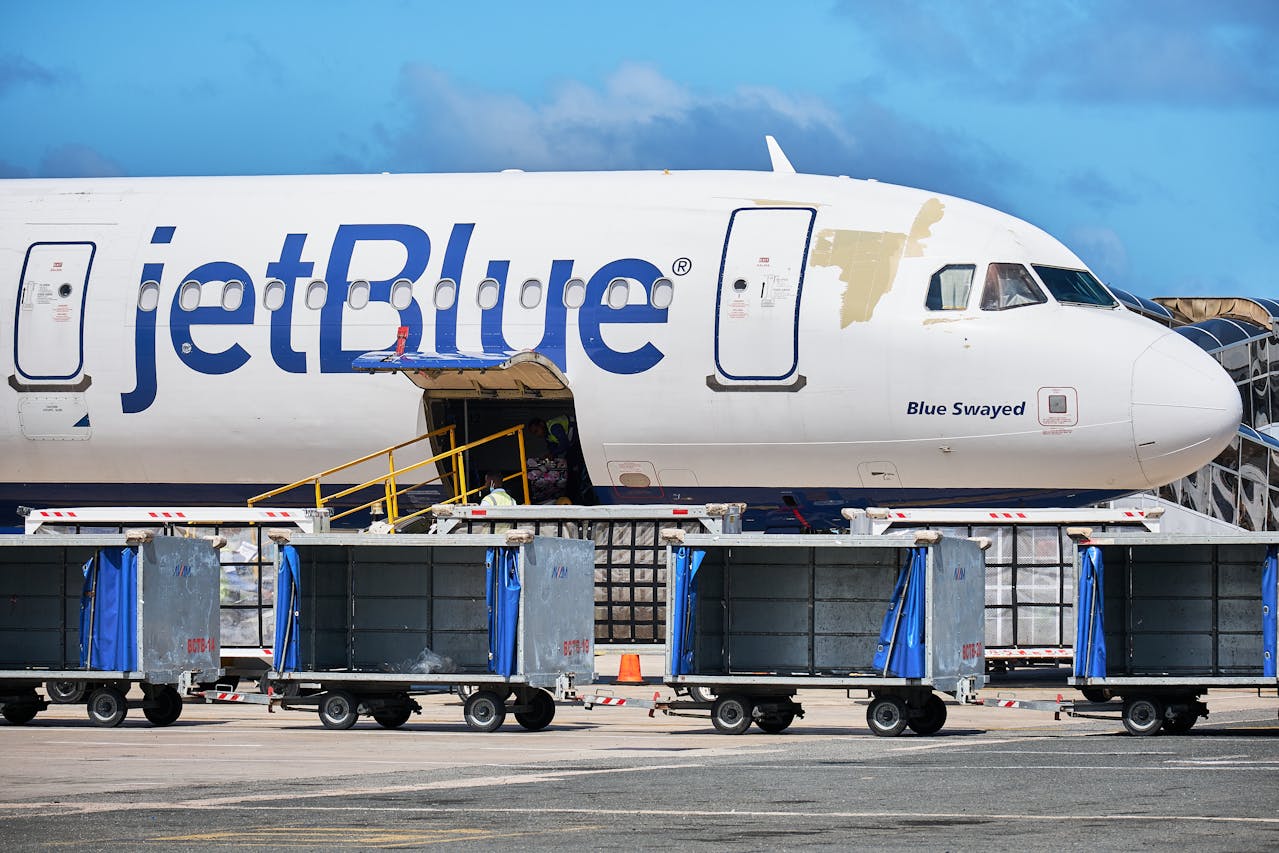
Competition among U.S. carriers in Aruba is intensifying as airlines continue expanding capacity into one of the Caribbean’s strongest-performing leisure destinations. New traffic data from the Aruba Airport Authority shows a market increasingly shaped by aggressive network positioning from JetBlue Airways and American Airlines, both of which led Aruba’s airline market during Q1 2026.
According to the airport’s latest statistics, JetBlue and American Airlines each captured 17% market share during the quarter, placing them ahead of Delta Air Lines at 14% and United Airlines at 13%. The figures underline how Aruba has become a highly competitive battleground for U.S. carriers seeking to strengthen their Caribbean leisure portfolios.
The competitive landscape is closely tied to the dominance of the U.S. market within Aruba’s international connectivity profile. New York remained the airport’s largest gateway in Q1 2026 with 17% of total seat capacity, followed by Boston at 11%, while Miami accounted for 6%. These high-density leisure corridors continue to attract significant airline investment, particularly during the summer season.
JetBlue appears to be pursuing one of the most aggressive expansion strategies. The carrier is reinforcing its position in the New York market with up to triple-daily JFK services during peak summer months, while also scaling operations from Fort Lauderdale and Newark. The airline’s strong presence reflects its broader Caribbean strategy, where leisure-heavy routes and VFR traffic remain central to network profitability.
American Airlines, meanwhile, continues leveraging the strength of its Miami hub while maintaining extensive connectivity from Charlotte, Dallas, Philadelphia and Chicago. The airline’s Aruba operation highlights the importance of hub diversification in Caribbean markets, allowing carriers to distribute traffic flows across multiple U.S. regions rather than relying exclusively on the Northeast corridor.
The market dynamics also reveal different strategic approaches among legacy carriers. United Airlines is expanding frequencies from Washington Dulles, Houston and Chicago, reinforcing its connectivity from major business and connecting hubs. Delta, by contrast, continues focusing primarily on Atlanta and JFK while maintaining selected seasonal services from Boston.
Beyond the major network airlines, secondary and low-cost carriers are also shaping Aruba’s competitive environment. Southwest Airlines maintains operations from Baltimore and Orlando, while Spirit Airlines is increasing Fort Lauderdale frequencies during the summer period. At the same time, the report indicates that Frontier Airlines discontinued its Atlanta service, illustrating how competition intensity can quickly reshape route viability in Caribbean markets.
The data suggests Aruba’s air market is becoming increasingly diversified, but also more capacity-intensive. Airlines are no longer competing solely on destination presence; frequency density, gateway breadth and seasonal adaptability are becoming equally important competitive tools.
For Aruba, this competitive pressure ultimately reinforces the island’s role as a high-priority Caribbean destination within airline network planning. For carriers, however, sustaining profitability in such an increasingly crowded market may become more challenging as capacity growth continues accelerating across the region.