
The global aviation system may be entering its most demanding transition since the jet age.
In its Strategic Plan 2026–2050, the International Civil Aviation Organization (ICAO) projects annual passenger traffic will rise from 4.6 billion passengers in 2024 to 12.4 billion by 2050, while global air cargo volumes are expected to more than double over the same period. The figures illustrate not only the scale of future demand, but the magnitude of the structural pressures already building across the aviation ecosystem.
For airports, air navigation service providers, governments and infrastructure investors, the challenge is no longer simply about accommodating growth. It is about determining whether the global aviation system can expand fast enough — and sustainably enough — to absorb an entirely new scale of operations.
The document, approved by the ICAO Council in November 2024, outlines a long-term vision extending far beyond traditional aviation policy priorities. Safety and security remain central, but the organization increasingly frames the sector’s future around infrastructure investment, digitalization, climate adaptation, automation, workforce shortages and the integration of entirely new categories of airspace users.
Traffic growth is entering another dimension
ICAO’s long-term projections point to a profound acceleration in global mobility demand over the next 25 years. According to the organization, annual passenger traffic could nearly triple by mid-century, reaching 12.4 billion passengers globally by 2050, compared with 4.6 billion in 2024.
The trajectory reflects a continuation of long-term aviation expansion, but at an increasingly compressed pace. ICAO notes that the industry reached its first billion annual passengers roughly 40 years after the organization was founded in 1944. The jump from 1 billion to 2 billion passengers took 19 years. Reaching 4.6 billion passengers then required only another 15 years.
The implications extend far beyond airline capacity alone.
Airports, border systems, ground handling operations and air traffic management infrastructures are already under strain in several regions. Continued growth at this scale would require not only major capacity expansion, but also a redesign of how aviation systems operate under increasing congestion and operational complexity.
Cargo demand is expected to intensify those pressures further. ICAO projects global air cargo volumes will rise from 265 billion freight tonne-kilometres (FTK) in 2024 to 638 billion FTK by 2050, reinforcing aviation’s growing role within global supply chains and time-sensitive logistics networks.
For many infrastructure operators, the question is becoming increasingly urgent: where will future capacity come from, and who will finance it?
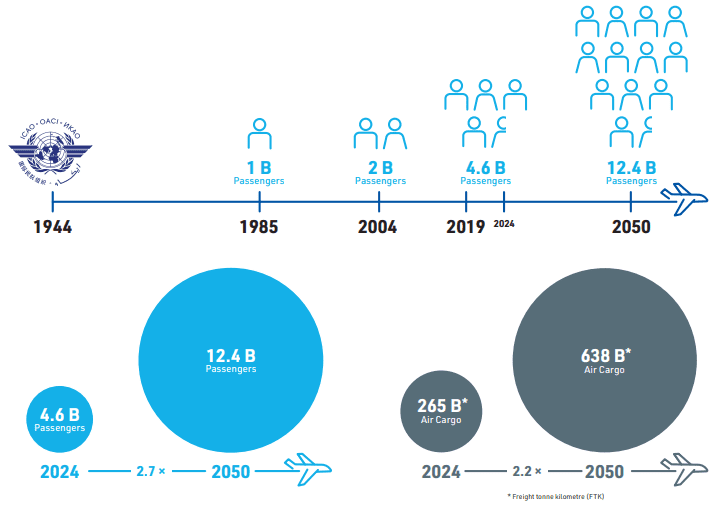
ICAO projects global passenger traffic will reach 12.4 billion passengers by 2050.
Infrastructure gaps are becoming a strategic concern
One of the clearest signals emerging from ICAO ’s strategy is the growing concern surrounding aviation infrastructure disparities between regions.
The organization repeatedly highlights the need for investment in airports, air navigation systems and operational infrastructure, particularly in developing states and small island economies where connectivity remains economically critical but infrastructure financing often remains limited.
ICAO warns that long-standing infrastructure gaps could become a major constraint on future aviation growth if capacity expansion fails to keep pace with rising demand.
That concern is particularly relevant across island and regional markets where aviation functions less as a convenience and more as an essential economic lifeline. In many Caribbean and small island developing states, air connectivity underpins tourism, trade, medical access, labor mobility and international business integration.
Unlike large continental markets, island systems typically operate with narrower financial margins, limited redundancy and higher exposure to external shocks. Expanding terminal capacity, modernizing ATM systems or deploying climate-resilient infrastructure often requires levels of capital investment difficult to mobilize domestically.
ICAO’s “No Country Left Behind” framework reflects growing recognition that aviation growth risks becoming increasingly uneven if financing, technical expertise and implementation support remain concentrated in larger economies.
The organization explicitly identifies resource mobilization, capacity building and infrastructure development as critical enablers of future aviation expansion.
Climate transition is now embedded into aviation strategy
Perhaps the most significant shift within ICAO’s long-term strategy is the extent to which climate considerations are now integrated directly into the future architecture of aviation planning.
The organization’s Long-Term Aspirational Goal (LTAG) of achieving net-zero carbon emissions from international aviation by 2050 is no longer presented as a parallel environmental initiative. Instead, decarbonization increasingly appears as a central operational and strategic constraint shaping the sector’s future development.
ICAO’s framework links future aviation growth to a broader energy transition that will require cleaner fuels, more efficient operations, new technologies and climate-resilient infrastructure.
The organization also places increasing emphasis on adaptation.
As climate-related disruptions intensify, airports and aviation infrastructure operators face rising exposure to flooding, coastal erosion, extreme heat, storms and operational instability. These risks are particularly acute for coastal and island airports, many of which already operate under geographical and land constraints.
For infrastructure investors and airport operators, sustainability is therefore evolving from a reputational issue into a long-term operational and financial consideration.
The pressure is likely to reshape future airport development strategies, fleet modernization decisions and regional investment priorities throughout the coming decades.
Future airspace will become significantly more complex
ICAO’s strategy also illustrates how rapidly the definition of “aviation” itself is expanding.
The organization anticipates a future airspace environment that will include not only conventional aircraft, but also drones, advanced air mobility systems, highly automated aircraft, high-altitude operations and commercial space transport activities operating simultaneously within increasingly congested airspace environments.
Managing that complexity safely will require major advances in digital infrastructure and air traffic management technologies.
ICAO specifically identifies artificial intelligence, satellite-based systems, advanced communication and surveillance technologies, automation and big data as critical tools for improving aviation system resilience and efficiency.
The scale of the technological transition could become particularly challenging for smaller markets and developing states where modernization cycles often move more slowly due to financial and technical constraints.
As airspace environments become more digitally intensive, the gap between technologically advanced aviation systems and under-resourced markets may widen further unless international coordination and implementation support accelerate significantly.
Workforce and talent pressures are emerging as another critical risk
Beyond infrastructure and technology, ICAO also identifies human capital as one of the sector’s major long-term vulnerabilities.
The organization warns that aviation will require a significantly expanded and more technologically adaptable workforce capable of operating increasingly digitalized and automated systems.
That challenge arrives as many regions already face shortages affecting pilots, air traffic controllers, maintenance technicians, cybersecurity specialists and airport operational staff.
ICAO additionally places stronger emphasis on diversity, gender equality and talent attraction as strategic priorities linked directly to long-term sector resilience.
While workforce shortages have often been treated as cyclical operational issues, ICAO’s strategy suggests they may become structural constraints affecting the industry’s ability to scale efficiently over the coming decades.
Aviation’s next challenge may be systemic rather than cyclical
ICAO’s Strategic Plan ultimately reflects a broader reality confronting the aviation industry: future growth is no longer simply a demand story.
Demand already exists.
The deeper challenge is whether aviation systems, infrastructure networks, regulatory frameworks, financing mechanisms and workforce pipelines can evolve quickly enough to support that growth safely, sustainably and inclusively.
By 2050, the industry may not simply look larger. It may operate under an entirely different operational, technological and environmental model than the one that shaped global aviation during the past several decades.
For airports, airlines, regulators and infrastructure investors, the transition outlined by ICAO suggests the next era of aviation expansion will be defined less by the ability to grow — and more by the ability to scale intelligently under mounting structural pressure.