
Regional air connectivity remains one of the structural challenges of the Caribbean aviation market. Fragmented geography, relatively small passenger markets and high operating costs have historically limited the number of viable intra-regional routes.
In this context, the return of interCaribbean Airways to Saint-Martin represents more than the reopening of a single route. It forms part of a broader expansion strategy aimed at strengthening regional mobility across the Caribbean.
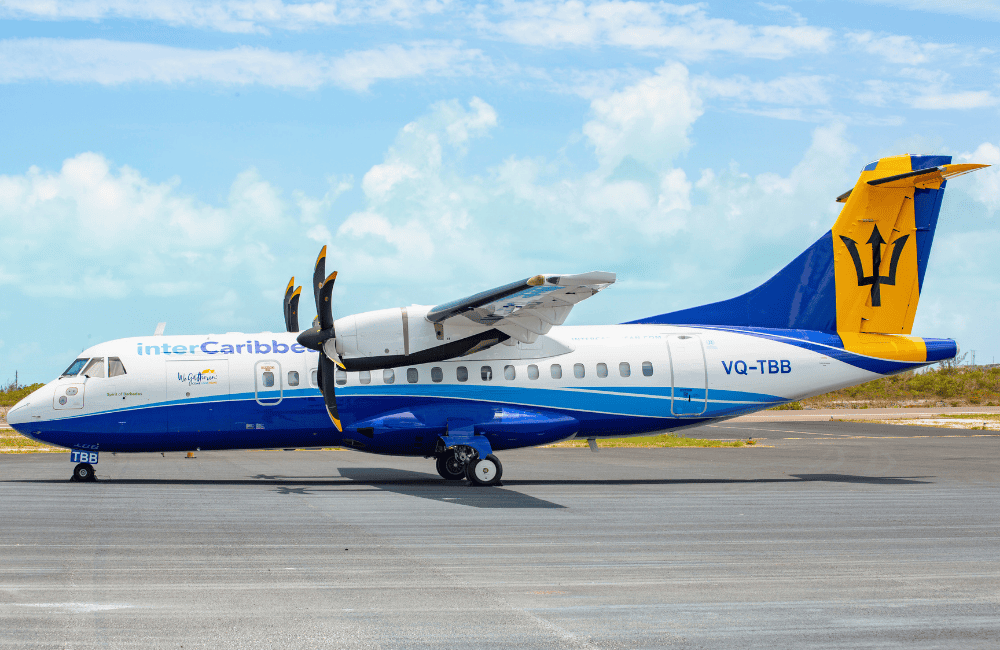
The airline recently launched new services linking Saint-Martin to Bridgetown and Tortola. Flights to Bridgetown operate twice weekly, while the Tortola service also runs two times per week using ATR 42 aircraft.
Although modest in frequency, these connections contribute to restoring an essential layer of regional connectivity, linking northern Caribbean islands with destinations further south.
Barbados emerging as a strategic Caribbean hub
The new routes to Saint-Martin form part of a wider network expansion centred on Barbados as a growing regional hub.
InterCaribbean has recently launched additional services from Bridgetown to several destinations across the Caribbean. These include a new nonstop connection between Barbados and Tortola operating three times weekly, as well as four weekly flights linking Barbados with Port of Spain in Trinidad and Tobago.
This expanding network positions Barbados as an increasingly important transfer point within the region. By connecting northern Caribbean destinations such as Saint-Martin with southern markets including Trinidad and Tobago, the airline is progressively building a multi-directional regional network.
Such hub strategies remain essential in the Caribbean aviation ecosystem, where fragmented markets often require intermediate gateways to sustain viable air connectivity.
Saint-Martin’s gateway role in the northeastern Caribbean
Within this network architecture, Saint-Martin continues to play a key role in linking the northeastern Caribbean.
Much of this connectivity revolves around Princess Juliana International Airport, one of the region’s best-known aviation gateways. The airport combines long-haul international services with a dense network of regional routes, allowing passengers to move between global destinations and smaller Caribbean islands.
New services to Barbados and Tortola therefore strengthen Saint-Martin’s function as a redistribution point within the regional aviation system. In a geography composed of numerous island markets, these secondary hubs are essential for maintaining travel links across the Caribbean.
Additional connectivity between Tortola and Saint-Martin is also planned, with new twice-weekly flights expected to begin shortly, further reinforcing mobility across the northern Caribbean sub-region.
Business mobility and tourism driving regional air demand
Beyond tourism flows, regional air connectivity also plays a critical role in supporting economic mobility across Caribbean markets.
Industry leaders have emphasized that business travel remains a key driver of intra-Caribbean aviation demand. Executives, engineers, financial professionals and consultants frequently move between regional economic centres such as Trinidad and Tobago, Barbados and other island economies.
At the same time, improved air links contribute to strengthening tourism exchanges between Caribbean destinations themselves, an increasingly important segment for island economies seeking to diversify their visitor markets.
By expanding its regional network and modernizing its fleet with ATR 42-500 turboprop aircraft, interCaribbean Airways is positioning itself to capture this growing demand for reliable intra-Caribbean connectivity.
Rebuilding the Caribbean’s regional air network
The airline’s renewed expansion also reflects the gradual rebuilding of the Caribbean’s regional aviation ecosystem following the disruptions caused by the COVID-19 pandemic.
InterCaribbean had previously operated services to Saint-Martin before suspending them in 2019. Its return signals renewed confidence in the recovery of regional travel demand and the viability of short-haul island routes.
While the scale of these operations remains relatively small compared with long-haul international markets, such routes play a critical role in knitting together the Caribbean’s fragmented geography.
For Saint-Martin, expanding regional air links remains a strategic lever to reinforce its position within the evolving network of Caribbean aviation hubs.