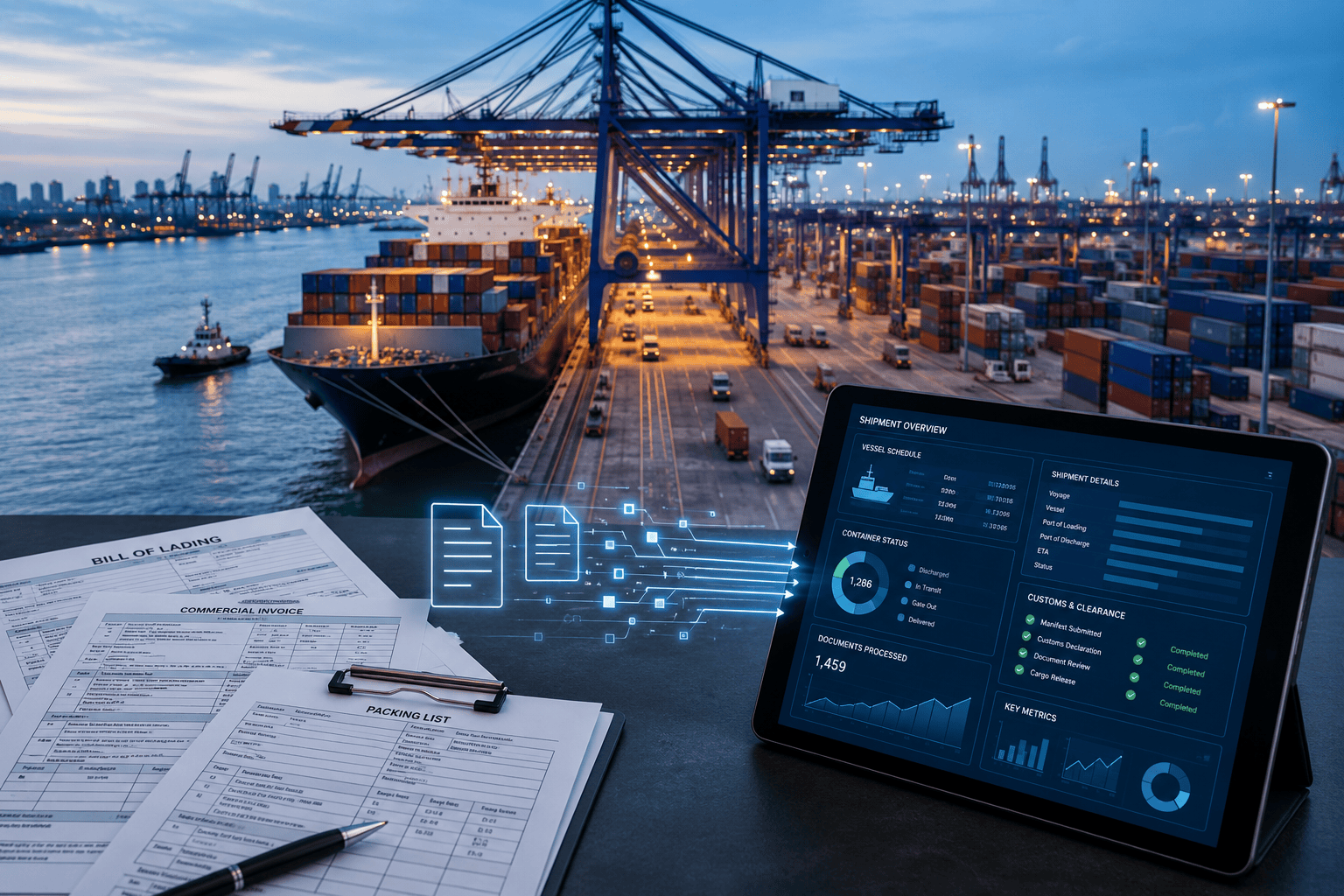
Shipping’s digital transformation is increasingly exposing a persistent operational problem: critical information may exist, yet remain difficult to use because it is scattered across documents, formats and disconnected workflows. In From documents to data to decisions: How AI is fixing shipping’s data problem, a feature published in Issue 57 of Caribbean Maritime, the official journal of the Caribbean Shipping Association (CSA), this fragmentation is presented as a major obstacle to turning available information into usable operational data. The article, associated with maritime technology provider Advantum, examines how artificial intelligence can help extract and structure information for downstream systems, including customs and port platforms.
The problem is not always a lack of data
Maritime and logistics operations generate large volumes of information. But the presence of data does not automatically make it usable.
The Caribbean Maritime feature points to a practical constraint: information can remain dispersed across documents and different formats rather than being available as clean, structured data. In that environment, the challenge is not simply collecting more information. It is converting existing information into a form that operational systems can process and organizations can use consistently.
This distinction matters. A shipping document may contain commercially or operationally relevant information, but if that information cannot move efficiently into the systems used by customs, ports or logistics operators, the document remains part of a fragmented workflow rather than an integrated data chain.
From document processing to system-ready information
This is where the AI use case described in the magazine becomes more specific. Rather than presenting artificial intelligence as an autonomous decision-maker, the feature focuses on its ability to process disparate documents, identify relevant information and convert it into structured data.
The broader use case is supported beyond the vendor perspective. A 2025 World Economic Forum report on AI in TradeTech identifies cognitive document processing as an application of AI, including the extraction of information from supporting trade documents and the analysis of data mismatches.
For shipping and logistics operators, the significance lies in what happens after extraction. The objective is not merely to “read” a document faster. It is to make the information usable within the digital systems that support trade, customs and port operations.
Why ASYCUDA matters in this workflow
One of the systems referenced in the Caribbean Maritime feature is ASYCUDA. The term is sometimes used loosely in discussions around port digitalization, but its function is specific.
Developed by UN Trade and Development, the Automated System for Customs Data (ASYCUDA) is an integrated customs management system for international trade and transport operations. It supports the automation and management of customs processes rather than functioning as a general port collaboration platform.
That distinction helps clarify the potential value of document-to-data processing. If information arriving in heterogeneous formats can be accurately extracted, structured and prepared for use by customs systems, the issue is no longer simply document digitization. It becomes one of integration with the operational infrastructure through which trade procedures are managed.
This is also consistent with the wider evolution of customs technology. UNCTAD’s 2025 ASYCUDA report highlights the programme’s continuing shift towards data-driven decision-making and longer-term interoperability.
A Port Community System serves a different purpose
The magazine also refers to Port Community Systems, or PCS. These should not be confused with ASYCUDA.
A PCS is designed around information exchange and coordination across the wider port ecosystem. World Bank guidance describes Port Community Systems as digital collaborative platforms enabling information exchange among stakeholders such as customs agencies, port management bodies, shipping and logistics companies and freight forwarders.
IMO guidance similarly places PCS within a broader port community environment, where multiple public and private actors need to exchange information and coordinate processes.
The distinction is therefore operationally important: ASYCUDA is centred on customs management, while a PCS supports collaboration and data exchange across the port community. They may interact within a broader digital ecosystem, but they do not perform the same role.
For AI-based document processing, this creates a more meaningful question than whether a tool can simply extract text: can information be transformed into reliable, structured data that can move into the appropriate operational environment?
Interoperability is becoming the larger challenge
The discussion extends beyond individual platforms. Ports and trade ecosystems increasingly operate with multiple digital layers, including customs systems, Port Community Systems and Maritime Single Windows.
Since 1 January 2024, IMO Member States have been required under the FAL Convention framework to use a Maritime Single Window for the electronic exchange of information associated with the arrival, stay and departure of ships.
A Maritime Single Window is again distinct from both ASYCUDA and a PCS. Its core purpose is to streamline the submission and exchange of regulatory information related to ship clearance. The wider challenge is ensuring that these different systems can exchange and reuse information rather than creating new digital silos.
The World Bank identifies interconnectivity and interoperability between Port Community Systems, Maritime Single Windows and Trade Single Windows as a major next stage in port digital transformation. Its analysis notes that boundaries between platforms are beginning to break down as trade and transport systems move towards greater data collaboration and reduced duplication of submissions.
AI is one layer, not the entire solution
Seen in this context, the strongest argument for AI in shipping is not that it can replace existing customs, port or logistics systems. It is that it may help address a problem that sits upstream of them: information trapped in documents that cannot be readily processed, exchanged or reused.
The Caribbean Maritime feature provides a concrete industry perspective on this challenge, while the wider institutional landscape points to a broader shift towards interoperability. Customs platforms, Port Community Systems and Maritime Single Windows each have different functions, yet all depend on information that can be exchanged in consistent and usable forms.
For Caribbean shipping, this makes the quality and structure of data an increasingly important part of digitalization. AI-based document processing may help bridge some of the gaps between fragmented inputs and operational systems, but its value ultimately depends on accurate extraction, appropriate integration and the ability of different platforms and institutions to work together.
As maritime digitalization advances, the central challenge may therefore be less about generating more data than ensuring that existing information can move from documents into systems — and from systems into decisions.