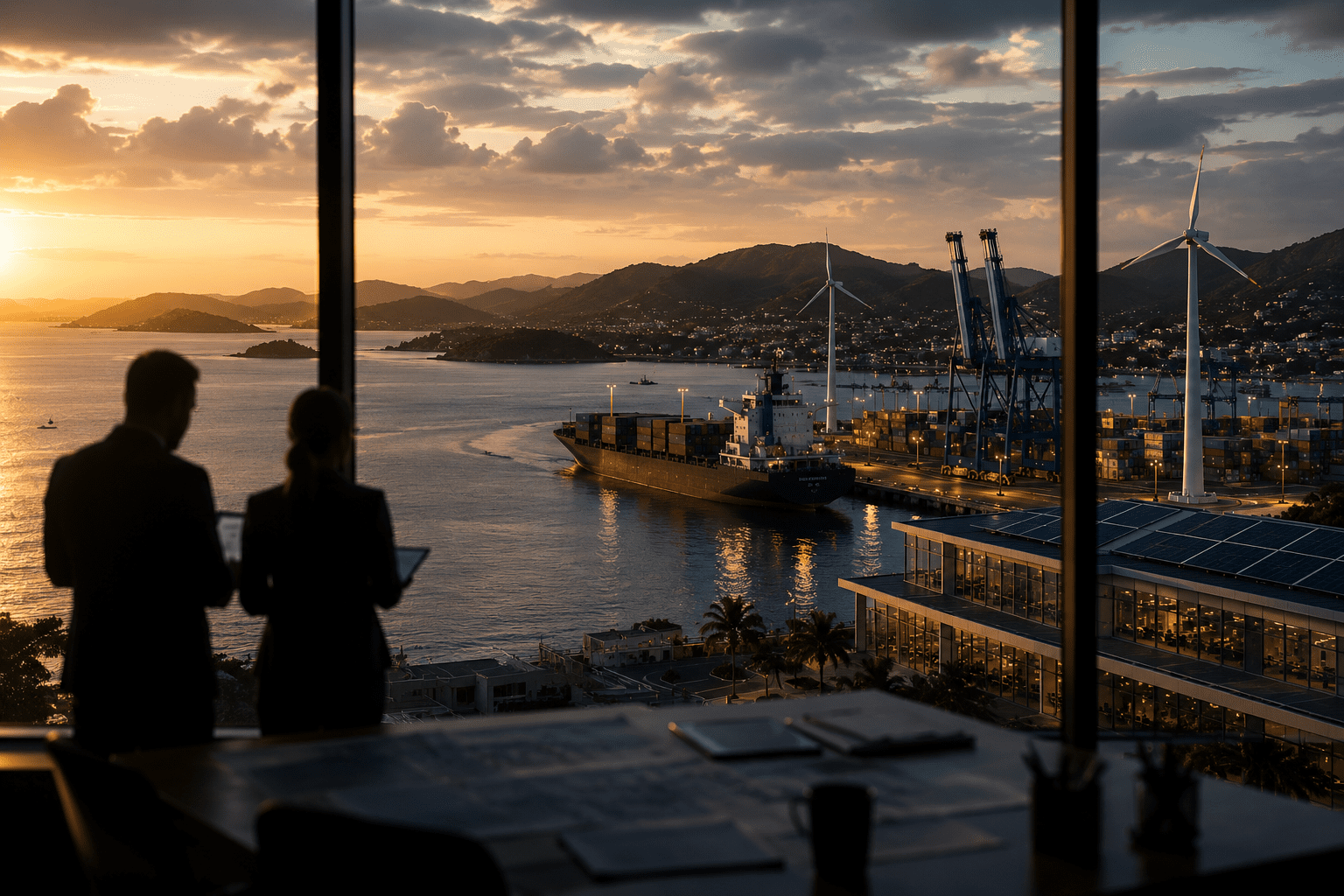
Across the Caribbean, maritime decarbonisation ambitions are becoming increasingly visible. Ports, governments and regional organisations are now actively discussing renewable energy integration, equipment electrification, emissions monitoring and low-carbon maritime infrastructure. Yet despite growing momentum, one structural challenge continues to slow implementation across many Small Island Developing States (SIDS): financing.
That issue emerged repeatedly during the “Progressing Maritime Decarbonisation in St. Kitts and Nevis” workshop organised under the IMO–EU Global MTCC Network (GMN) Phase II programme in February 2026. While participants highlighted rising regional awareness around maritime energy transition, discussions also revealed a widening gap between climate ambition and project execution capacity.
For Caribbean ports, the problem is no longer simply identifying decarbonisation pathways. Increasingly, the challenge lies in transforming small-scale maritime infrastructure concepts into financially viable and investment-ready projects.
Caribbean maritime projects face structural financing constraints
Compared with major global port hubs, Caribbean SIDS operate within far smaller economic and infrastructure ecosystems. Port projects often involve limited traffic volumes, smaller electricity demand and constrained fiscal capacity, reducing their attractiveness for conventional infrastructure investors.
That reality directly affects maritime decarbonisation initiatives.
Workshop participants identified several recurring barriers slowing low-carbon maritime investment across the region, including:
- high upfront capital costs;
- limited technical preparation capacity;
- constrained public finances;
- complex climate funding requirements;
- and insufficient project bankability.
Many Caribbean ports also face a scale mismatch problem. While renewable energy systems, electrification programmes and smart infrastructure upgrades may be operationally relevant for island ports, the projects themselves are often too small to attract traditional international infrastructure financing at competitive conditions.
As a result, many initiatives remain trapped between pilot-stage ambition and full commercial deployment.
“Bankable” projects are becoming the region’s central challenge
One of the workshop’s strongest recurring themes was the need to develop “bankable” maritime decarbonisation projects capable of meeting investor and climate-finance expectations.
That concept goes far beyond environmental ambition alone.
For Caribbean ports, project bankability increasingly depends on several interconnected factors:
- technical feasibility;
- long-term operational viability;
- reliable energy demand projections;
- institutional coordination;
- regulatory readiness;
- and scalable implementation frameworks.
In many cases, ports and public institutions may still lack the specialised engineering, financial modelling and project preparation resources required to structure complex climate infrastructure proposals.
That preparation gap is particularly important because many international climate-finance mechanisms require extensive documentation, feasibility studies, emissions analysis and implementation frameworks before capital can be mobilised.
For smaller island administrations with limited technical capacity, that process can become a major bottleneck.
Climate finance is available — but difficult to access
The workshop discussions highlighted several financing pathways currently being explored for Caribbean maritime decarbonisation projects.
Among the institutions and mechanisms referenced were:
- the Green Climate Fund (GCF);
- the Caribbean Development Bank (CDB);
- the Inter-American Development Bank (IDB);
- blended finance structures;
- concessional financing;
- innovation grants;
- and public–private partnership models.
However, access to these financing channels remains uneven across the region.
Many climate-finance programmes were originally designed around larger infrastructure environments with stronger institutional preparation capacity. Caribbean SIDS, by contrast, often struggle with:
- limited project preparation resources;
- fragmented regulatory frameworks;
- small procurement pipelines;
- and higher perceived investment risk.
That mismatch can leave strategically important projects without sufficient financing despite clear long-term operational relevance.
The issue becomes even more complex within maritime infrastructure, where ports must simultaneously address decarbonisation targets, operational continuity, climate resilience, and energy security.
Pilot projects are emerging as financing catalysts
Against that backdrop, demonstration projects are increasingly being viewed as a pragmatic pathway toward future investment mobilisation.
The Basseterre Deep Water Port pilot project discussed during the workshop reflects that logic.
The initiative aims to test a renewable energy-powered microgrid integrating wind generation, monitoring systems and smart energy technologies within a real port operating environment.
Although relatively modest in scale, such projects may play a critical role in helping Caribbean ports:
- generate operational data;
- validate infrastructure models;
- improve technical readiness;
- and demonstrate feasibility to future investors.
In practice, small-scale pilot programmes can help reduce uncertainty around energy yields, operational integration, maintenance requirements, infrastructure resilience, and long-term financial performance.
For investors and development banks, that data may ultimately prove essential before larger-scale financing can be deployed across the region.
Caribbean ports are entering a new infrastructure financing phase
The financing discussions in St. Kitts and Nevis ultimately reflected a broader transition underway across Caribbean maritime infrastructure planning.
Historically, many ports across the region focused primarily on:
- cargo handling capacity;
- cruise development;
- and operational expansion.
Today, ports are increasingly being drawn into a more complex infrastructure landscape involving:
- renewable energy systems;
- smart-grid integration;
- electrification strategies;
- resilience engineering;
- and climate adaptation.
That shift is changing not only how ports operate, but also how maritime infrastructure projects must be financed and structured.
For Caribbean SIDS, future maritime competitiveness may increasingly depend on the ability to combine infrastructure planning, climate resilience, technical credibility, and investment readiness within a single project framework.
As maritime decarbonisation accelerates globally, Caribbean ports are no longer confronting a shortage of climate ambition. The region’s next challenge may instead be building the financial and institutional architecture capable of turning pilot concepts into scalable infrastructure deployment.