
Caribbean Airlines is continuing to reshape its regional network after several routes launched or expanded in recent years failed to meet commercial expectations. The latest withdrawal, affecting direct Tobago–Barbados service from September 2026, highlights a broader challenge for intra-Caribbean aviation: strong demand for connectivity does not always translate into sustainable route economics.
Caribbean Airlines reverses part of its regional expansion
Caribbean Airlines began a major network optimisation programme in late 2025 after reviewing route performance, aircraft deployment and long-term sustainability. From January 10, 2026, the Trinidad and Tobago-based carrier discontinued services to Tortola and San Juan and began restructuring its Barbados hub, moving aircraft and crew resources back towards Trinidad.
Caribbean Airlines expanded the review further in June 2026. The airline withdrew from Dominica and St Kitts, discontinued the nonstop Ogle–Paramaribo service between Guyana and Suriname, and reduced Martinique and Guadeloupe from four weekly flights to two. Trinidad and Tobago’s Transport and Civil Aviation Minister Eli Zakour said several routes introduced during the 2023 Eastern Caribbean expansion had failed to perform in line with the commercial assumptions used when they were launched.
The September 2026 adjustment adds another layer to the restructuring. Caribbean Airlines discontinued flights BW212 and BW213 linking Trinidad, Tobago and Barbados, removing the direct Tobago–Barbados sector while maintaining direct Port of Spain–Barbados services. The airline said passengers would continue to have alternative options across the three markets.
Route losses force a sharper commercial discipline
The financial numbers explain why Caribbean Airlines has become more selective. As of April 2026, the airline had recorded losses of approximately US$730,000 on Dominica, US$1.65 million on St Kitts, US$1.24 million on Ogle–Paramaribo, US$1.23 million on Martinique and US$1.86 million on Guadeloupe.
Caribbean Airlines had already accumulated further losses on two routes removed earlier from the network. Jamaica–Fort Lauderdale generated approximately US$7.2 million in losses, while Trinidad–Puerto Rico accounted for around US$4.92 million. The combined losses associated with the group of routes identified by the government reached US$18.84 million by April 2026.
The broader financial picture is even more significant. Speaking in the Trinidad and Tobago Senate on June 17, 2026, Eli Zakour said Caribbean Airlines had lost more than US$60 million on its routes between 2023 and 2025. The minister said frequency changes and route discontinuations already announced were expected to generate around US$18 million in savings.
Tobago–Barbados exposes the capacity dilemma
The Tobago–Barbados withdrawal illustrates why replacing a lost connection is not always straightforward. LIAT Air and interCaribbean Airways both said in early September 2026 that they were monitoring the gap created by Caribbean Airlines, but neither carrier announced an immediate replacement service.
LIAT Air and interCaribbean Airways pointed instead to demand, operational planning and the risk of placing too much capacity into already thin markets. interCaribbean Airways Chairman Lyndon Gardiner said launching a replacement route would require planning, while LIAT Air Chief Executive Officer Hafsah Abdulsalam indicated that the carrier was cautious about adding capacity where another operator might already be better positioned.
The response underlines a structural feature of intra-Caribbean aviation. Small island markets may value direct connectivity highly, but limited passenger volumes can make it difficult to support multiple operators, high frequencies or aircraft that are too large for the available demand.
Regional capacity is shifting rather than disappearing
The current restructuring does not mean intra-Caribbean connectivity is simply contracting. interCaribbean Airways has been expanding at the same time that Caribbean Airlines has been reducing selected routes.
In March 2026, interCaribbean Airways added five new nonstop destinations across gateways including Barbados, Tortola, Port of Spain, Georgetown and St Maarten. The airline also launched a new Barbados–Port of Spain service on March 8, strengthening its position in a market where Caribbean Airlines was simultaneously concentrating more of its own resources around Trinidad.
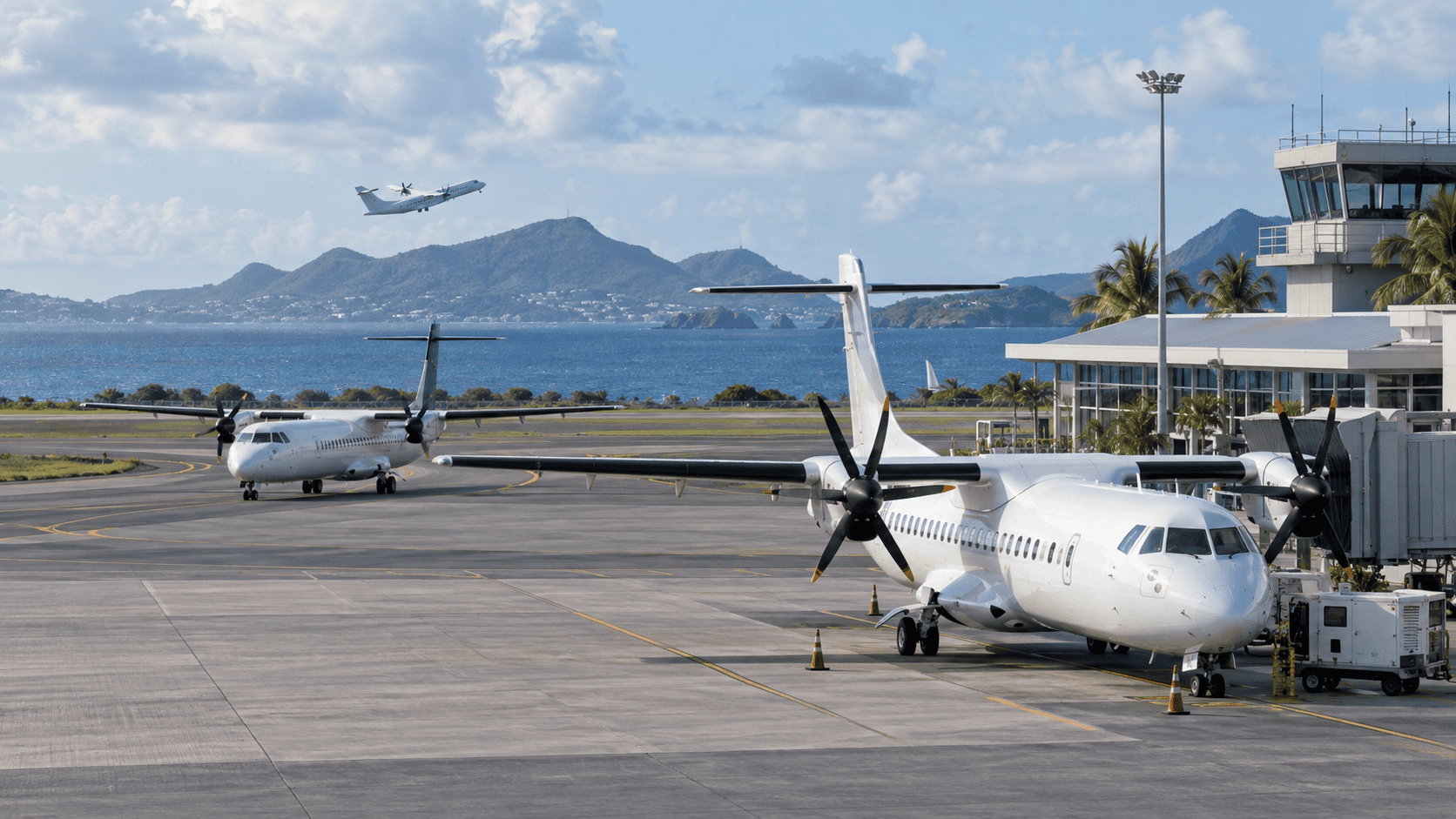
interCaribbean Airways has also been building connectivity through Tortola. New services launched in March 2026 included seven weekly flights between Tortola and Barbados, with four operating nonstop, alongside new connectivity between Tortola and St Maarten. The expansion is supported by the carrier’s growing ATR turboprop fleet, which is better suited to many lower-volume regional markets than larger narrowbody aircraft.
Partnerships may become as important as nonstop routes
The evolution of the regional market is increasingly about commercial cooperation as well as direct capacity. LIAT Air and Air Caraïbes signed an interline agreement on May 29, 2026, with ticket sales beginning on June 1. The agreement allows passengers to combine flights across both networks on one itinerary and check baggage through to the final destination.
The LIAT Air–Air Caraïbes agreement connects LIAT’s Eastern Caribbean network with Air Caraïbes services from Guadeloupe and Martinique and onward long-haul connectivity to Paris-Orly. The model illustrates how regional carriers can expand the practical reach of their networks without operating every sector themselves.
For Caribbean aviation, partnerships may become increasingly important where direct services are commercially difficult to sustain. Codeshares, interline agreements and coordinated connections can preserve access between smaller islands while reducing the pressure on individual airlines to operate thin routes independently.
The connectivity problem remains bigger than one airline
CARICOM has repeatedly identified air transport as a structural challenge for regional integration. In December 2025, CARICOM Secretary-General Carla Barnett highlighted limited flight options, high operating costs and regulatory barriers as continuing obstacles to mobility and trade across the region.
Caribbean Airlines’ current network review therefore reflects a problem that extends beyond one carrier. The region still needs frequent, affordable and reliable air links, but airlines must also operate networks capable of sustaining themselves financially.
The emerging answer may be a more fragmented but interconnected system: Caribbean Airlines concentrating resources on stronger markets, interCaribbean Airways and LIAT Air filling selected regional niches, and commercial partnerships linking networks where direct flying is difficult to justify.
For the Caribbean, the central question is no longer simply how many routes airlines can open. The more difficult question is which routes can support sustainable capacity, and how the region can preserve connectivity when commercial economics alone are not enough.
Which Caribbean Airlines routes were reduced or withdrawn in 2026?
Caribbean Airlines discontinued services including Tortola, San Juan, Dominica and St Kitts, ended the Ogle–Paramaribo nonstop service, reduced frequencies to Martinique and Guadeloupe, and removed the direct Tobago–Barbados sector from September 2026.
Why is Caribbean Airlines reducing parts of its regional network?
The airline and the Government of Trinidad and Tobago have cited route performance, resource utilisation and financial sustainability. Several routes accumulated significant losses.
Will LIAT Air or interCaribbean replace Tobago–Barbados?
Neither airline had announced an immediate replacement service as of September 1, 2026. Both said they were assessing demand and operational considerations.
Is intra-Caribbean connectivity declining everywhere?
No. While Caribbean Airlines is reducing selected routes, interCaribbean Airways has expanded its network in 2026 and LIAT Air is rebuilding regional connectivity.
Can airline partnerships improve regional connectivity?
Interline and codeshare agreements can allow passengers to reach more destinations without requiring one carrier to operate every route directly. The LIAT Air–Air Caraïbes agreement launched in June 2026 is one example.