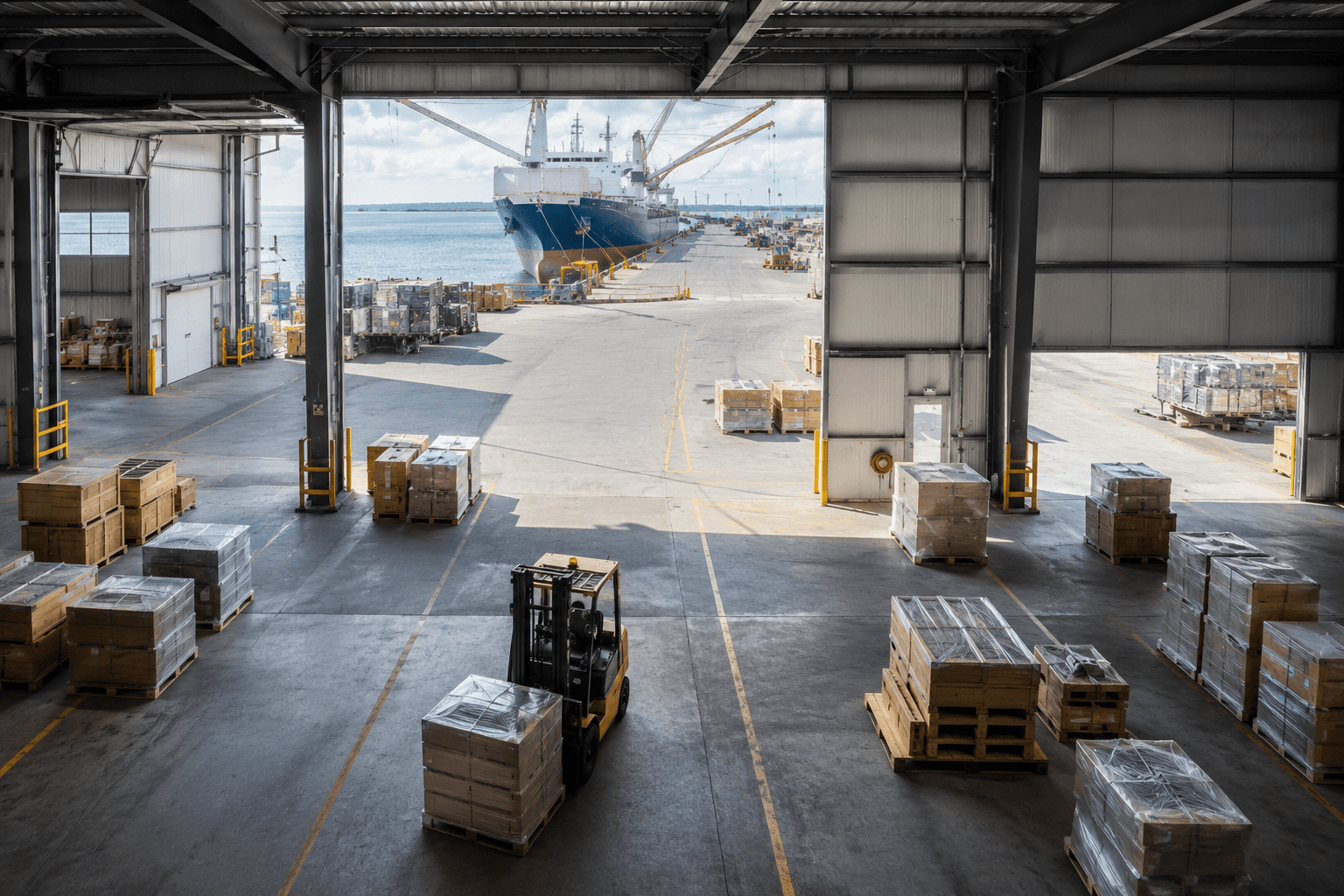
As Caribbean ports seek to improve cargo throughput without necessarily expanding their waterfront footprint, investment is increasingly shifting toward landside logistics infrastructure. The British Virgin Islands Ports Authority (BVIPA) has taken a step in that direction by launching a procurement process for a new general cargo warehouse at Port Purcell, Tortola. Beyond the construction project itself, the initiative reflects the growing importance of storage, cargo circulation and operational efficiency within modern port estates.
Rebuilding a critical link in the cargo chain
The project calls for the complete replacement of the existing general cargo warehouse. According to the tender documents, the selected contractor will demolish the current slab and foundations, clear and prepare the site, construct new foundations, walls, columns, ramps and a reinforced concrete slab, and erect a steel-frame structure supplied by the BVI Ports Authority. The scope also includes drainage works, utility coordination, backfilling and compaction, perimeter fencing and other enabling works required to deliver the new facility.
While the warehouse itself is the project’s visible outcome, its operational role extends well beyond providing covered storage. General cargo facilities form a key interface between vessel discharge and inland distribution, supporting cargo reception, temporary storage, consolidation and dispatch. Their efficiency influences how freight moves through the port, making landside infrastructure an increasingly important component of overall cargo performance.
The project is being financed directly by the BVI Ports Authority. Tender submissions are due by 10:00 a.m. local time on 3 July 2026, with bid opening scheduled immediately afterwards.
Maintaining cargo flows during construction
One of the most significant aspects of the procurement is the emphasis placed on maintaining port operations throughout the construction programme.
Rather than focusing exclusively on the completed facility, the tender requires contractors to demonstrate how they will safely execute the works while preserving day-to-day activities inside the port. Detailed method statements must cover demolition, excavation, concrete works, erection of the steel structure, drainage installation and utility coordination. Contractors are also required to submit traffic management plans, site security procedures, dust suppression measures, material staging arrangements and final site restoration methodologies.
The prominence given to traffic management and construction sequencing suggests that uninterrupted cargo circulation is being treated as an operational objective rather than simply a construction requirement. For a working commercial port, limiting disruption to internal vehicle movements and freight handling can be as important as delivering the new infrastructure itself.
Technical capability takes priority in contractor selection
The evaluation framework further illustrates the operational priorities behind the project.
Rather than relying primarily on price, the procurement process assigns the highest weighting to technical delivery. Construction methodology accounts for 35 points, followed by personnel qualifications (25 points), work programme (20 points) and company experience (20 points). Contractors must achieve a minimum technical score of 70 points before being considered for contract negotiations.
Tenderers are expected to demonstrate experience on at least three comparable projects completed during the past ten years, while identifying key personnel—including the proposed Project Manager and Surveyor—and submitting a detailed construction programme tailored specifically to the project. The Authority also requires organisational charts and comprehensive execution methodologies designed for an active port environment.
Successful bidders will be required to provide a performance security equal to 10% of the contract value, while delays beyond the agreed completion date may incur liquidated damages of US$500 per day.
Landside infrastructure is becoming a competitive asset
Although structured as a procurement exercise, the Port Purcell warehouse project reflects a broader shift in Caribbean port investment priorities.
Historically, port modernisation has focused on waterfront assets such as berths, quay walls and cargo-handling equipment. Increasingly, however, operators are investing in the infrastructure that supports freight once it reaches land. Warehouses, internal circulation networks and logistics facilities play a direct role in cargo throughput, operational resilience and the efficiency of supply chains moving beyond the port gate.
The Port Purcell project illustrates this evolution. Rather than expanding maritime infrastructure alone, the British Virgin Islands Ports Authority is reinforcing a critical element of its landside logistics system. As Caribbean ports continue seeking productivity gains within existing footprints, investments in cargo support infrastructure are becoming an increasingly important component of long-term operational performance.