
Argentina opened its skies. Foreign carriers flooded in. Traffic exploded. It became the fastest-growing aviation market in the region — almost overnight.
No new terminal was built. No runway extended. Just one thing changed: the regulatory framework.
For Rafael Echevarne, Director General of ACI-LAC — the association representing 350 airports and 95% of regional passenger traffic — that story is the whole argument. “Liberalization and deregulation of air transport will be, by far, the most transformative measure that can be implemented in our region.”
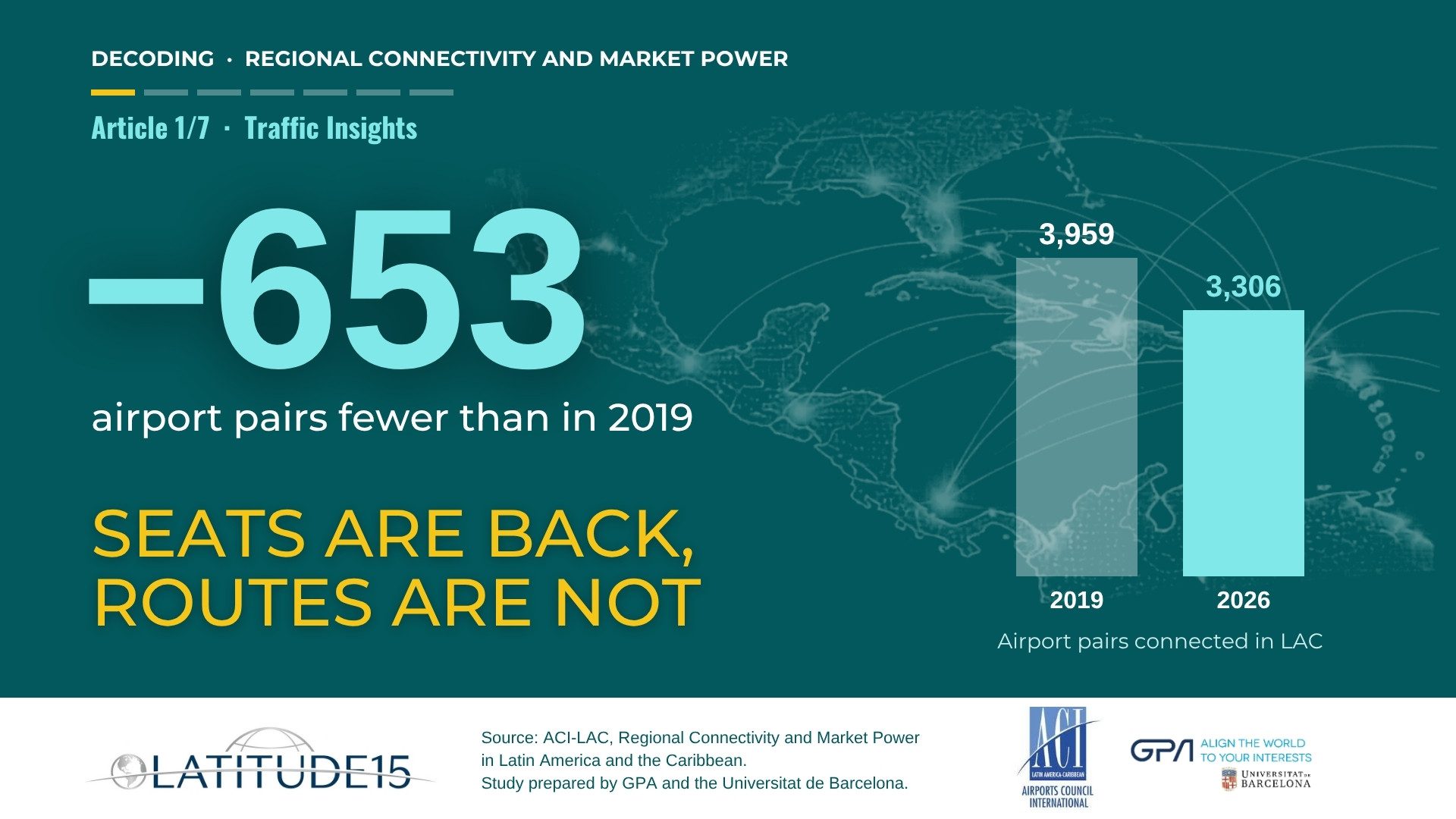
Yet across Latin America and the Caribbean, dozens of bilateral agreements still cap frequencies, restrict market access and keep fares artificially high. In parts of the Caribbean, connectivity today remains below pre-pandemic levels. The constraint is not demand, it is regulation.
The Structural Limits of Bilateral Air Service Agreements
“Liberalization and deregulation of air transport will be, by far, the most transformative measure that can be implemented in our region.”
The numbers back it up.
Many bilateral air service agreements across Latin America and the Caribbean continue to limit frequencies, capacity and market access. These frameworks determine which carriers can operate, on which routes, and under what conditions. Where ceilings remain restrictive, connectivity growth is structurally capped.
The result is measurable:
- Constrained intra-regional routes
- Limited access for secondary destinations
- Higher fares relative to open markets
Infrastructure investment alone cannot compensate for regulatory rigidity. Expanding terminals without reforming traffic rights risks underutilized capacity.
Argentina and Peru: Early Signals of Reform Acceleration
Recent developments in the region illustrate the leverage effect of policy reform.
Argentina, following a shift toward market opening and reduced access restrictions for foreign carriers, has emerged as one of the fastest-growing aviation markets in Latin America.
Peru has renegotiated its bilateral agreement with Spain, removing frequency caps entirely — allowing traffic levels to be determined by market demand rather than government ceilings.
These cases demonstrate that connectivity expansion can accelerate rapidly when regulatory barriers are eased. As Rafael Echevarne puts it : “Drop all the barriers, open the markets, and let market reality determine whether flights are viable or not.”
What Europe’s Single Aviation Market Demonstrates
Rafael Echevarne points to Europe as the clearest proof of concept. In the EU, carriers operate across borders with minimal restriction — the market decides, not governments.
The result has been increased competition, lower fares and broader access to secondary cities — dynamics that reshaped regional aviation economics.
The comparison is not about replication, but about principle: when connectivity frameworks are liberalized, market responsiveness increases.
Why Regulatory Reform May Matter More Than Infrastructure
The instinctive response to traffic growth is physical expansion — new terminals, extended runways, additional gates. But Echevarne challenges that reflex that without aligned regulatory frameworks, infrastructure investment alone cannot unlock regional integration
Without aligned policy, infrastructure alone cannot unlock regional integration.
Regulatory modernization affects:
- Airline entry
- Route development
- Market competition
- Tourism flows
- Investment attractiveness
In this context, liberalization becomes not simply a transport policy issue, but an economic development lever.
Strategic Implications for Tourism and Secondary Destinations
For island economies and emerging tourism markets, access determines competitiveness.
Restrictive bilaterals limit frequency flexibility, often reducing the viability of direct links between secondary cities. Liberalization, by contrast, enables airlines to deploy capacity where demand exists — improving route density and strengthening tourism resilience.
In regions where aviation underpins economic integration, connectivity policy directly influences destination positioning.
The Decade of Regulatory Alignment
Across more than thirty jurisdictions, the coming decade will test the region’s ability to align regulatory frameworks with growth ambitions.
ACI-LAC positions itself as a catalyst in this process — facilitating dialogue, promoting harmonization and supporting states in strengthening aviation governance.
The technologies exist. The infrastructure pipeline exists. Traffic demand is growing.
One variable remains decisive: regulatory alignment.
“Drop the barriers. Open the markets.” The region knows what needs to happen. The next decade will show whether it has the political will to do it.