
Montego Bay and Aruba share 85% of their extra-Caribbean network. Punta Cana and Montego Bay, 83%. Nassau and Bridgetown, 85%. The NACO/ACI-LAC study released in March 2026 introduces an original indicator — the Route Network Overlap Index — that exposes head-to-head competition between Caribbean hubs to capture the same North American flow. A decoding.
With 16.3 million stay-over arrivals from the United States in 2023, roughly 50% of all Caribbean tourists, and around 3 million more from Canada, North America accounts for the majority of international visitors to the region. It is this structural weight that frames the choices of Caribbean airports, as documented by the study The State of Air Connectivity in the Caribbean, commissioned by ACI-LAC to NACO and published in March 2026.
The Route Network Overlap Index: measuring duplication
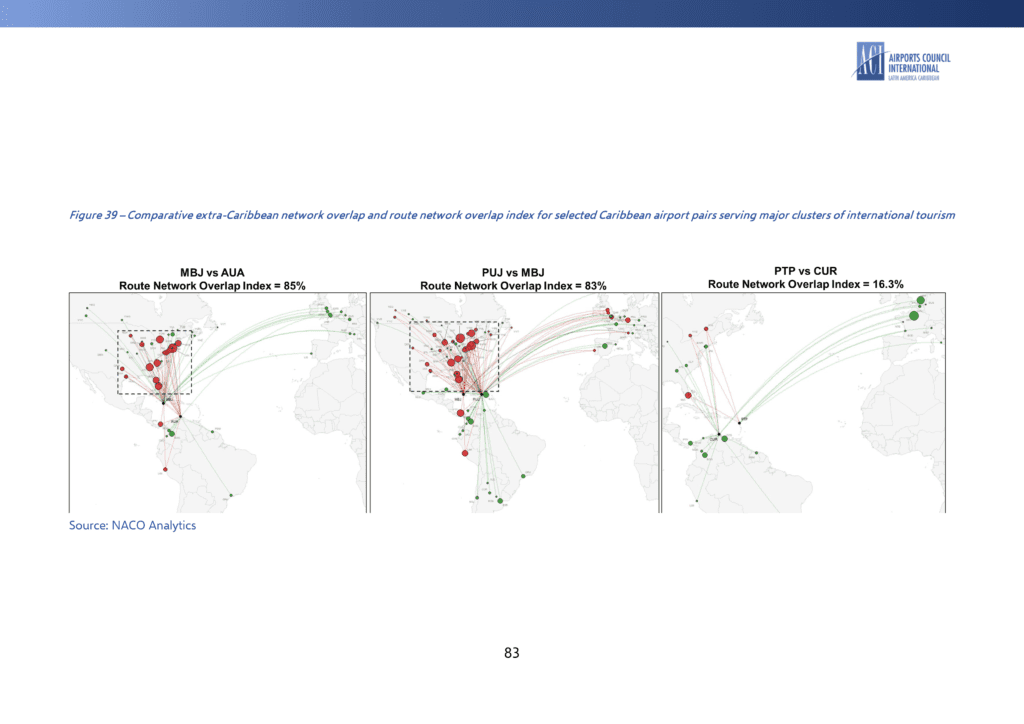
To quantify this competition precisely, NACO introduces an original analytical tool: the Route Network Overlap Index. The calculation is simple — the total seats offered to overlapping extra-Caribbean destinations by two airports, divided by the combined total seats of the two airports. The higher the index, the more the two airports compete for the same passenger pool.
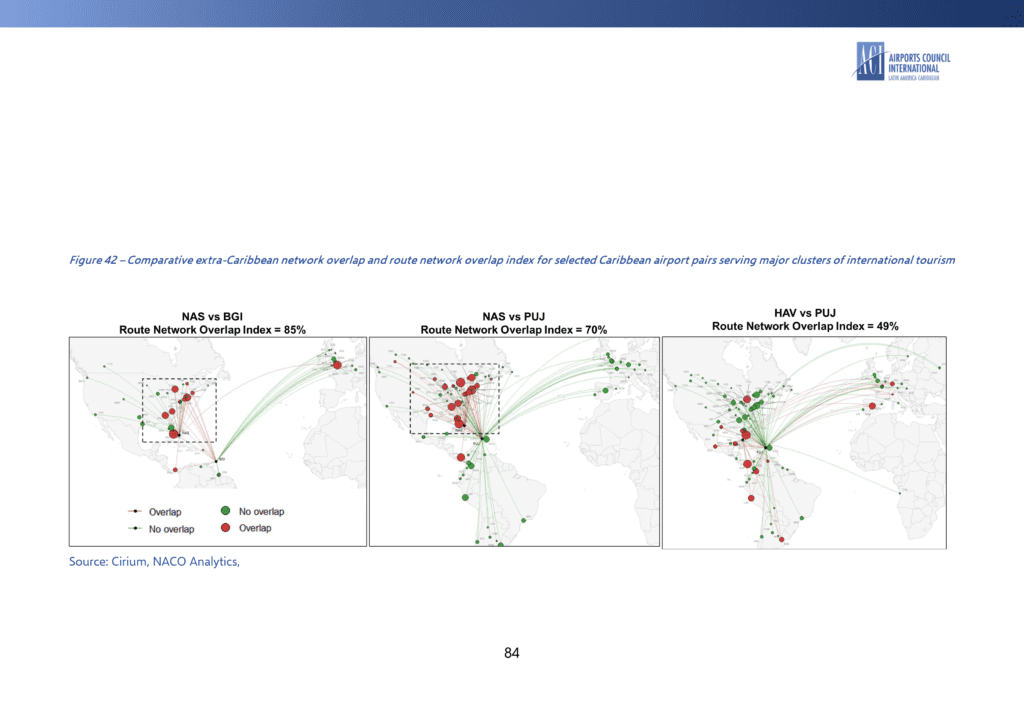
The results published by NACO are striking. Montego Bay and Aruba share roughly 85% of their extra-Caribbean network. Punta Cana and Montego Bay, 83%. Nassau and Bridgetown, 85%. Nassau and Punta Cana, 70%. By contrast, overlaps are far lower between markets less dependent on North American links: Pointe-à-Pitre and Curaçao share only 16% of their network, Havana and Punta Cana 49%.
Competition driven by tourism dependence
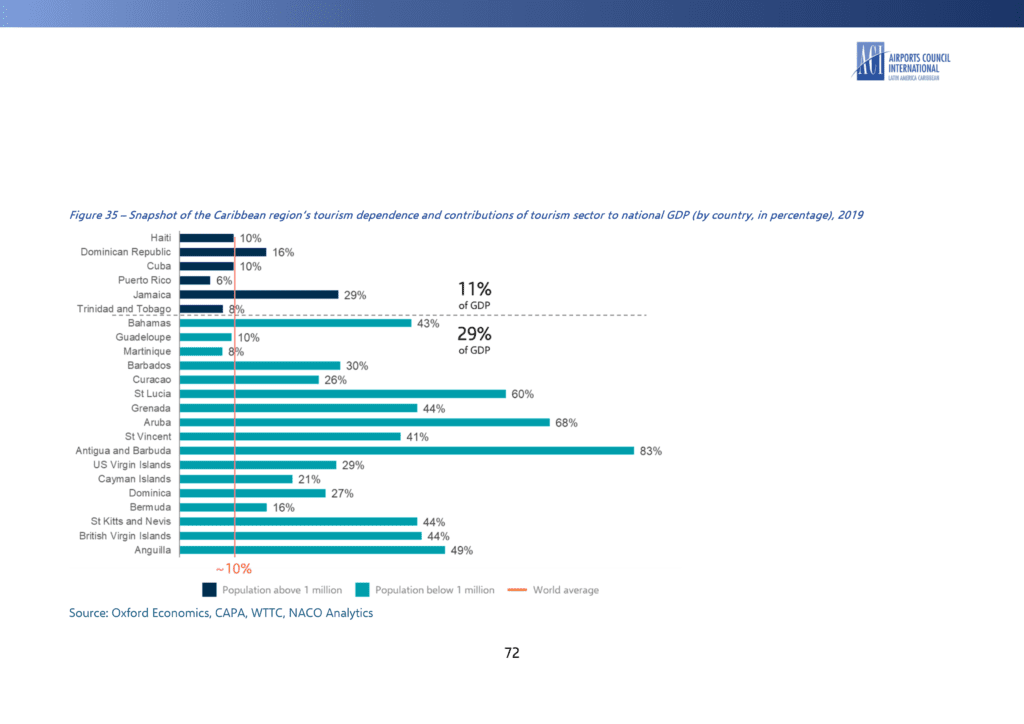
The study highlights a structural mechanism: most Caribbean tourism hubs (and their airports) are competing for the same East Coast traffic, with very little differentiation. This logic is economically rational. In several small island states, tourism contributes between 60 and 80% of GDP — Antigua, Saint Lucia and Aruba are among the most exposed economies. For these markets, attracting more flights from key North American and European source markets is, as the report puts it, a critical economic priority.
Air service development resources and political attention therefore concentrate primarily on securing lucrative flights from North America to support local jobs and tourism. A new direct route from JFK or YYZ delivers high-spending visitors, immediate jobs and tax revenue, whereas launching a flight to a neighbouring island yields more modest and less tangible benefits.
“Nice to have, not a strategic commercial priority”
It is against this backdrop that one Caribbean aviation executive interviewed by NACO frames the trade-off as directly as possible. According to the testimony reported by the study, limited resources are placed where the return is immediate — that is, flights from the U.S., not necessarily other Caribbean islands.
More broadly, industry stakeholders interviewed for the study reiterated that they would welcome stronger intra-regional connectivity, but acknowledged that it is generally treated as a “nice to have” rather than a strategic commercial priority for airports. The phrase, brief, condenses a decade of economic rationality.
The “one-stop-one-island” tourism trap
This frontal competition is reinforced by the very nature of the Caribbean tourism product and the preferences of source markets. According to market research cited by NACO, the typical North American vacationer has on average 12 vacation days per year and travels once a year for a stay of approximately 8 days. The direct consequence: they fly to a single island and stay there for the entire duration of the trip.
Caribbean tourism supply has adjusted to this demand: all-inclusive resorts and point-to-point flights are the norm, providing convenient and efficient holidays. As one industry stakeholder cited in the study summarises it, American tourists don’t have time for island-hopping: they come to the Caribbean for five to seven days and they want to spend their entire vacation in one location. The internal air network remains, as a result, thin, infrequent and less financially viable.
A self-reinforcing logic
The mechanism is thus cumulative. North American tourism demand favours single-island stays. Airports concentrate their commercial efforts on source markets that feed this model. Airlines adjust their networks to this dominant demand. Intra-regional flights remain infrequent, hence expensive, hence underused by residents, which deprives the intra-regional segment of local demand that could offset the weakness of inter-island tourism. The loop closes on itself.
The NACO study does not reproach airports for being rational in their trade-offs. It does, however, point out that the absence of countervailing incentives — political, regulatory, economic — allows this duplication logic to take root. The report explicitly recommends a targeted bilateral approach and regional connectivity incentive schemes, which we will explore in the closing article of this series.
The next article addresses another structural lock: the paradox of a Caribbean air liberalisation that is effective on paper but fragmented in practice.
Source : NACO (Netherlands Airport Consultants), The State of Air Connectivity in the Caribbean: A Renewed Vision for Progress, independent study commissioned by ACI-LAC, March 2026, 128 pages. Data sources: sections 4.4 and 4.5. Reference sources: NACO Analytics, Cirium.