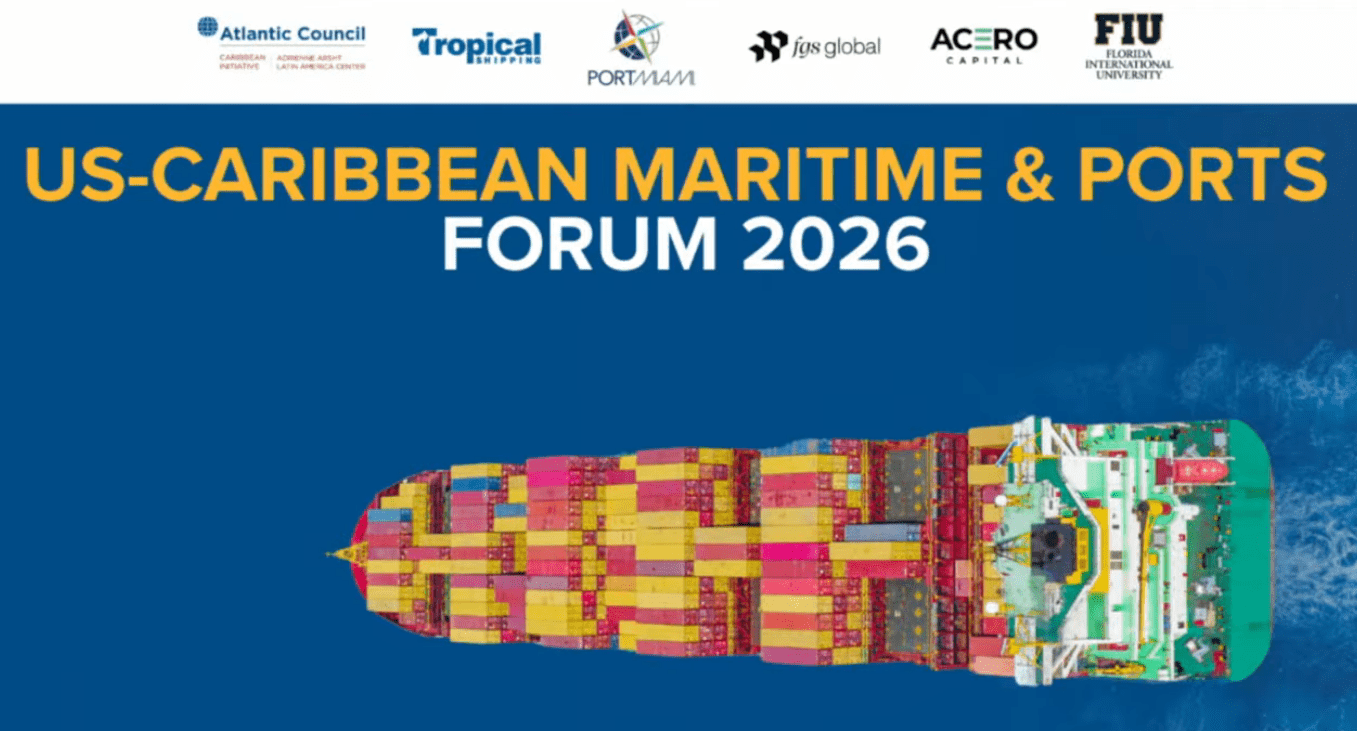
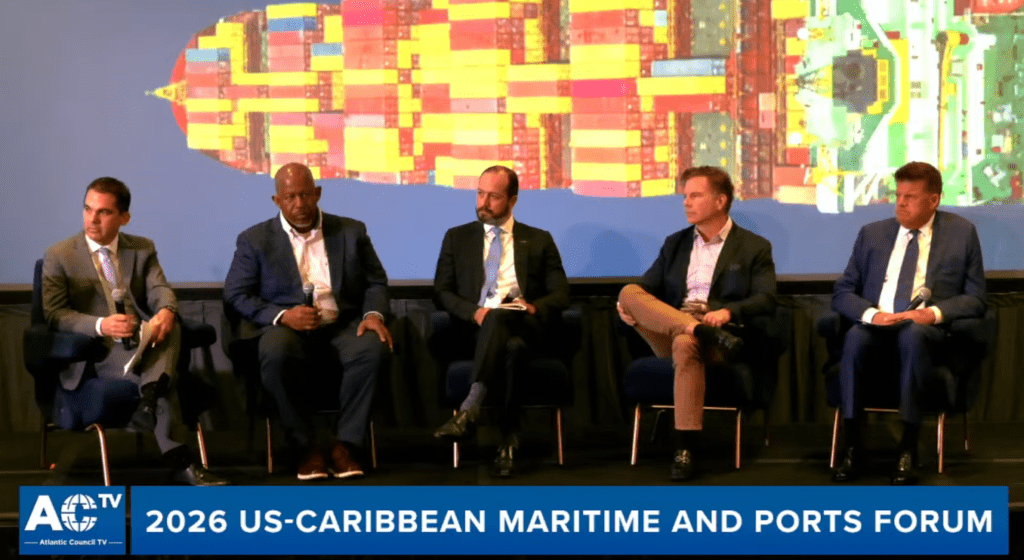
On February 20, 2026, the Atlantic Council’s Caribbean Initiative hosted the inaugural US–Caribbean Maritime and Ports Forum in Miami. Held at the Fountainbleu Hotel, the event formally launched what organizers described as a long-term platform aimed at strengthening cooperation between the United States and Caribbean nations across ports, shipping, and the broader maritime sector.
The forum was positioned not as a one-off conference, but as the beginning of a sustained policy and investment dialogue. Discussions centered on port infrastructure, maritime security, workforce development, regulatory reform, and the role of technology in supporting sector growth. The initiative builds on momentum from the 2025 CARICOM Heads of Government meetings, where maritime cooperation emerged as a stated regional priority.
Ports Framed as Strategic Lifelines
Throughout the forum, ports were consistently described as essential systems underpinning regional trade, investment flows, energy security, public safety, and food supply chains. This framing moved beyond traditional commercial narratives and positioned port infrastructure as critical national assets.
The Caribbean’s role in global cruise operations was also emphasized. The region was described as the world’s leading cruise destination, with Miami identified as the global capital of cruise operations. Cruise connectivity, cargo throughput, and gateway functions were presented as interconnected components of regional economic stability.
Rather than treating ports solely as logistics platforms, speakers repeatedly referenced them as “lifelines” for island economies — infrastructure that directly affects economic continuity and resilience.
Climate Risk as a Structural Maritime Challenge
Climate exposure emerged as a central operational reality for Caribbean port systems. During the forum, Jamaica’s representative provided concrete data points to illustrate the scale of climate pressure over the past five years:
- One Category 4 hurricane
- One Category 5 hurricane
- Two tropical storms making direct landfall
- The hottest day ever recorded
- Three of the four worst droughts in 120 years
- Three of the ten wettest days in 120 years
These figures were used to underscore the structural vulnerability of port infrastructure in small island states.
Jamaica has deployed a systemic risk assessment tool designed to evaluate storm surge, flooding, and wind damage exposure. According to the intervention, the tool proved “almost 100% correct” during the last two hurricane events. The country has also invested in a supercomputer to enhance risk modeling capacity and inform public investment decisions. Coastal protection studies assessing storm surge scenarios of up to 20 feet were referenced, alongside collaboration with the Port of Miami on hurricane preparedness frameworks.
The message was clear: climate resilience is not optional for Caribbean ports — it is foundational to operational continuity.
The “Third Border” Narrative
A notable geopolitical framing emerged during the discussions. One intervention described the United States as having “three borders: Canada, Mexico, and the Caribbean.” This characterization reframed the region not as peripheral, but as a maritime frontier directly linked to US economic and security interests.
Speakers referenced the need for deeper coordination between Caribbean governments and US institutions, including the Development Finance Corporation (DFC), the Export-Import Bank (EXIM), and the State Department. It was acknowledged that the United States often “moves too slowly,” while competitors — explicitly referencing China — “move very quickly.”
Although the forum did not delve into detailed geopolitical confrontation, the underlying implication was that maritime infrastructure cooperation carries strategic weight beyond trade alone.
Ports were presented as instruments of influence, economic alignment, and regional security integration.
Infrastructure Gaps and Operational Constraints
Beyond high-level strategy, the forum exposed a series of practical constraints shaping the daily reality of Caribbean ports.
Several speakers pointed to the need for modernization of freight handling equipment. In smaller jurisdictions, aging cranes and limited cargo infrastructure directly affect turnaround times. In a market where shipping lines prioritize reliability and speed, even incremental inefficiencies can influence routing decisions.
Digitization was repeatedly cited as a necessary next step. Streamlined customs procedures and stronger coordination between port authorities, inspection agencies, and border services were described as essential to improve predictability. One example highlighted how weekend customs closures can extend cargo clearance into midweek, creating avoidable delays that ripple through supply chains.
The message was clear: infrastructure upgrades alone are not sufficient. Administrative systems and institutional coordination play an equally critical role in port performance.
Cybersecurity also emerged as a growing concern. As ports integrate digital tools and data-driven systems, their exposure to cyber threats increases. Given the central role of ports in national supply chains, operational disruption carries broader economic implications.
Congestion risks were also discussed, with Nassau referenced as an example of how capacity pressures can strain both cruise and cargo operations. For ports operating close to their limits, fluctuations in traffic volumes can quickly translate into system-wide stress.
Alongside these challenges, the structural limitations of scale were acknowledged. Smaller island ports operate within constrained cargo volumes, limiting revenue streams and complicating the financing of large capital projects. Without sufficient throughput, infrastructure investments become more difficult to amortize, reinforcing the need for coordinated financing models and external support mechanisms.
Financing and Bankability Challenges
Investment frameworks formed another key theme. Public-private partnerships (PPPs) were identified as critical vehicles for port modernization, though speakers noted political sensitivities and procurement complexities that can slow implementation. Establishing a stable “enabling environment” — including regulatory clarity and risk-sharing mechanisms — was described as essential to attract private capital.
Multilateral development institutions were referenced as important actors in bridging financing gaps. Debt-for-climate swaps were mentioned as emerging tools in the region’s broader financing landscape.
From an investor perspective, clarity around revenue models, demand stability, and operational governance remains central to bankability assessments.
A Formalized Strategic Dialogue
The inaugural forum did not announce specific infrastructure projects or financing commitments. Instead, it formalized a structured dialogue at the intersection of infrastructure, climate resilience, maritime security, and regional cooperation.
By launching a long-term platform focused specifically on US–Caribbean maritime collaboration, the forum elevated ports from sectoral infrastructure to strategic systems with economic and security implications.
The recurring themes — climate exposure, infrastructure modernization, financing constraints, digitalization, and institutional coordination — reflect a region balancing vulnerability with strategic positioning.
Whether framed as economic lifelines or as America’s maritime frontier, Caribbean ports now sit at the center of a structured policy conversation linking trade, resilience, and regional alignment. The 2026 forum marked the institutional beginning of that dialogue.