
South America’s aviation sector is entering a new phase of its development. Faced with growing demand, increasing environmental pressures and rising expectations in connectivity, the region is no longer positioning aviation as a purely operational industry. Instead, it is redefining it as a strategic lever for economic integration and long-term growth.
The SAM Regional Strategy 2035, developed under the framework of International Civil Aviation Organization, reflects this shift. Beyond its 6 strategic pillars, the document outlines a deeper transformation: regulation is no longer treated as a constraint, but as the primary tool to reshape the aviation ecosystem across the region.
A structurally constrained aviation market
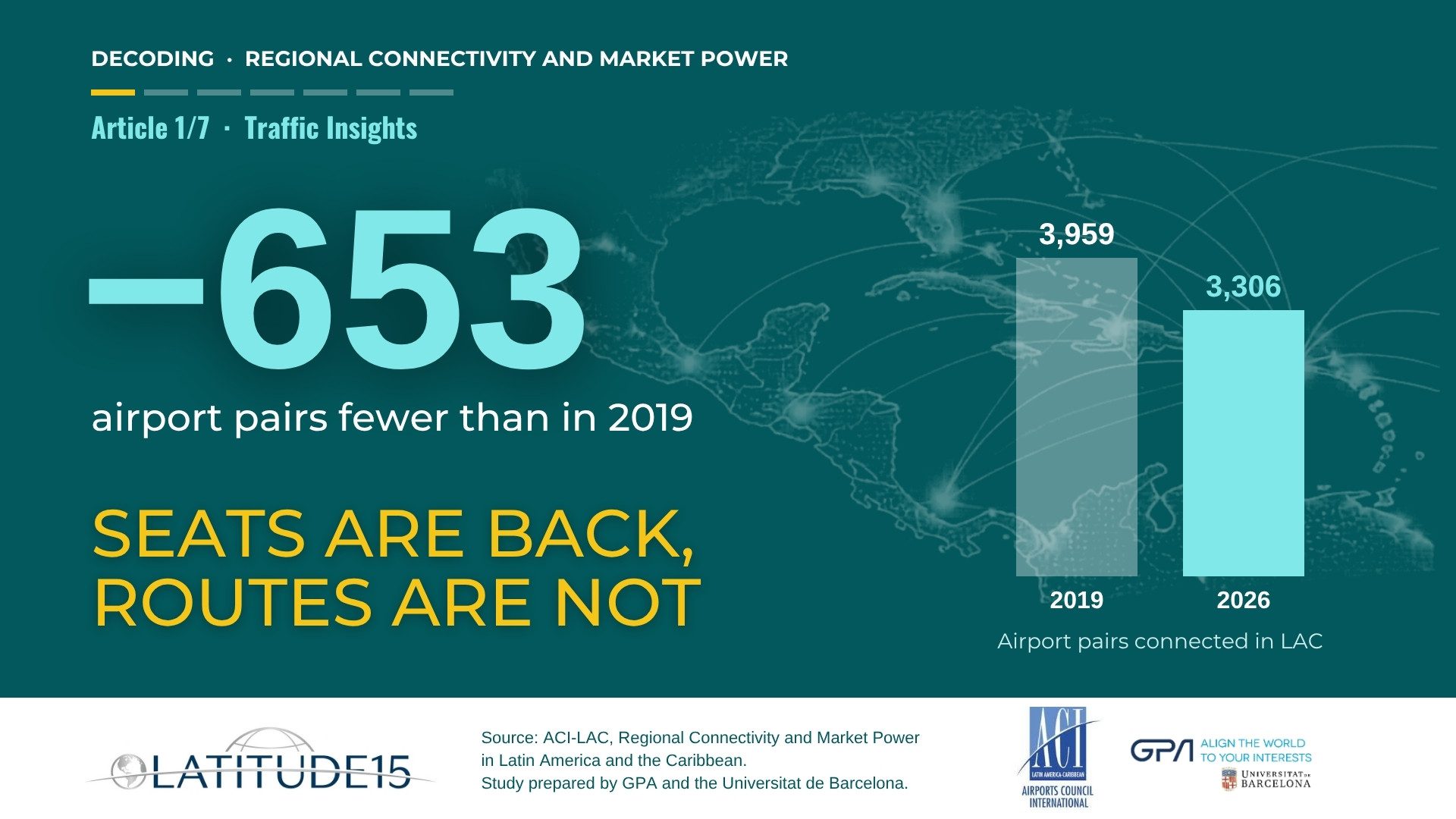
Despite its growth potential, South American aviation continues to face structural limitations. Limited market liberalization, high operating costs driven by taxes and tariffs, insufficient investment in infrastructure and uneven connectivity across territories remain persistent challenges.
These constraints are not cyclical. They are embedded in the organization of the market itself. In many cases, fragmented national frameworks and weak regional coordination have limited the ability of the sector to scale efficiently or attract sustained investment.
As a result, the issue is not a lack of demand, but a system that struggles to convert that demand into sustainable growth.
Regulation as a competitiveness tool
Against this backdrop, the strategy clearly positions regulatory reform as a driver of competitiveness. Advancing market liberalization, reducing economic barriers and strengthening regional integration are presented as key priorities for the coming decade.
This marks a significant shift. Regulation is no longer confined to oversight functions; it is being reframed as an economic instrument. By enabling greater market access, facilitating public–private partnerships and aligning policies across countries, regulators are expected to play a central role in unlocking new routes, improving affordability and enhancing connectivity.
In this context, competitiveness is not only determined by airline performance or infrastructure capacity, but increasingly by the quality and coherence of regulatory frameworks.
Environmental transition will depend on policy frameworks
The strategy also highlights the central role of regulation in addressing environmental challenges. While the region has significant potential in sustainable aviation fuels (SAF) and low-carbon solutions, progress remains constrained by limited policy support, insufficient infrastructure and gaps in regulatory frameworks.
Participation in global mechanisms such as CORSIA remains uneven, and the development of a competitive SAF ecosystem is still at an early stage. The document makes it clear that technological solutions alone will not drive the transition.
Instead, coordinated public policies, incentive mechanisms and regulatory alignment will be required to scale sustainable initiatives. In this sense, environmental performance becomes as much a regulatory issue as it is an industrial one.
Governance: the real bottleneck
If regulatory reform is identified as the solution, governance emerges as the most critical challenge. The strategy points to structural weaknesses within civil aviation authorities, including limited institutional independence, frequent leadership turnover and outdated legal frameworks.
These issues directly affect the consistency and effectiveness of policy implementation. Without stable, transparent and technically independent institutions, even well-designed regulatory frameworks risk remaining ineffective.
Modernizing governance structures, strengthening legal foundations and ensuring continuity beyond political cycles are therefore presented as essential conditions for the sector’s transformation.
A transformation dependent on execution
The SAM Regional Strategy 2035 sets out a clear direction for South American aviation. It recognizes that the region’s future competitiveness will not be determined solely by traffic growth or infrastructure expansion, but by its ability to reform and align its regulatory systems.
However, the success of this transformation will ultimately depend on execution. Translating strategic guidelines into concrete policies, ensuring coordination between States and maintaining long-term institutional stability will be decisive.
In this evolving landscape, regulation is no longer a background function. It is becoming the central architecture upon which the future of aviation in South America will be built.