French Guiana’s SARGASOL project is testing more than ways to convert sargassum into energy. It raises a broader question for the Caribbean: can ports help turn an unpredictable environmental burden into a reliable industrial feedstock?
The Caribbean has no shortage of sargassum. What it lacks is a reliable way to move the biomass from the ocean into an industrial process.
That distinction is becoming increasingly important as governments, researchers and companies across the region explore applications ranging from fuels to fertilisers and higher-value compounds. Satellite estimates can point to millions of tonnes floating across the Atlantic and Caribbean, but industrial plants do not run on satellite estimates. They require material that can be collected, landed, stored, characterised and supplied consistently.
French Guiana is now testing whether a port can help bridge that gap.
In July 2026, the Grand Port Maritime de la Guyane (GPM Guyane) detailed its involvement in SARGASOL, a 44-month research programme selected under the Sargassum III call led by France’s ANR and ADEME. The port received €209,895 in support and is participating alongside SARA, research organisations and specialised technology companies in a programme examining both energy and non-energy uses for the biomass.
But the most significant part of the project may sit upstream of the conversion technologies themselves.
From biomass to feedstock
SARGASOL is examining several potential processing routes. SARA identifies liquid-energy pathways including steam explosion and ethanol fermentation, as well as gaseous-energy technologies including pyrogasification, liquefaction and hydrothermal gasification. The programme, scheduled to run between 2026 and 2029 across French Guiana, Martinique and mainland France, also includes a “zero-waste” objective aimed at finding uses for processing by-products.
That gives SARGASOL the characteristics of an emerging biorefinery programme rather than a single-purpose waste-treatment project.
Yet having viable conversion technologies does not automatically create an industry.
An analysis published by the Inter-American Development Bank in May 2026 highlights the underlying problem. Sargassum can begin deteriorating in less than 48 hours under tropical conditions, leaving an operational window of roughly 48 to 72 hours for many applications. Its chemical composition varies, logistics become overwhelmed during large arrival events, and arsenic concentrations exceeded international regulatory limits in 86% of the samples reviewed by the IDB.
The result is a fundamental mismatch between abundance at sea and predictability at the factory gate.
For sargassum, logistics may therefore matter as much as conversion technology.
The supply chain starts offshore
This is where GPM Guyane’s involvement becomes particularly relevant.
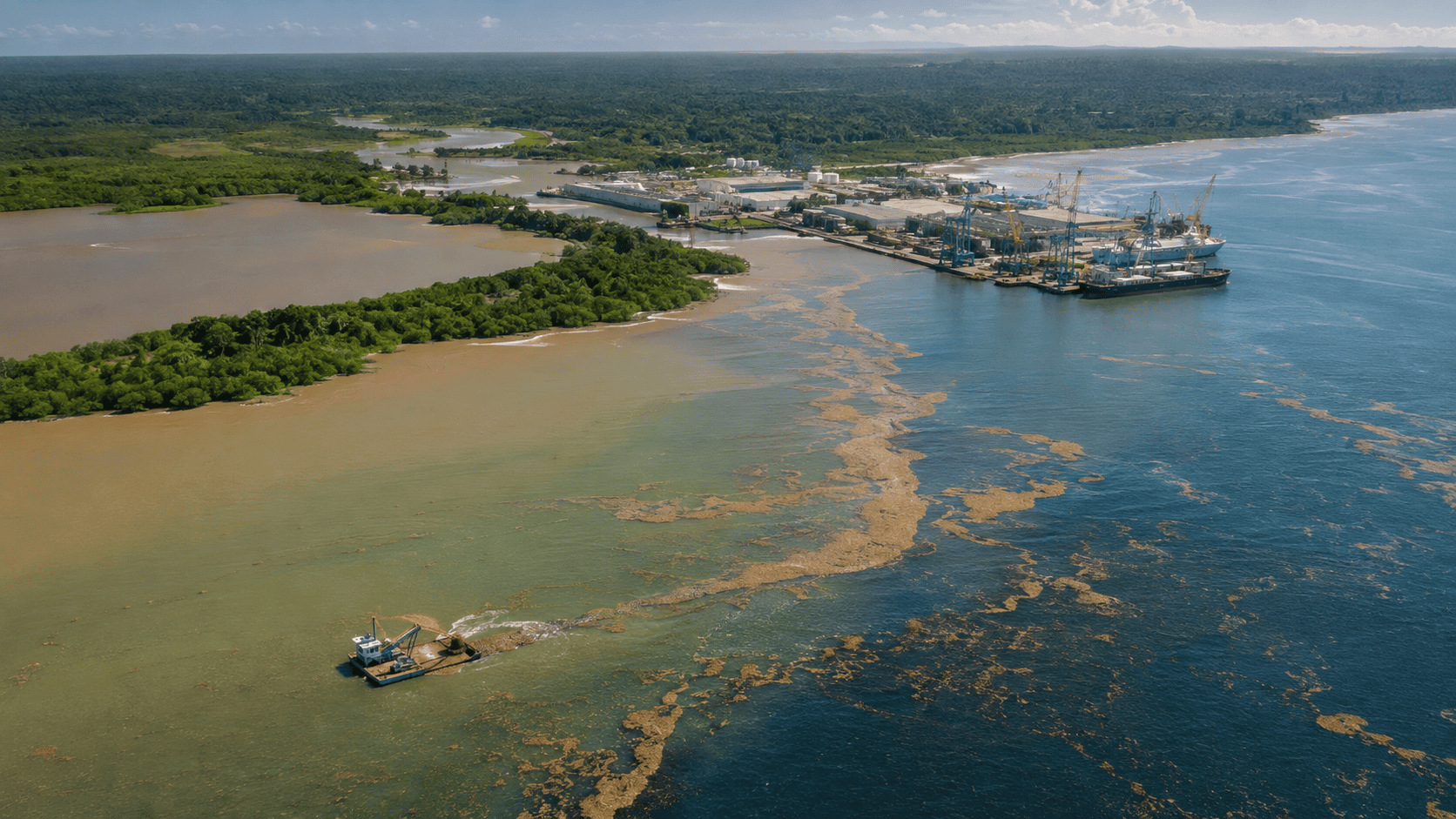
In June 2026, an observation mission was carried out in what the port describes as the “small Sargasso Sea” off French Guiana. CLS and NBC supported the port respectively in detecting and tracking sargassum mats and in collecting samples for physico-chemical analysis.
These activities sit well before any refinery or processing unit.
A functioning sargassum supply chain would potentially require forecasting where biomass will be found, determining when it can be reached, deploying suitable vessels, harvesting it without excessive environmental impact, transporting it ashore, controlling its quality and moving it rapidly into pre-treatment or storage.
In other words, the industrial problem begins at sea.
That differentiates the French Guiana approach from the model most commonly associated with sargassum in the Caribbean, where biomass is frequently treated only after it reaches beaches and becomes an environmental and economic liability.
Offshore collection could change that sequence.
Instead of arrival, cleanup and disposal, the chain could become detection, harvesting, landing, conditioning and conversion.
That does not mean French Guiana has demonstrated such a system at commercial scale. It means the project is testing several of the links that would be required for one to exist.
A regional market still looking for scale
French Guiana is not working in isolation.
From June 1 to 5, 2026, technical experts and policymakers representing nine Organisation of Eastern Caribbean States member countries visited Martinique and Guadeloupe to examine sargassum management and valorisation technologies. The programme explicitly connected technical solutions with a broader objective of turning the region’s sargassum problem into part of the Caribbean blue economy.
This growing regional interest reflects a significant shift.
The question is increasingly moving from how to remove sargassum towards whether the biomass can support viable economic activity.
But that transition remains difficult.
The IDB argues that the large volumes observed from space can be misleading from an investment perspective. What matters to a processor is not how much sargassum exists across the Atlantic, but how much material of sufficient quality can reach its equipment every day.
If that supply changes sharply from one season to another, large processing plants can become a liability. Fixed costs remain even when suitable biomass is unavailable. Under those conditions, remaining at pilot scale can be economically rational rather than simply a sign of technological immaturity.
That helps explain why the Caribbean has generated numerous sargassum applications without yet creating a mature regional industry around them.
Why a port could matter
Ports occupy an unusual position in this equation.
An individual processor may specialise in ethanol, gas, fertiliser or another product. It is much harder for that company to build the entire system required to supply its facility: maritime observation, collection capacity, landing infrastructure, storage, quality monitoring and industrial land.
A port can potentially connect those functions.
That is why GPM Guyane’s role within SARGASOL was described by the programme’s backers as “essential to structuring regional value chains.”
The wording matters. It suggests a role for ports that goes beyond providing land for a processing facility. A port could become the interface between an irregular marine resource and several downstream users.
In such a model, common infrastructure could serve multiple processors rather than forcing each company to solve the same supply problem independently.
The logic closely reflects the broader conclusion reached by the IDB: the Caribbean sargassum market may need shared infrastructure, information, quality standards and regulatory frameworks before private investment can scale.
For ports looking at circular economy and blue-economy activities, that creates a potentially new function: not merely handling cargo, but helping create a commodity that does not yet have a conventional supply chain.
Harvesting is not automatically sustainable
There is another question SARGASOL and similar initiatives will eventually have to answer.
Sargassum floating offshore is not simply waste waiting to be removed. Mats provide habitat for marine organisms, meaning large-scale offshore harvesting cannot be treated in the same way as collecting decomposing biomass from a beach.
Any future commercial system would therefore need to reconcile two objectives that can pull in different directions: securing enough biomass to make processing economically meaningful while ensuring that collection itself does not create new pressure on marine ecosystems.
The same applies to contamination, processing residues and transport. Turning a nuisance into a resource only works if the environmental costs of collecting and transforming it do not outweigh the benefits. That is why SARGASOL should not yet be read as evidence that French Guiana is creating a commercial sargassum industry.
Its significance lies somewhere earlier in the process. The project is testing whether the pieces needed for such an industry — detection, characterisation, maritime logistics, processing technologies and industrial coordination — can begin to function as a system.
For the Caribbean, that may be the more important experiment. The region already knows that sargassum is abundant. The harder challenge is determining whether an unpredictable biomass can become a predictable maritime commodity.
French Guiana is now testing whether a port can help make that transition possible.
Source : Grand Port Maritime de la Guyane // SARA — Rapport de mission 2025, section SARGASOL, published in 2026 // Inter-American Development Bank (IDB) — Development of the Sargassum Industry in the Caribbean: The Wrong Kind of Abundance, 18 May 2026. // (OECS) — OECS Delegates Gather Sargassum Management Strategies Following Their French Territories Mission, 15 July 2026.