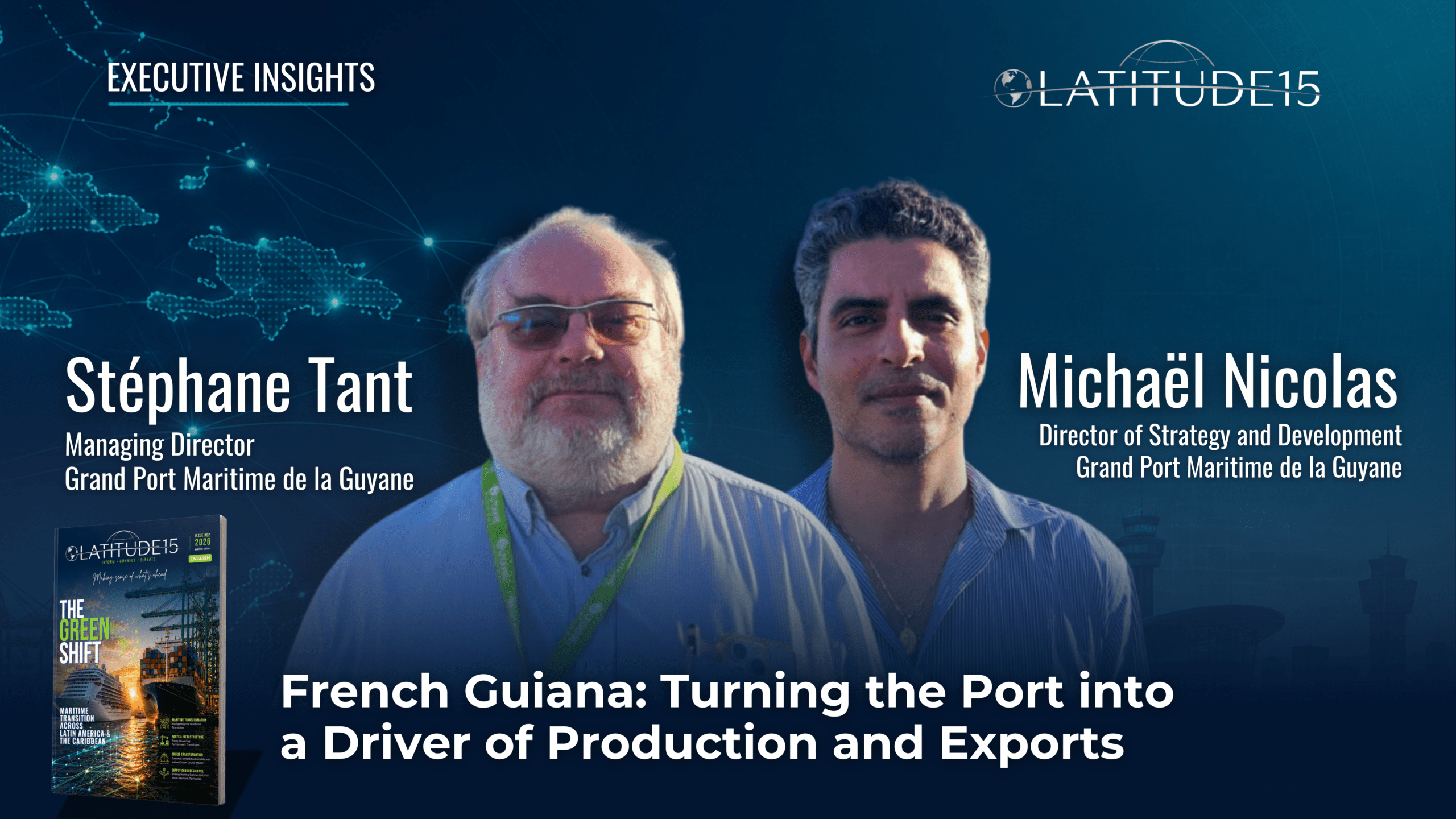
In conversation with Stéphane Tant, Chairman of the Management Board and Chief Executive Officer, and Michaël Nicolas, Director of Strategy and Development at the Grand Port Maritime de la Guyane.
Cargo traffic at the Grand Port Maritime de la Guyane continues to grow steadily. Yet this growth, largely driven by the territory’s domestic needs, is not enough to transform its economic model.
The real opportunity lies elsewhere: in French Guiana’s ability to produce, process goods locally and use the port as a gateway to new markets. Behind the expansion of port land and the development of new infrastructure lies a broader ambition: to turn the port into a driver of production and exports.
Traffic at the Grand Port Maritime de la Guyane has increased with remarkable consistency. Around one million tonnes of cargo now pass through the port every year, compared with 650,000 tonnes when the port authority was established in 2013. Average annual growth of between 2% and 3% has broadly followed increases in both population and consumption.
This is a solid trend. However, it primarily reflects the growing needs of a territory that remains heavily dependent on external supplies. Traffic growth therefore continues to be driven mainly by imports. For Stéphane Tant, Managing Director of the Grand Port Maritime de la Guyane, a genuine shift in scale will not come from higher import volumes alone.
“If we really want to change the model, we need to produce or process locally so that, at some point, we can export. That is what will have the greatest multiplier effect on development,” he emphasises.
This perspective shifts the centre of gravity of the port’s strategy. The objective is no longer simply to adapt quays, yards and equipment to the expected growth in cargo volumes. It is also to create the logistical and land conditions required for new economic activities to establish themselves, serve the local market and, potentially, expand beyond French Guiana.
Port Land to Support the Emergence of New Industries
In Rémire-Montjoly, the port is working to make additional land available for activities that do not yet exist in French Guiana but could become increasingly necessary as the population and its needs continue to grow.
Animal feed provides a concrete example of this approach. Expanding local livestock farming would require changes in the way the sector is supplied. Rather than importing only finished products in containers, French Guiana could receive grain in bulk, store it and prepare livestock feed mixtures locally.
The port would have a dual role: enabling raw materials to arrive under suitable conditions and reserving the land required for storage and processing facilities. Should production eventually exceed the needs of the local market, the immediate proximity of the port could also facilitate the export of surpluses to other Caribbean markets that currently import part of their animal feed from Europe or the United States.
At this stage, this does not amount to announcing the creation of an established industry. The port is preparing the capacity to accommodate future projects and identifying potential uses for its land. The distinction is important: the port authority can make an investment possible, but it cannot create production on its own or take the place of investors and industrial operators.
The Economic Challenge of Imbalanced Trade Flows
The current structure of French Guiana’s port traffic illustrates the scale of the challenge. Large quantities of goods enter the territory, while export capacity remains limited. The containers used to transport locally consumed products must subsequently be shipped out again.
Higher local production in sectors such as timber, agriculture, fishing, seafood processing and other locally available resources could make use of this outbound capacity. The objective goes beyond generating additional cargo volumes. Achieving a better balance between imports and exports would improve the overall economics of trade flows and strengthen the port’s position within the local value chain.
The Grand Port and the companies operating within the port community say they already have the capacity to handle these exports. The main constraint lies further upstream, in the limited investment being directed towards production, extraction and processing facilities.
Consumption currently supports the development of retail distribution, logistics and service activities. It also generates predictable growth in port traffic. However, it does not produce the same economic multiplier effect as an economy capable of processing its own resources and accessing external markets.
The port can therefore prepare the infrastructure, but the transition will ultimately depend on French Guiana’s ability to attract productive investment.
Circular Economy: Pre-Processing Locally, Recovering Value Elsewhere
The same approach is shaping the port’s thinking on the circular economy. French Guiana does not generate sufficient volumes of every recoverable waste material to justify the creation of a complete industrial processing chain within the territory. However, this limitation does not prevent certain activities from being organised locally.
The port is considering accommodating facilities capable of improving the collection, preparation or pre-processing of certain materials before they are exported to specialised recovery sites. Locating these activities close to port infrastructure could reduce handling requirements and improve control over logistics costs.
The strength of this strategy lies in its pragmatism. It does not assume that every stage of every value chain must take place in French Guiana. Instead, it seeks to determine which parts of the value creation process can realistically be carried out locally, given the available volumes, before establishing efficient connections with industrial facilities elsewhere.
Under this model, the port is no longer simply the point through which waste leaves the territory. It also becomes a location where waste can begin to be prepared as a resource.
New Equipment Expands the Range of Opportunities
This shift towards a more productive economic model also requires the removal of practical logistics constraints. The cranes recently commissioned at the port now make it possible to accommodate vessels without their own lifting equipment, reducing its dependence on geared vessels.
The Border Control Post, operational since December 2024, also expands the range of possibilities. By allowing sanitary inspections to be carried out directly in French Guiana, it could enable future local industries to source inputs from within the region without routing them through Europe.
At this stage, its significance lies less in the volumes being handled than in the new logistics options it creates for local production.
The Port Can Lay the Groundwork, but It Cannot Build the Productive Base Alone
The 2024–2028 strategic plan provides for €70 million in expenditure and €85 million in commitments, with some investments expected to extend beyond 2028. This programme is intended to support traffic growth, expand capacity and improve port productivity.
However, the impact of these investments will depend on the economic activities they make possible around the port. More efficient quays and additional land can help absorb the consequences of population growth. They take on a broader strategic dimension when they also create opportunities for storage, processing and circular-economy activities.
The strategy of the Grand Port Maritime de la Guyane therefore establishes a clear boundary between the port’s responsibilities and those of other economic stakeholders. The port can develop and equip land, reserve space, secure operations and facilitate access to markets. It can remove some of the logistical and land-related constraints that may discourage new businesses from establishing themselves.
It cannot, however, guarantee the arrival of investors or create export volumes by itself.
The challenge facing French Guiana is therefore not solely a port issue. It is about turning infrastructure into a productive economic asset. As long as growth remains primarily consumption-driven, port traffic will continue to increase without fundamentally changing the economic model.
Should new industries succeed in producing, processing and making use of the available logistics capacity, the port could become more than a gateway for imports. It could serve as a platform for creating value in French Guiana and connecting that value to markets across the wider region.
Discover More About French Guiana in The Green Shift
This Executive Insight explores one of the strategic issues examined in the latest maritime edition of LATITUDE15. Discover how French Guiana is addressing port development, regional connectivity and the transition towards a more resilient and sustainable economic model.