
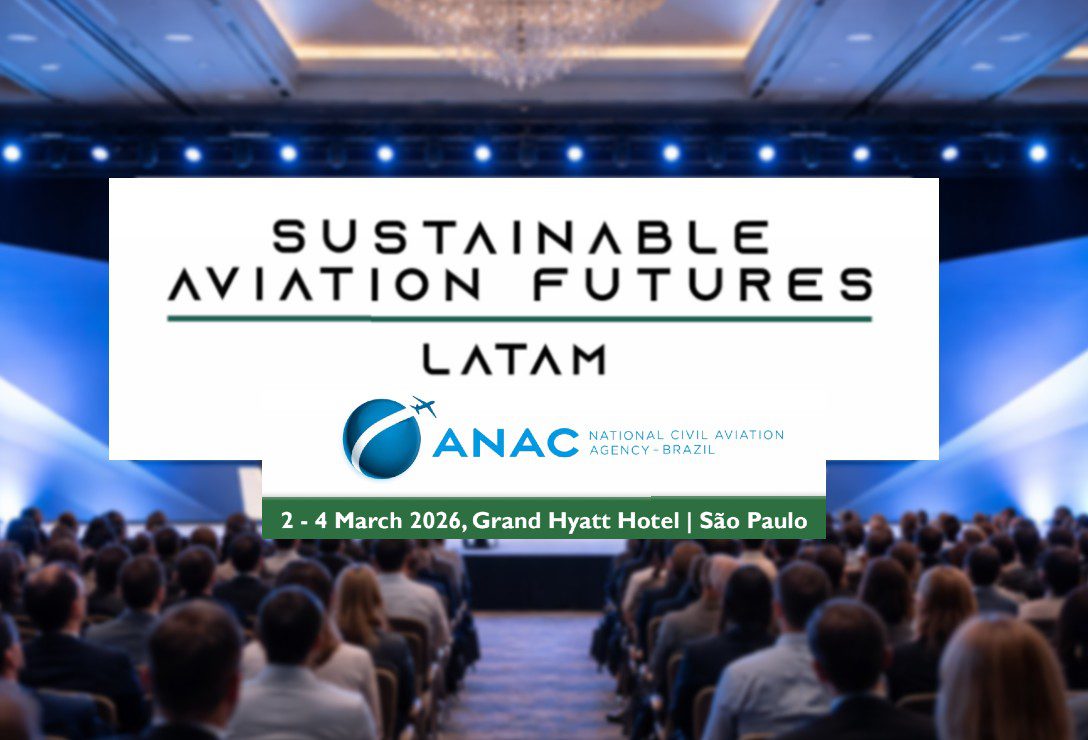
From 2 to 4 March 2026, São Paulo will host the second edition of the Sustainable Aviation Futures LATAM Congress, bringing together more than 400 industry leaders and around 100 speakers across aviation, energy, finance and government. On the surface, it is another sector gathering focused on Sustainable Aviation Fuel (SAF). In substance, it reflects a deeper shift: Latin America is moving from ambition to market architecture.
The timing is significant. Brazil’s 2027 blending mandate is approaching, and policy clarity is beginning to translate into industrial positioning. The congress agenda and speaker lineup suggest that the region is no longer debating whether SAF should scale, but how — and under what financial, regulatory and logistical conditions.
Brazil as the Emerging Anchor Market
Brazil’s prominence within the programme is unmistakable. Senior representatives from ANAC, the Ministry of Mines and Energy, the Ministry of Development, Industry, Trade and Services, as well as BNDES and Petrobras, are scheduled to intervene. Discussions will focus on the “Fuel of the Future” bill, the 2027 mandate, and the implementation of ProBioQAV mechanisms designed to reduce aviation greenhouse gas emissions over the coming decade.
This level of government engagement signals that SAF in Brazil is not merely an environmental initiative; it is industrial policy. The integration of taxation frameworks, carbon markets and development bank financing points to a structured attempt to build a domestic supply base capable of serving both national carriers and export markets.
The question is no longer whether Brazil intends to participate in the global SAF market. It is whether it can position itself as a competitive production hub — leveraging its bioethanol legacy and agricultural scale to bridge the cost gap between conventional jet fuel and low-carbon alternatives.
From Feedstock Potential to Commercial Readiness
Beyond mandates, the congress agenda highlights the technical and agricultural foundations of SAF scale-up. Dedicated sessions will examine ethanol-to-jet pathways, co-processing solutions, and feedstock availability — including sugarcane, soy, macauba and other regional crops.
This emphasis reflects a broader regional narrative: Latin America holds significant biomass and bioenergy potential. Yet scaling SAF production requires more than feedstock abundance. It demands carbon intensity certification, alignment with CORSIA and RED III standards, and credible responses to Indirect Land-Use Change (ILUC) scrutiny.
ILUC remains particularly sensitive for South American producers exporting to Europe. Discussions around transparency, traceability and harmonisation of carbon accounting frameworks indicate awareness that international credibility will shape market access.
The shift from pilot projects to Final Investment Decisions (FID) is another recurring theme. Industry case studies are expected to address how early facilities have navigated technology readiness, engineering constraints and financing hurdles — a sign that the conversation is entering the commercial phase.
Finance Moves to the Forefront
If one element stands out in this year’s edition, it is the weight of financial actors. BNDES, IDB Invest, CAF and BloombergNEF are all represented, alongside panels dedicated to due diligence, risk evaluation and investment metrics.
SAF remains costlier than conventional jet fuel. Without structured financial support, price-sensitive Latin American markets could struggle to absorb sustained premiums. The presence of development banks suggests recognition that public capital will play a catalytic role, particularly for first-of-a-kind facilities.
Questions around long-term offtake agreements, price floors, and risk-sharing mechanisms are central. Investors will look for policy stability and credible demand signals before committing capital. In that sense, the congress functions not only as a technical forum but as a confidence-building platform.
Airlines Under Pressure
Airline participation — including executives from LATAM Airlines, Azul, GOL and international carriers such as JetBlue — adds a commercial dimension to the debate.
Carriers face mounting sustainability pressures from corporate clients, regulators and international frameworks. Yet profitability remains fragile across much of the region. Integrating SAF into procurement strategies without undermining margins is a delicate balance.
Sessions addressing Scope 3 disclosures and book-and-claim mechanisms highlight attempts to reconcile decarbonisation with financial viability. The development of credible registries and interoperable tracking systems will be critical if SAF credits are to gain widespread acceptance.
Trade Corridors and Geopolitical Alignment
The congress also situates Latin America within the broader geopolitical landscape of energy transition. Discussions are expected to examine the impact of U.S. tax incentives, European certification requirements and emerging Asia-Pacific demand.
Latin America’s strategic positioning between Washington, Brussels and Asian markets presents both opportunity and complexity. Trade agreements, export standards and carbon compliance models will influence where SAF flows — and under which regulatory umbrella.
As global mandates evolve, the region must navigate a fragmented policy environment. Alignment, or at least compatibility, with international standards will determine whether Latin American SAF production integrates seamlessly into global supply chains.
A Transition Moment
The Sustainable Aviation Futures LATAM Congress 2026 is not simply an industry networking event. It represents a convergence point: policy frameworks maturing, feedstock strategies crystallising, financial institutions engaging and airlines recalibrating procurement models.
For Latin America, the transition to sustainable aviation fuels is no longer abstract. It is entering the operational phase. The coming years will reveal whether the region can transform its bioenergy strengths into durable competitive advantage — or whether cost pressures and regulatory fragmentation will slow momentum.
As Brazil approaches its 2027 mandate, São Paulo will serve as a barometer of regional ambition. The real test will not lie in conference halls, but in the speed at which projects move from discussion to deployment.