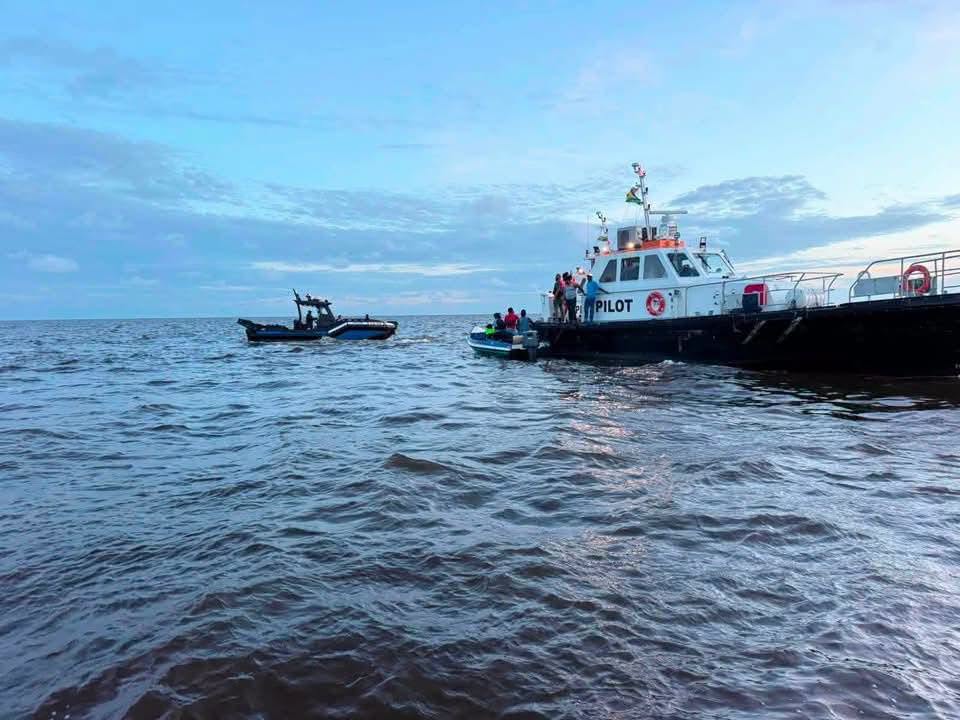
At least ten bodies have been recovered after the MV Barima capsized off Guyana’s coast, as an expanding search operation continues for passengers and crew still unaccounted for.
The government-operated passenger and cargo ferry overturned late on Saturday, July 18, while travelling to Port Kaituma in Guyana’s north-western Region One. Authorities said the vessel had departed Parika at approximately 3:15 p.m. before transmitting a distress signal at 11:01 p.m. near Iron Punt, off the Essequibo coast.
By Monday, 67 people, including 15 children, had been rescued. Search teams, supported by divers and private energy-sector vessels, had extended operations across an area of approximately 1,040 square kilometres. Air and naval assets from Trinidad and Tobago were also being deployed to assist Guyana.
The full scale of the disaster remains uncertain because authorities have not established how many people were actually aboard the ferry.
Passenger manifest discrepancies complicate the response
The official manifest recorded 116 passengers and 17 crew members, giving an initial total of 133 people. However, the government subsequently disclosed that several rescued passengers were not listed in the vessel’s documentation.
According to the Associated Press, at least 35 of the 67 survivors were absent from the official manifest. The discrepancy has complicated efforts to determine how many people remain missing and raised serious concerns about boarding controls and passenger registration procedures.
Prime Minister Mark Phillips has ordered an urgent investigation involving the Guyana Police Force, the Guyana Defence Force, the Maritime Administration Department and technical maritime specialists.
The inquiry will examine the passenger manifest, the loading of passengers and cargo, compliance with maritime safety regulations and the conduct of the captain and crew before and during the voyage.
“Where negligence, misconduct or criminal wrongdoing is established, those responsible will face the full force of the law,” Phillips said during a government briefing.
The ferry’s captain and at least one other crew member remained in police custody after testing positive for cannabis, according to the authorities. This forms part of the investigation, but no official cause of the capsizing has yet been established.
An ageing vessel within a wider maintenance programme
The MV Barima was built in 1939 and had served Guyana’s passenger and cargo network for decades. Its age is likely to attract scrutiny, although authorities have rejected claims that the vessel had previously been declared unfit for operation.
Public Works Minister Juan Edghill said the ferry was last dry-docked in 2024 and was scheduled to undergo another planned dry-docking programme during the second half of 2026. He described the anticipated hull inspections, underwater works and repairs as part of the fleet’s routine maintenance cycle.
Several months before the accident, the Guyanese government had announced an estimated GYD124.5 million in additional works for the MV Barima. The investment formed part of a rehabilitation programme valued at more than GYD440 million for three vessels serving the country’s riverine and coastal transport network.
The existence of the maintenance programme does not, by itself, establish that the vessel’s condition caused the accident. That question will need to be determined through technical inspections and the official investigation.
A vital link for Region One
The tragedy also highlights the strategic importance of ferry services in Guyana, where extensive forest coverage and limited road connections leave many hinterland communities dependent on river and coastal transport.
The MV Barima regularly carried passengers and freight between the coast and Port Kaituma, serving communities across the North West District, including Mabaruma and Kumaka. Government documents describe the vessel as a vital connection for the movement of people, goods and services into Region One.
For businesses and residents, ferries can also provide a more affordable option than domestic air freight, particularly for transporting larger volumes of goods to interior communities.
The loss of the MV Barima therefore presents an immediate operational challenge as well as a wider safety issue. Authorities will need to maintain transport capacity to Region One while reviewing passenger controls, crew supervision, emergency preparedness and the technical condition of the public ferry fleet.
As recovery operations continue, the investigation’s findings could have implications extending well beyond a single vessel. They may shape how Guyana manages manifests, enforces maritime procedures and prioritises the renewal of the ships connecting its coastal economy with remote hinterland communities.