In conversation with Patrick Pourbaix — Managing Director, MSC Cruises & Explora Journeys France & Monaco
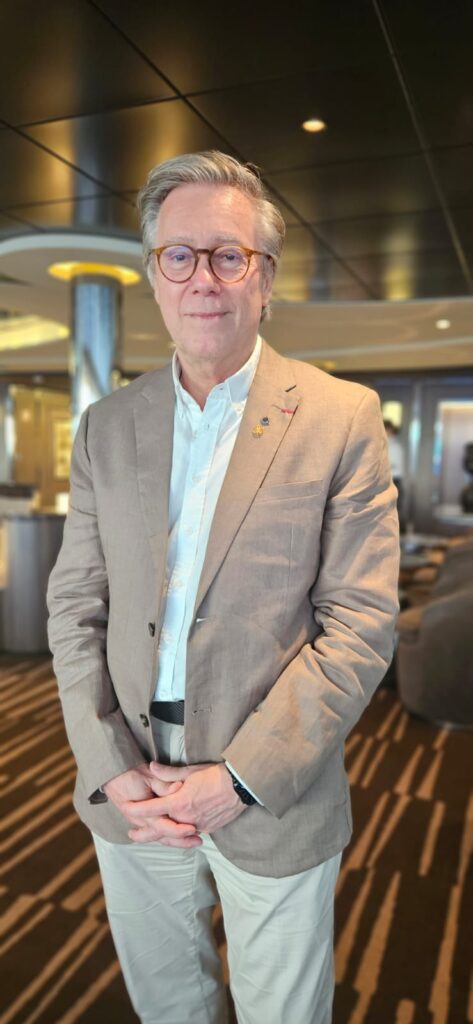
There is a statistic that Patrick Pourbaix, CEO of MSC Cruises France, delivers with quiet confidence — and it stops every conversation cold. “Caribbean islanders are the world’s biggest cruise enthusiasts,” he says, seated aboard the MSC Virtuosa in Fort-de-France harbour. “The cruise penetration rate in mainland France is 1%. In the Caribbean islands, it is ten times higher. 10% of Caribbean islanders go on a cruise. That is the highest rate in the world — higher than Americans.“
For a region that has long watched the global cruise industry orbit around Miami and the mass market model that city represents, the figure carries weight. And for MSC Cruises, it is not just a data point — it is the foundation of a strategic vision that is reshaping how the Caribbean is approached by one of the world’s largest cruise operators.
A European Company in a Caribbean Sea
MSC Cruises occupies an unusual position in an industry long dominated by American groups. “We are today the third largest cruise operator in the world and we are a European company,” says Patrick Pourbaix. “And we are also the world’s number one container shipping company, with more than 900 vessels sailing every ocean on the planet.” What began as a container business built by a family of sailors has grown into a cruise operation defined, he insists, by a distinctly European sensibility — a cultural identity passengers feel the moment they board.
That identity is literal. Nineteen of MSC’s 23 ships currently in operation were built at the Chantier de l’Atlantique shipyard in Saint-Nazaire, France. Six more are in the pipeline.
Fort-de-France as Hub — The Numbers Behind the Strategy
MSC has been working with authorities in Martinique and Guadeloupe for years to develop a homeport offering in the Caribbean — an alternative to the traditional model where Caribbean cruises begin and end in Miami. “All of our development has not gone through American ports,” Patrick Pourbaix notes. “The Caribbean islands play a very important role.”
Last season, MSC carried around 50,000 passengers from Fort-de-France — roughly half from mainland France and half from the Caribbean islands themselves. The upcoming seasons will go further. Starting in the coming seasons, a second vessel — the MSC Opera — will complement operations from Fort-de-France, offering departures every 14 days in winter and weekly sailings during the summer. From 2027 onward, MSC will operate year-round weekly departures from Martinique.
“We are offering a European vision of the Caribbean,” says Patrick Pourbaix, “one that does not necessarily depart from Miami.” Guadeloupe and the Dominican Republic — specifically La Romana — are being developed as complementary hubs in this expanded network.
What Makes a Destination Strategic
For Patrick Pourbaix, the days when a cruise company’s relationship with a port was reduced to docking fees and ship clearances are long gone. “A successful cruise destination today requires a 360-degree relationship — not just the port, but local infrastructure, excursions, travel agencies, and airports that are developing alongside the growth in passenger volumes.“
He points to Martinique as a model of what that dialogue looks like in practice. “What we have built with Martinique and Guadeloupe is a harmonious development, constructed together through permanent dialogue. Without that, we would never have arrived where we are today.“
The Green Challenge — And Why It Is Not a Burden
When asked about MSC’s main challenge, Patrick Pourbaix does not hesitate. “To continue the journey of environmental transition. It is not a burden for us — because we are achieving results that are truly spectacular.” MSC has already reduced its carbon intensity by 38% against its 2008 baseline, a figure the company views as proof that environmental ambition and commercial growth are not in opposition.
It is a theme Latitude 15 will explore in depth in its upcoming maritime edition, dedicated entirely to the green transition of ports and the shipping industry across Latin America and the Caribbean.
On the Horizon
MSC’s ambitions extend well beyond the French Caribbean. The company is already the number one cruise operator in South America, operating seasonal deployments to Rio de Janeiro and São Paulo, while actively growing its presence in the North American market.
“There is still an immense potential for major development,” says Patrick Pourbaix. “And what is wonderful is that this development also supports the economic development of the Caribbean islands. We are very proud to be contributing to that.“