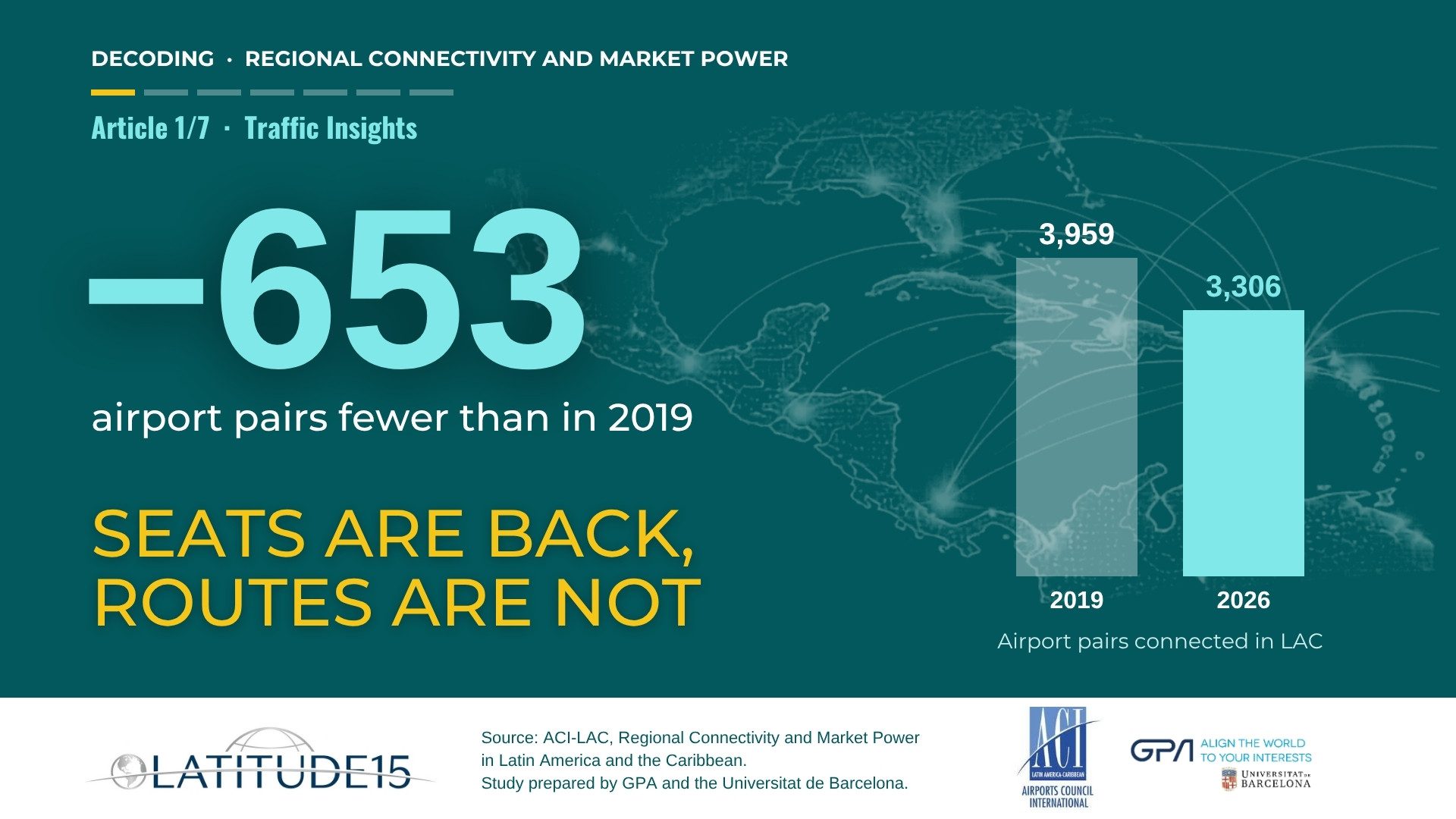

Latin America and the Caribbean’s largest airports continued to expand in 2025, reinforcing the dominance of the region’s major aviation hubs while highlighting new growth dynamics across international connectivity and air cargo. According to preliminary data released by the Airports Council International Latin America and the Caribbean, the region’s top 10 airports handled more than 790 million passengers last year, representing a 3.8% increase compared to 2024.
São Paulo–Guarulhos Airport once again ranked as the busiest airport in Latin America and the Caribbean, handling more than 47.1 million passengers in 2025. Bogotá’s El Dorado Airport followed with 45.4 million passengers, while Mexico City International Airport completed the podium with 44.6 million passengers despite a slight year-on-year decline.
Beyond the rankings themselves, the 2025 figures also reveal how a small group of large hubs continues to concentrate regional connectivity, while airports such as Panama Tocumen, Lima Jorge Chávez and Rio Galeão are gaining momentum through international transit, cargo activity and tourism-driven growth.
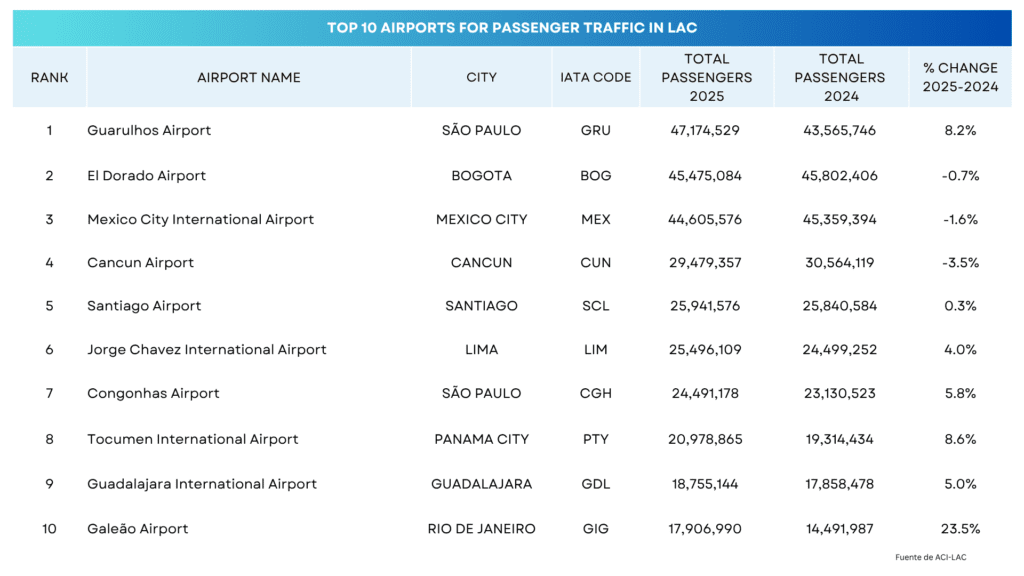
Guarulhos, Bogotá and Mexico City continue to dominate regional traffic
Brazil’s São Paulo/Guarulhos International Airport remained the region’s largest airport in 2025, recording 47.17 million passengers, up 8.2% compared to the previous year. The airport’s performance once again underlined the scale of Brazil’s domestic aviation market, but also the growing importance of Guarulhos as South America’s leading intercontinental gateway.
Close behind, El Dorado International Airport handled 45.47 million passengers. Although total traffic declined slightly by 0.7%, Bogotá retained its position as one of the continent’s most strategic aviation hubs, supported by strong international connectivity and its central role in regional transit flows.
Mexico City International Airport also remained among the region’s dominant airports with 44.6 million passengers. However, traffic declined by 1.6%, reflecting some of the operational and capacity pressures that continue to affect the Mexican capital’s main airport.
Commenting on the results, ACI-LAC Director General Rafael Echevarne said the figures demonstrated the resilience of the region’s leading hubs despite global challenges. He highlighted Guarulhos, El Dorado and Mexico City as strategic gateways whose growth continues to be supported by international connectivity and recovering domestic demand.
Further down the ranking, Santiago, Lima and Guadalajara all posted moderate growth, illustrating the continued resilience of major metropolitan aviation markets across the region.
Tocumen strengthens its position as Latin America’s leading international hub
International traffic remained one of the strongest growth segments in 2025. According to ACI-LAC, the region’s top 10 airports handled approximately 134 million international passengers last year, representing a 3.69% increase compared to 2024.
Within this segment, Tocumen International Airport clearly reinforced its strategic role as the region’s main international connecting hub. The airport handled more than 20.7 million international passengers in 2025, up 8.2% year-on-year, making it the largest international gateway in Latin America and the Caribbean.
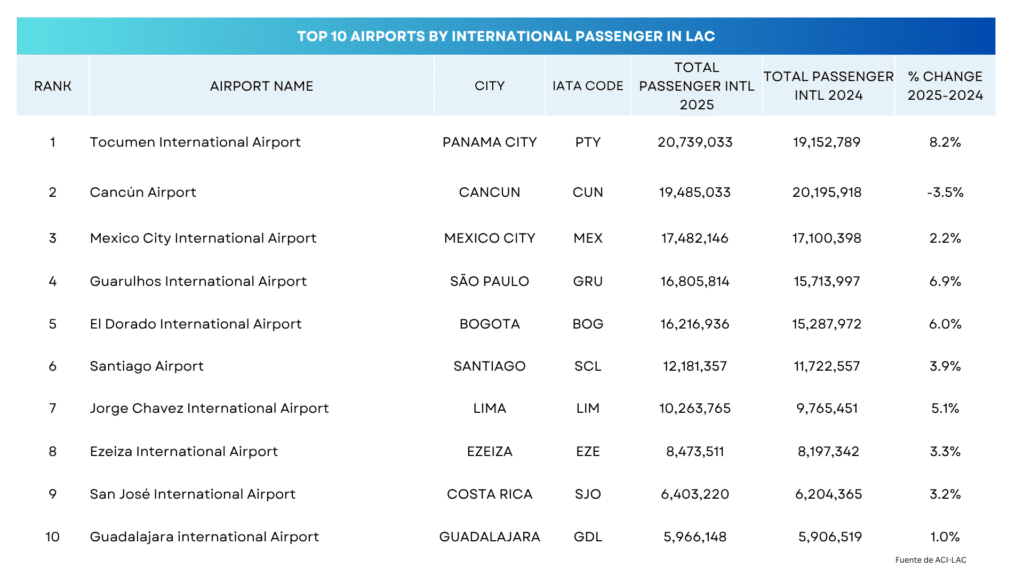
The figures confirm the continued effectiveness of Panama’s hub-and-spoke model, supported by the country’s geographic position and the expansion of regional transit traffic through Panama City.
Meanwhile, Guarulhos also recorded strong international growth (+6.9%), while Bogotá’s El Dorado expanded its international traffic by 6%. In contrast, Cancún Airport — traditionally one of the region’s strongest tourism gateways — saw international passenger traffic decline by 3.5% despite remaining the second-largest international airport in the ranking.
Rio Galeão records the strongest passenger growth among major airports
One of the most notable developments in the 2025 rankings was the sharp rebound of Rio de Janeiro/Galeão International Airport.
The airport recorded 17.9 million passengers in 2025, representing a 23.5% increase compared to the previous year — the strongest growth rate among the region’s top 10 airports.
ACI-LAC linked the airport’s performance to infrastructure investment and tourism promotion efforts, illustrating how strategic repositioning and improved connectivity can rapidly transform traffic performance at major gateways.
The rebound also reflects broader efforts to restore Rio de Janeiro’s role within Brazil’s aviation network after years of traffic concentration around São Paulo.
Cargo growth highlights the rise of Lima and Panama
While passenger traffic remained the dominant growth driver across the region, cargo activity also continued to expand in 2025. According to ACI-LAC, the top 10 cargo airports in Latin America and the Caribbean handled more than 3.8 million metric tons last year, up around 1.7% compared to 2024.
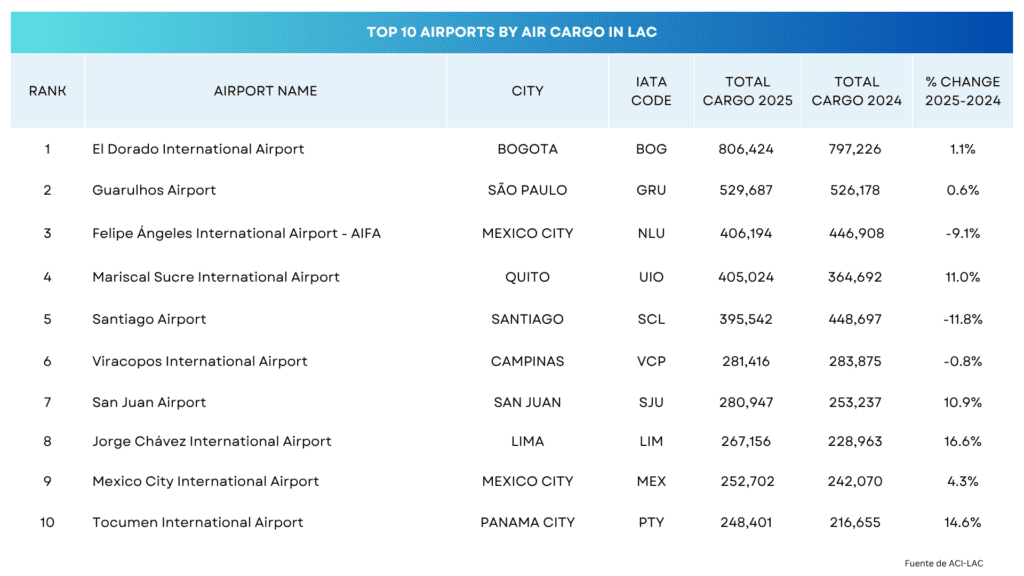
El Dorado International Airport remained the region’s leading cargo airport with more than 806,000 metric tons transported during the year, well ahead of Guarulhos and Mexico City’s Felipe Ángeles International Airport.
However, some of the strongest cargo growth rates were recorded elsewhere in the region. Jorge Chávez International Airport posted a 16.6% increase in cargo volumes, while Tocumen International Airport grew by 14.6%. Quito’s Mariscal Sucre International Airport also recorded double-digit growth at 11%.
The figures suggest that cargo growth is increasingly diversifying across multiple logistics corridors in Latin America, particularly in airports positioning themselves as regional distribution and transshipment platforms.
Regional aviation growth remains uneven across the region
The 2025 rankings illustrate a regional aviation market that continues to grow, although at varying speeds depending on airport profiles and traffic segments.
Large consolidated hubs such as Guarulhos, El Dorado and Mexico City continue to dominate overall traffic volumes, while airports like Tocumen are strengthening their international transit role. At the same time, Lima and Panama are gaining relevance in cargo logistics, and Rio Galeão’s rebound demonstrates how investment and tourism recovery can rapidly reshape airport performance.
Taken together, the ACI-LAC figures point to an aviation landscape where connectivity, network positioning and infrastructure strategy are becoming increasingly decisive in defining the region’s next generation of leading hubs.