
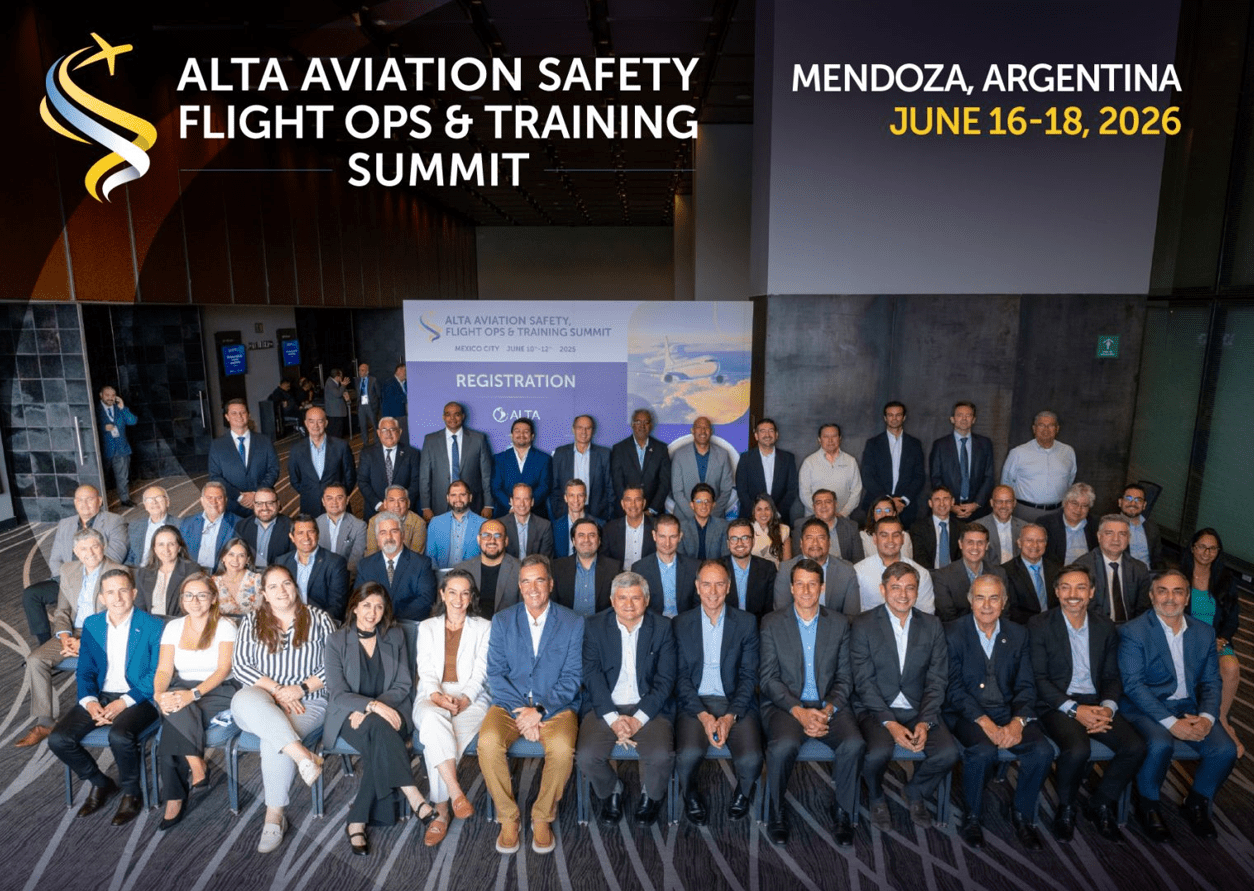
As aviation activity continues to expand across Latin America and the Caribbean, industry leaders will convene in Argentina this June to address one of the sector’s most critical priorities: safety. The ALTA Aviation Safety, Flight Ops & Training Summit 2026, organized by the Latin American and Caribbean Air Transport Association (ALTA), will take place from June 16 to 18, 2026 in Mendoza, Argentina, bringing together airlines, regulators, manufacturers and operational experts from across the region. The event aims to provide a platform for collaboration and the development of practical solutions to ensure safe and sustainable air transport in a rapidly evolving aviation environment.
A growing aviation sector brings new safety challenges
Latin America’s aviation industry continues to expand as connectivity increases and passenger demand rebounds across the region. While this growth creates new opportunities for airlines and airports, it also introduces additional operational complexity and emerging safety risks.
Against this backdrop, the ALTA summit positions itself as a key forum where the industry can collectively examine operational challenges and translate safety insights into concrete action. The objective is not only to discuss safety performance but also to strengthen the processes, training and collaboration required to maintain high operational standards across the region.
A platform for collaboration across the aviation ecosystem
The summit will feature high-level discussions addressing some of the most pressing safety and operational issues facing the aviation sector. Participants can expect a program combining strategic debates, case studies drawn from real operational experience, and the sharing of best practices from across Latin America and the Caribbean.
Beyond the formal sessions, the event also serves as a major networking platform, enabling industry leaders to exchange perspectives and coordinate on practical solutions aimed at improving operational safety. According to ALTA, the summit is designed to move beyond theoretical discussions and foster actionable outcomes that can be applied directly within airlines and aviation organizations.
Bringing together airlines, regulators and industry experts
The event traditionally attracts a wide range of aviation stakeholders. Representatives from airlines, aircraft manufacturers, civil aviation authorities, airports, air traffic control organizations and training institutions are expected to participate. Aviation schools, industry associations and specialized consulting firms will also be present.
Previous editions have featured speakers from major organizations including International Air Transport Association (IATA), Boeing, LATAM Airlines, American Airlines, Delta Air Lines, and Aeromexico, highlighting the summit’s importance as a regional gathering point for aviation safety expertise.
Keeping people at the center of aviation safety
One of the core themes of the summit is the importance of maintaining a safety culture that places people at the heart of aviation operations. While technological advances and data-driven decision-making increasingly shape airline operations, industry leaders emphasize that human expertise, training and professional judgment remain essential pillars of safety.
The summit will therefore explore how technology and human capabilities can work together to strengthen operational resilience, improve risk management and support continuous safety improvement across the aviation ecosystem.
The event will take place in Mendoza, the capital of Argentina’s Mendoza Province, located at the foothills of the Andes Mountains.
Aligning the region’s aviation industry on safety
As air transport in Latin America continues to evolve, maintaining strong safety performance remains a central priority for the industry. By bringing together airlines, regulators and technical experts, the ALTA Aviation Safety, Flight Ops & Training Summit aims to reinforce regional collaboration and support the development of practical strategies to keep aviation operations safe, efficient and forward-looking.