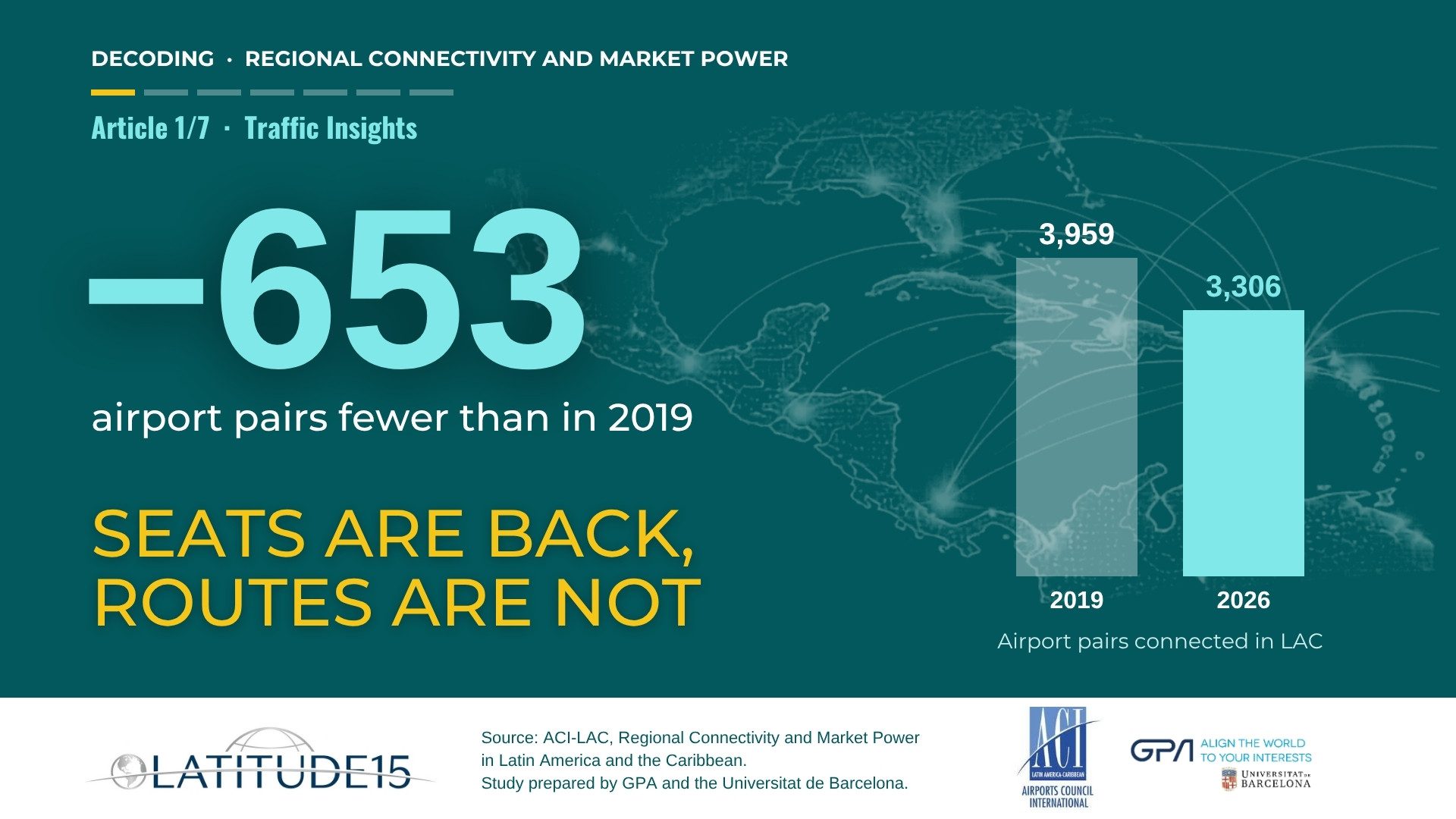

Passenger demand across Latin America and the Caribbean (LAC) weakened in June even as airlines continued to add capacity, creating a notable gap between traffic growth and seat deployment. The divergence was most pronounced in the intra-regional market, where capacity expanded despite falling demand and a sharp drop in load factor.
Capacity rises as demand contracts
Revenue passenger kilometers (RPKs) across Latin America and the Caribbean (LAC) fell 1.0% year on year in June 2026, while available seat kilometers (ASKs) increased 0.9%. The region’s average passenger load factor consequently declined 1.6 percentage points to 81.6%, according to the latest traffic report from the Latin American and Caribbean Air Transport Association (ALTA).
Passenger volumes moved in the same direction. Airlines carried 37.3 million passengers to, from and within the region during the month, down 2.3% from June 2025 and equivalent to approximately 893,000 fewer passengers. It was the region’s first monthly year-on-year contraction since 2021.
The result follows a clear loss of momentum after a strong start to the year. Passenger traffic grew 6.2% in January, 6.6% in February and 6.0% in March, before slowing to 1.0% in April, recovering to 2.7% in May and turning negative in June.
The broader first-half picture remains positive. Between January and June, LAC handled 242.8 million passengers, 3.4% more than during the same period in 2025.
June therefore represents a warning signal rather than evidence, at this stage, of a structural reversal in regional demand.
Intra-regional traffic shows the widest gap
The most significant divergence between capacity and demand appeared in international traffic within Latin America and the Caribbean (LAC).
Intra-regional passenger volumes declined 3.0% in June to approximately 4.24 million passengers. RPKs fell 2.8%, while ASKs increased 4.4%. The segment’s load factor dropped from 76.9% to 71.6%, a deterioration of 5.3 percentage points year on year.
The gap was considerably smaller elsewhere.
In domestic markets, RPKs declined 1.9% while capacity increased 0.9%, pushing load factor down 2.3 points to 78.6%. Extra-regional international traffic proved more resilient, with RPKs down just 0.4%, capacity up 0.2% and load factor decreasing 0.5 point to 84.8%.
The intra-regional June performance is particularly striking when compared with the first half of the year. From January through June, intra-regional passenger traffic remained 6.6% above 2025 levels, RPKs increased 10.5%, ASKs grew 7.3%, and load factor improved 2.3 percentage points to 80.4%.
For airlines, airports and route-development teams, the key question is therefore whether June was a short-term correction after several months of expansion or the beginning of a more sustained moderation in demand.
Large markets lose momentum
The regional result was reinforced by simultaneous weakness across its largest aviation markets.
Brazil, Mexico and Colombia, which together represented nearly 65% of regional passenger traffic, all recorded year-on-year declines in June. Combined, they carried 517,000 fewer passengers than in the same month of 2025.
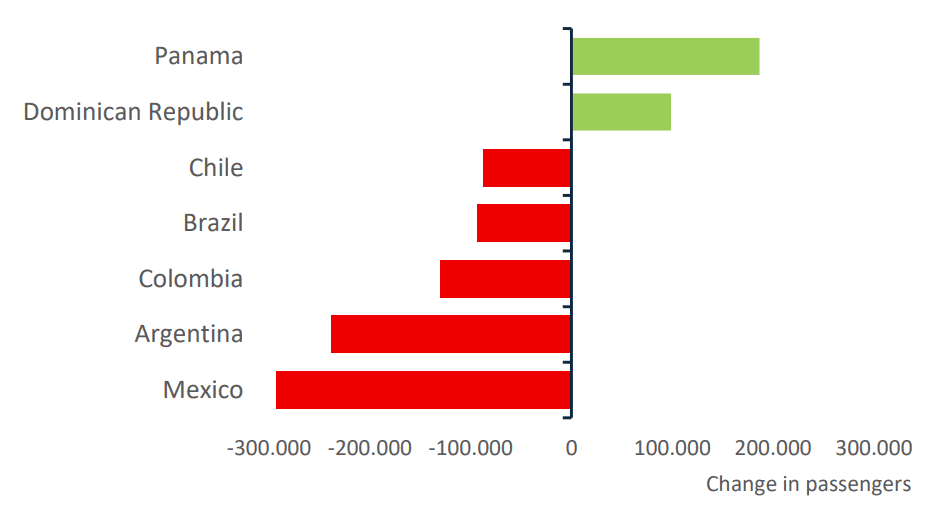
Mexico handled 9.5 million passengers, down 3.0%, marking a fourth consecutive month of contraction. Colombia carried 4.69 million passengers, down 2.7%, its first negative month of 2026. Brazil, the region’s largest market, handled 10.29 million passengers, down 0.9% and ending more than twenty consecutive months of growth.
Colombia offers a particularly clear example of the capacity-demand tension. Domestic passenger traffic declined 1.7% even as domestic capacity increased 5.9%. At the same time, four major domestic corridors contracted: Bogotá–Medellín by 8.3%, Bogotá–Cali by 12.2%, Bogotá–Cartagena by 6.6%, and Cartagena–Medellín by 12.2%.
Argentina illustrates a different configuration. Total traffic fell 10.1%, driven mainly by a 17.0% decline in domestic passengers. Airlines had already reduced domestic seats by 8.3% and flights by 10.3%, yet passenger demand fell faster than the capacity adjustment.
Regional connectivity is becoming more uneven
The aggregate decline does not mean every intra-regional corridor is weakening.
Traffic between Argentina and Brazil, the largest intra-regional country pair by volume, fell 7.5% in June. Brazil–Chile declined 8.6%, while Argentina–Chile contracted 13.3%.
Other markets continued to expand. Colombia–Dominican Republic grew 17.6%, Mexico–Panama increased 15.9%, and Colombia–Mexico remained marginally positive at 0.5%.
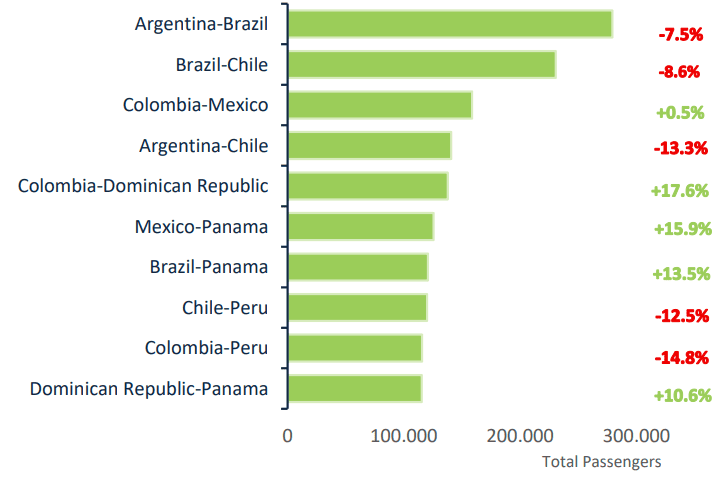
The June figures therefore point less to a uniform retreat in intra-regional connectivity than to increasingly different performances between individual markets and corridors.
That distinction matters for network planning. An aggregate regional slowdown may conceal routes where demand remains strong enough to support additional frequencies or new services, while other markets may require closer capacity management.
Network expansion continues
The softer traffic environment has not stopped airlines from opening new connections.
ALTA identified 33 routes that began regular operations in June after recording no regular service during 2025. Mexico accounted for 24 of the 33, all operating from airports other than Mexico City International Airport. Puebla added ten routes and Querétaro six.
Long-haul connectivity also expanded with the launch of Barcelona–Lima and Brussels–São Paulo, while new intra-regional services included Guatemala City–Medellín, Montego Bay–Medellín and Cap-Haïtien–Punta Cana.
The continued deployment of new capacity makes the evolution of demand and load factors particularly important to watch during the second half of the year. If weaker demand persists, the performance of newly added frequencies and routes will become an increasingly relevant indicator for both airlines and airports.
Cost pressures add another layer to that equation. ALTA reported an average regional jet fuel price of USD 3.92 per gallon for the week ending July 31, 77.3% above the 2025 average. Fuel accounted for nearly 30% of regional airlines’ operating costs in 2025.
June alone is not enough to establish a structural capacity imbalance across Latin American and Caribbean aviation (LAC). But the combination of softer demand, continued capacity growth and declining load factors — particularly in the intra-regional market — gives airlines, airports and route-development teams a clear set of indicators to watch as the market moves into the second half of 2026.