
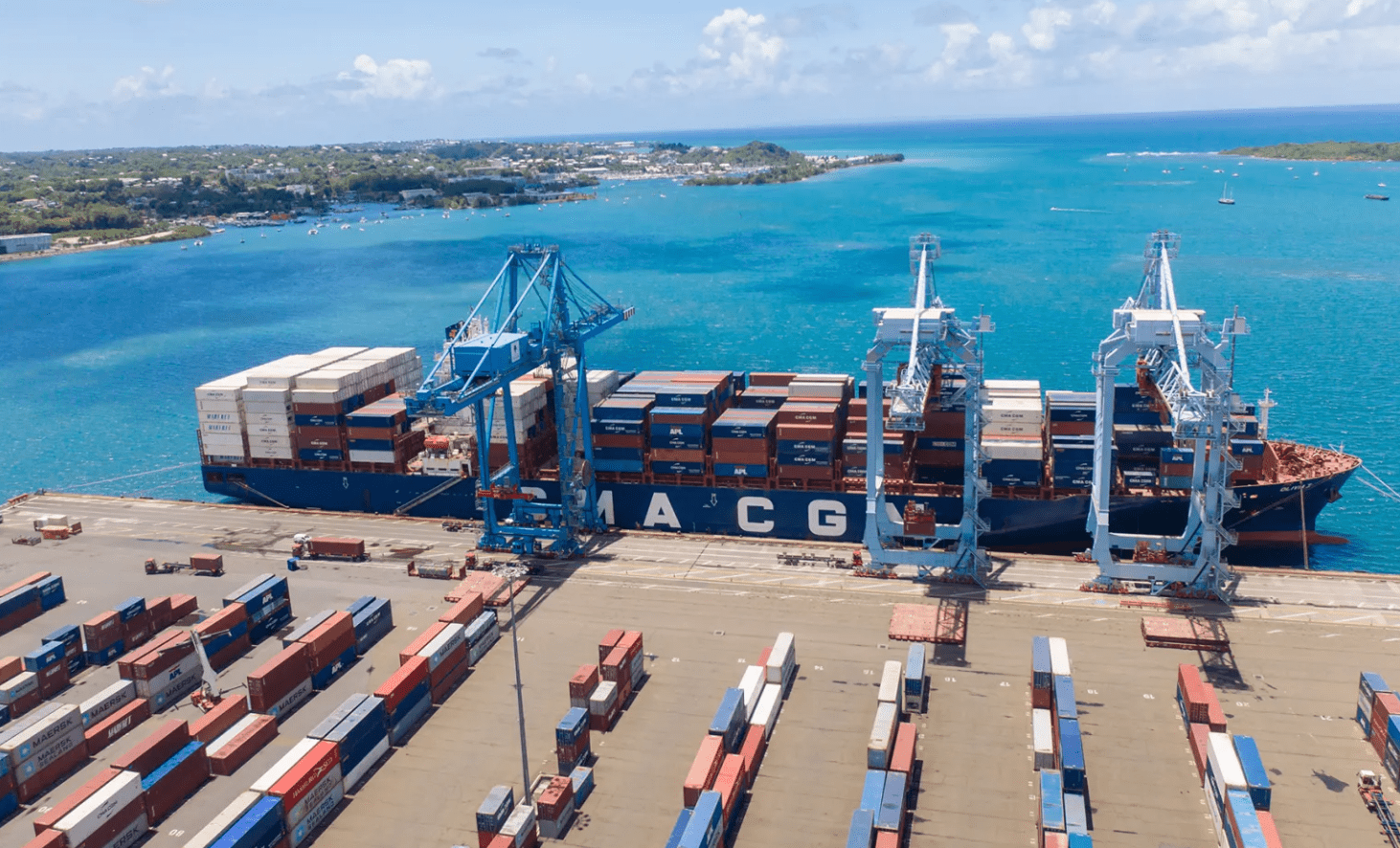
The Grand Port Maritime of Guadeloupe (GPMG) closed 2025 with largely stable volumes, but beneath that apparent continuity, structural signals point to a port preparing for deeper regional repositioning.
According to official figures released by the port authority, total cargo throughput reached 3.4 million tonnes, up 2% year-on-year. Vessel calls increased by 6%, totaling 1,117 commercial ship calls, while container traffic stood at 207,000 TEUs, also up 2%. Notably, transshipment volumes rose by 13% to 40,000 TEUs, a figure that deserves particular attention in the broader Caribbean context.
Stable Tonnage, Subtle Strategic Signals
At first glance, 2025 resembles 2024. Total throughput remains modest by regional standards, but stable. However, stability in a highly competitive Caribbean environment should not be underestimated.
The 13% increase in transshipment suggests stronger integration into regional shipping networks. While Guadeloupe is not positioned as a primary hub like Kingston or Caucedo, the growth in transshipment volumes indicates that carriers are increasingly using the port within their regional routing strategies.
Containerized cargo accounts for 48% of total traffic, with liquid bulk representing 23% and solid bulk 22%. This balanced structure provides operational resilience but also reflects the port’s dependence on import-driven flows.
Construction Materials Surge Signals Domestic Economic Activity
One of the most striking developments in 2025 was the surge in construction-related imports. Products linked to the construction sector reached 511,000 tonnes, marking a sharp 53% increase compared to the previous year.
Aggregates represented 68% of this segment, with clinker accounting for 29%. This acceleration suggests sustained or renewed infrastructure and building activity within the archipelago, positioning the port as a direct indicator of domestic economic momentum.
By contrast, energy products declined significantly. Throughput in this category fell 22% to 357,000 tonnes, reflecting either inventory adjustments, energy transition effects, or demand normalization after previous volatility.
Agricultural products remained comparatively stable, with moderate growth of 4%.
Jarry Terminal: Capacity Expansion and Operational Modernization
Infrastructure modernization remains central to the port’s strategic roadmap.
In July 2025, the Jarry terminal in Baie-Mahault was equipped with three new gantry cranes designed to handle larger vessels and improve operational efficiency. These investments aim to densify yard storage, streamline cargo flows, and adapt to a global shipping landscape increasingly dominated by higher-capacity vessels.
The port authority has also confirmed the continuation of major works under its 2024–2028 strategic plan, which includes the extension of quay 12 (scheduled for completion in 2027) and the finalization of the Jarry South land development in 2026.
Overall, nearly €230 million in investments are planned over the strategic period.
In an interview granted to Guadeloupe La 1ère, Director General Jean-Pierre Chalus emphasized that the modernization of quay infrastructure is intended to accommodate vessels with greater draft and beam, ensuring that Guadeloupe remains attractive to what he referred to as “main shipping lines.”
This emphasis on maintaining regional attractiveness suggests a defensive yet forward-looking positioning strategy in a competitive Caribbean maritime environment.
Passenger Traffic: Quantitative Softening, Qualitative Shift
Passenger traffic reached 1.1 million passengers in 2025, representing a slight 3% decline. Cruise activity recorded 125 calls, also down 3%. However, according to M. Chalus in remarks to RCI Guadeloupe, the market is evolving structurally: vessels calling in Guadeloupe are becoming larger and operating at higher occupancy rates.
Approximately 52% of cruise traffic corresponds to transit calls, while 48% relates to homeporting operations. This distribution reflects a balanced but delicate positioning within the regional cruise ecosystem.
Inter-island maritime services, by contrast, experienced a more mixed year, with some operators facing operational difficulties, leading to reduced service supply.
Security and Competitive Pressures
Beyond traffic volumes, port security remains a strategic priority. In comments to local media, Jean-Pierre Chalus acknowledged reinforced control and surveillance measures in response to trafficking concerns, developed in coordination with state authorities.
In the Caribbean basin, where maritime routes are both economic arteries and security-sensitive corridors, the ability to balance fluidity and control is critical for long-term competitiveness.
Preparing 2026: Consolidation or Regional Repositioning?
The 2025 results show a port that is stable but not static. While overall volumes remain moderate, the increase in transshipment, the surge in construction materials, and the scale of infrastructure investments suggest that the Grand Port Maritime of Guadeloupe is positioning itself for structural adaptation rather than simple continuity.
The coming years will determine whether these investments translate into stronger integration within regional shipping alliances and enhanced competitiveness against neighboring Caribbean ports. For now, the message is clear: stability in volumes masks a deeper strategic recalibration underway.


One Response