

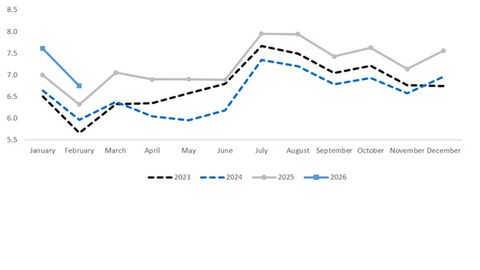
Corporación América Airports is entering 2026 with a reinforced operating and financial profile, as early traffic data confirms the momentum built over the past year, supported in part by its Latin American portfolio. February results point to a continuation of underlying trends, with international demand accelerating across several of the group’s core markets.
The airport operator reported a 6.7% year-on-year increase in passenger traffic in February 2026, reaching 6.7 million passengers across its network. This performance was largely driven by international traffic, which grew by 14.1%, while domestic traffic remained nearly flat at +0.2%.
This early-year performance follows a solid 2025, during which Corporación América Airports served 86.7 million passengers, up 9.8% compared to the previous year. Beyond traffic recovery, the group delivered a marked improvement in financial performance, with revenues excluding construction services reaching $1.75 billion and adjusted EBITDA rising to $715.5 million. Margins expanded to 40.7%, while the company maintained a strong balance sheet, with $592.8 million in cash and a net debt to EBITDA ratio of 0.7x.
Taken together, these elements suggest that the group is consolidating a more resilient and scalable operating model, combining traffic growth with improving profitability and financial discipline.
International traffic becomes the primary growth driver
The February traffic update confirms that international traffic is increasingly driving growth across the network. While domestic demand remains stable or constrained in some markets, international flows are expanding at a significantly faster pace.
In February alone, international passenger traffic increased by 14.1% year-on-year, with double-digit growth recorded in several countries, including Argentina, Italy, Brazil, Ecuador and Armenia. This contrasts with the limited growth observed in domestic segments, highlighting a shift toward more internationally oriented traffic patterns.
This trend reflects broader changes in air travel demand, where connectivity, tourism flows and medium- and long-haul routes are playing an increasingly central role in shaping airport performance.
Latin American markets play a central role in current traffic dynamics
Within this broader trend, Latin American markets play a central role in current traffic dynamics. Countries such as Argentina, Brazil, Uruguay and Ecuador all contributed positively to the group’s February performance, each reflecting distinct market conditions.
While growth is not exclusive to the region, several of the most significant contributions to traffic expansion originate from these markets, particularly on international routes connecting major regional and intercontinental destinations.
At the same time, domestic traffic trends remain more subdued in certain countries, reinforcing the idea that future growth is increasingly tied to international connectivity.
Argentina stands out as a key growth contributor
Argentina stands out as one of the most significant contributors to recent performance. The country accounted for more than half of total traffic growth in February and over two-thirds of the increase in international traffic.
Passenger traffic in Argentina rose by 5.8% year-on-year during the month, supported by a strong 17.8% increase in international passengers. This performance was achieved despite operational disruptions, including a nationwide 24-hour strike in mid-February and temporary fleet constraints at Aerolíneas Argentinas.
Demand remained particularly strong during peak travel periods. Traffic during the Carnival season increased by 27% compared to 2025, and February 20 marked the highest number of international passengers handled in a single day across the network.
These elements point to a market that remains exposed to short-term volatility, particularly in the domestic segment, while continuing to play a strategic role in international traffic growth.
A network shaped by diverse regional dynamics
Beyond Argentina, other markets within the portfolio contributed to overall performance, each with its own dynamics.
Brazil recorded an 8.2% increase in passenger traffic, supported by both domestic and transit flows, despite ongoing challenges in the aviation environment. Uruguay continued to benefit from strong seasonal demand, with increased flight frequencies and the reintroduction of routes linking Montevideo and Punta del Este to key regional hubs.
In Ecuador, passenger traffic rose by 8.6%, driven in part by international routes, particularly those connecting to Europe, even as local conditions—including security concerns and relatively high airfares—continued to influence domestic demand.
Taken together, these developments underline the diversity of operating environments across the group’s portfolio, while confirming the importance of regional and international connectivity.
Strengthening profitability beyond traffic growth
The group’s 2025 financial results provide additional insight into the evolution of its business model. Revenue growth outpaced passenger traffic, reflecting improvements in both aeronautical and non-aeronautical activities.
In the fourth quarter, revenues excluding construction services increased by 17.3% year-on-year, while adjusted EBITDA rose by nearly 40%, with margins expanding by more than seven percentage points. This indicates improved operating leverage and the group’s ability to capture additional value from passenger flows.
This dynamic suggests that Corporación América Airports is enhancing revenue per passenger through stronger commercial execution, including retail, services and ancillary activities across its airport network.
Long-term positioning supported by strategic developments
At the same time, the group continues to reinforce its long-term positioning through a series of strategic developments.
Recent initiatives include the extension of its airport concession in Armenia through 2067, supported by a $425 million investment program, as well as the rebalancing and extension of the Galápagos concession in Ecuador. In parallel, the company is expanding into new markets, including projects in Angola and Iraq.
These developments contribute to strengthening long-term visibility and securing future growth opportunities, while maintaining a diversified portfolio.
A regional platform with global reach
The combination of sustained traffic growth, improving profitability and expanded concession visibility suggests that Corporación América Airports is entering a new phase in its development.
February 2026 traffic figures confirm that the trends observed in 2025 remain in place. International traffic continues to act as a key driver, several Latin American markets contribute significantly to performance, and financial indicators point to a more efficient operating structure.
In this context, the group is progressively positioning itself as a regional platform with global reach, leveraging its established presence while expanding selectively into new markets with long-term potential.