Aruba Airport Authority (AAA) entered 2025 facing a challenge increasingly familiar across tourism-driven aviation markets: passenger growth is rising faster than existing airport infrastructure can comfortably absorb. At Queen Beatrix International Airport (AUA), that pressure is now accelerating the execution timeline of Gateway 2030, the airport’s long-term transformation program designed to expand capacity, modernize passenger processing and strengthen operational resilience.
The airport handled 3.41 million passengers in 2025, up from 3.29 million a year earlier, while aircraft movements also increased to 32,397. More than 45 destinations are now served nonstop from Aruba, reinforcing the island’s growing role as a Caribbean leisure gateway.
But behind those growth figures lies a more structural reality: Aruba Airport is entering a new operational scale, one that requires faster infrastructure delivery, tighter operational coordination and more technology-driven passenger management.
Passenger growth is reshaping Aruba Airport’s infrastructure priorities
AAA’s 2025 report repeatedly points to a central issue shaping the airport’s strategy: traffic growth is now exceeding earlier forecasts. According to interim CEO James Fazio, rising passenger volumes are creating “capacity challenges that demand bold action,” pushing the airport to accelerate several elements of the Gateway 2030 program.
That pressure is closely tied to Aruba’s continued strength as a premium leisure destination in the Caribbean. Sustained tourism demand continues to support both aeronautical and non-aeronautical revenue streams, while simultaneously placing additional strain on terminal operations, passenger flows and airside infrastructure.
The airport’s operational environment is becoming increasingly complex. Growth is no longer simply a commercial success metric; it is now a capacity management issue. This transition is visible throughout the report, from passenger processing investments to accelerated gate expansion and revised construction sequencing.
Financial indicators also reflect this transition phase. While EBITDA remained strong at AWG 99.9 million in 2025, operational expenditure increased faster than revenue, with the OPEX-to-revenue ratio rising to 55.1% from 52.1% a year earlier. The figures illustrate the operational cost of sustaining growth while simultaneously transforming core infrastructure.
Gateway 2030 moves into accelerated execution
Gateway 2030 is no longer presented as a gradual modernization initiative. In 2025, the project moved into a more urgent execution phase aimed at unlocking additional capacity before operational bottlenecks intensify further.
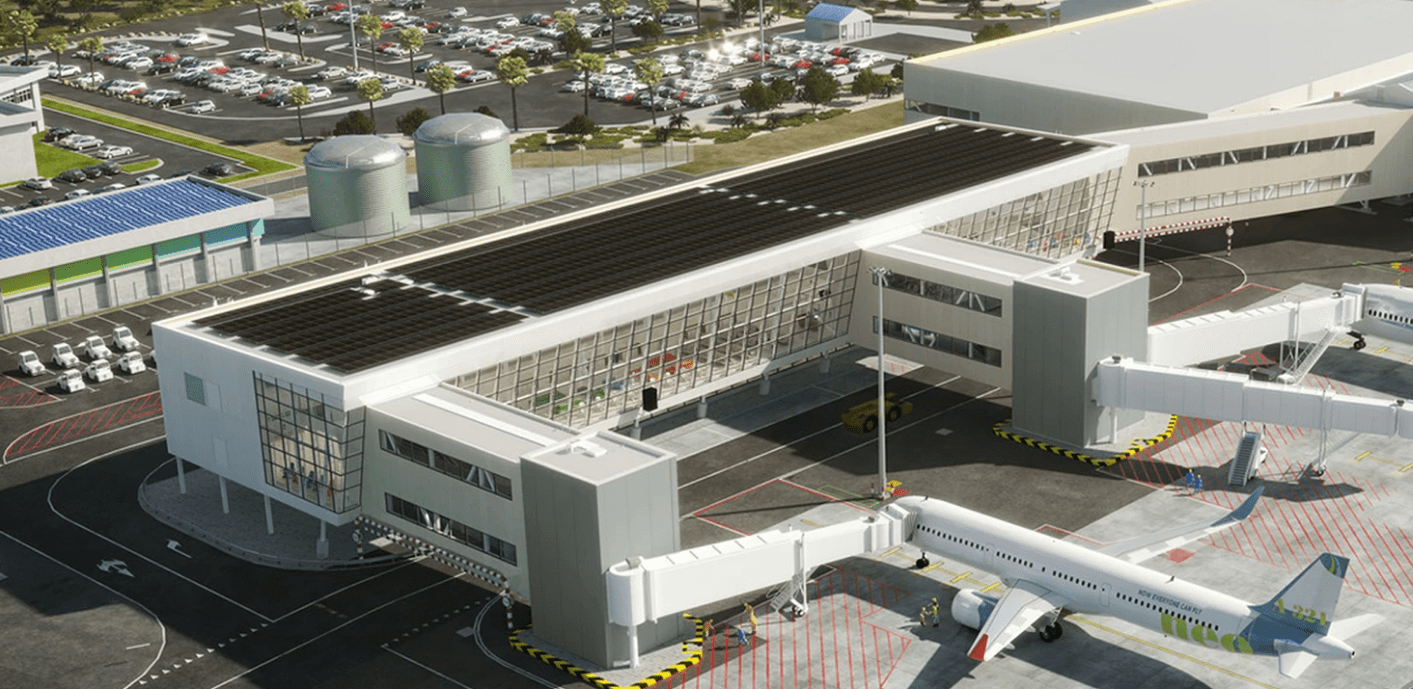
Phase 1A became operationally ready in April 2025, introducing a new check-in hall and a new baggage handling system designed to improve passenger throughput and modernize departures processing. Training exercises and operational simulations were conducted throughout the first quarter to prepare airport and airline staff for the transition into the new facilities.
Meanwhile, Phase 1B has regained momentum after earlier delays. The expansion phase, which includes three additional gates, is now targeted for early completion in December 2026. At the same time, AAA accelerated planning activities for Phase 2, with enabling works scheduled to begin in May 2026 ahead of larger-scale construction activity planned for 2026-2027.
By the end of 2025, Gateway 2030 Phase 1B had reached 29% physical progress.
The acceleration reflects a broader shift in airport planning priorities across tourism-dependent island markets. Infrastructure projects that were initially framed around long-term modernization are increasingly becoming immediate operational necessities as passenger demand rebounds faster than legacy airport systems were designed to handle.
Maintaining operations during expansion becomes a strategic challenge
One of the most significant aspects of Aruba Airport’s transformation is that the airport must continue operating under sustained traffic pressure while major construction and rehabilitation works remain ongoing.
That balancing act became increasingly visible throughout 2025.
AAA introduced a Passenger Flow Control system to optimize U.S.-bound passenger processing during Gateway 2030 construction works, while operational teams implemented daily coordination briefings and strengthened cross-department operational management to maintain service continuity.
Operational strain also appeared in customer satisfaction metrics. During the first half of 2025, Airport Service Quality (ASQ) scores declined, with satisfaction scores falling to 4.02 in Q1 and 4.00 in Q2 as construction activity and operational pressure intensified.
However, satisfaction indicators improved again in the second half of the year as operational adjustments, new facilities and passenger processing technologies gradually stabilized the experience. ASQ overall satisfaction rose to 4.18 in Q3 and 4.26 in Q4.
Airside infrastructure works also required significant operational coordination. The rehabilitation of Taxiway Golf, originally constructed in 1997, extended the asset’s lifespan by another 20 years while forcing temporary backtracking operations on the runway during parts of the project. The operation demanded close coordination between Aruba Airport Authority, Air Navigation Services Aruba (ANSA) and airline partners to maintain safe aircraft movements during construction.
For Caribbean airports operating with limited physical expansion flexibility, maintaining operational continuity during infrastructure upgrades is increasingly becoming a strategic capability rather than simply a project management exercise.
Aruba Airport is repositioning itself as a future-ready Caribbean hub
Beyond physical expansion, Aruba Airport’s 2025 strategy also reflects a broader repositioning toward a more digitalized, automated and sustainability-oriented airport model.
During the year, AAA expanded biometric passenger processing in partnership with U.S. Customs and Border Protection and iProov through the deployment of Enhanced Passenger Processing (EPP) technology at Aruba’s U.S. Pre-Clearance facility. The system uses facial biometric verification to streamline passenger processing and reduce reliance on physical document checks.
Additional operational technologies introduced during the year included:
- new biometric e-gates,
- self-service baggage drop units,
- upgraded passenger processing systems,
- and expanded cybersecurity and IT modernization initiatives.
At the same time, sustainability remains central to the airport’s long-term positioning strategy. Aruba Airport renewed its Airport Carbon Accreditation Level 3 certification in 2025 and continued implementing its ESG framework and Environmental Management System.
One of the year’s most symbolic milestones was the LEED Gold certification of the new check-in hall under Gateway 2030 Phase 1A, making it the first terminal building in the Caribbean to achieve the distinction.
Together, these initiatives show that Aruba Airport’s transformation is no longer limited to infrastructure expansion alone. The airport is simultaneously reshaping passenger processing, operational resilience, sustainability governance and long-term airport positioning.
A Caribbean case study in airport transformation under growth pressure
Aruba Airport’s 2025 trajectory highlights a broader shift taking place across several tourism-driven Caribbean aviation markets. Passenger recovery has evolved into structural growth, forcing airports to rethink infrastructure timelines, operational models and long-term scalability much faster than initially anticipated.
At Queen Beatrix International Airport, Gateway 2030 is becoming more than a modernization program. It is increasingly serving as the operational framework through which Aruba attempts to absorb sustained tourism growth, maintain passenger experience standards and position itself as a more resilient and future-ready Caribbean aviation hub.