

The latest annual results from Airport Carbon Accreditation, released by Airports Council International, provide an updated snapshot of how airports worldwide are progressing on carbon management and decarbonisation strategies.
According to the announcement, a total of 590 airports across 91 countries were accredited between May 2024 and May 2025, with 104 airports joining the programme for the first time. Together, these airports accounted for 53.6% of global passenger traffic, suggesting that more than half of the world’s air travellers passed through facilities actively engaged in emissions management .
In parallel, the programme reports a reduction of 542,559 tonnes of CO₂e in Scope 1 and Scope 2 emissions, representing an 8.1% decrease over the reporting period . Improvements in operational efficiency are also highlighted, with emissions per passenger falling to 1.54 kg of CO₂e and emissions per traffic unit to 1.34 kg of CO₂e.
At the highest level of certification, 21 airports have now reached Level 5, indicating that they have achieved net zero emissions for sources under their direct control and are engaging with broader value chain emissions towards longer-term targets .
As outlined in the accompanying annual report, Airport Carbon Accreditation continues to position itself as a structured, performance-based framework guiding airports through progressive stages of carbon management, from initial footprinting to full net zero alignment .
What this signals for the sector
Beyond headline figures, the results point to a gradual but tangible shift in how airports approach decarbonisation—not as a standalone environmental initiative, but as a core component of operational and strategic planning.
The programme’s tiered structure, ranging from Level 1 to Level 5, reflects increasing levels of maturity in carbon management. This progression indicates that a growing number of airports are moving beyond measurement and incremental reductions towards integrated, long-term decarbonisation pathways aligned with international climate objectives.
Another notable signal lies in the apparent decoupling of traffic growth from emissions performance. Despite the continued recovery and expansion of passenger traffic, the reported decrease in emissions per passenger suggests that efficiency gains and targeted measures are beginning to offset part of the environmental impact associated with growth.
At the same time, the emphasis on Scope 3 emissions—those generated by third-party activities across the airport ecosystem—highlights the increasing complexity of airport decarbonisation. The initiative is presented as encouraging broader stakeholder engagement, positioning airports as coordinators of climate action across airlines, ground handlers, and other on-site operators.
Taken together, these elements suggest that Airport Carbon Accreditation is evolving from a certification mechanism into a strategic framework shaping how airports structure their transition to net zero.
LAC region gains momentum, but gaps remain
Within this global dynamic, Latin America and the Caribbean show a growing level of participation, although with distinct characteristics compared to more mature regions.
According to the report, 103 airports in the region are currently accredited under the programme , representing a significant share of the global total. The region also recorded 20 new certifications during the reporting period, indicating continued engagement with the programme.
However, the distribution across certification levels suggests that many airports in Latin America and the Caribbean are still positioned in the intermediate stages of carbon management. While participation is increasing, progression towards the highest levels of accreditation—particularly those requiring full net zero alignment—remains more limited.
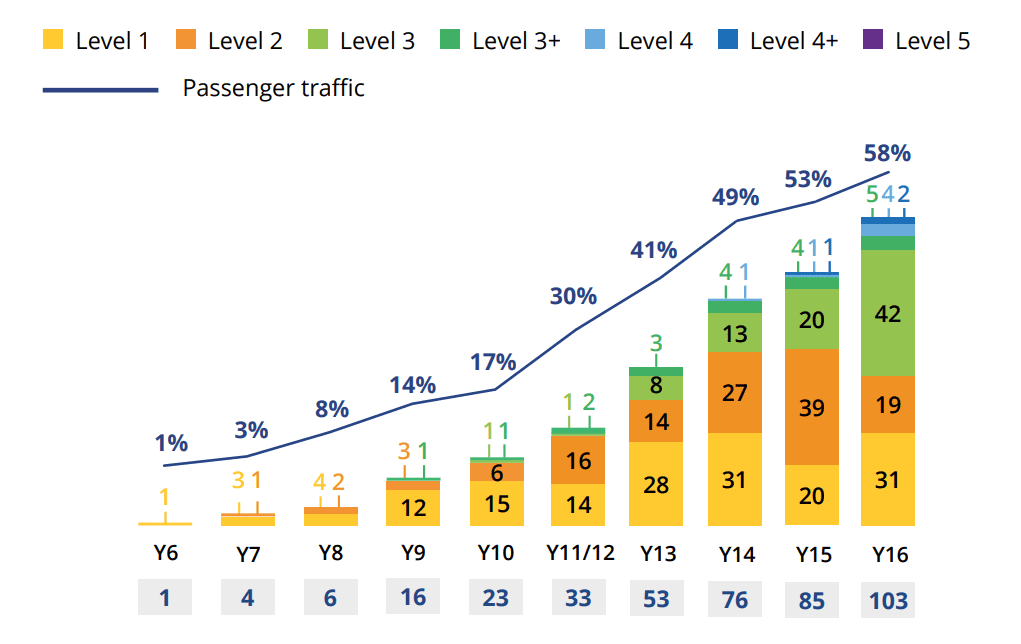
This reflects broader structural factors, including varying regulatory environments, investment capacities, and infrastructure constraints. At the same time, the growing adoption of the programme indicates a convergence towards global standards, which could play a role in strengthening the region’s positioning in terms of sustainability and international connectivity.
In that sense, Airport Carbon Accreditation plays a dual role in the Latin American and the Caribbean. It supports environmental progress and reinforces strategic positioning in a competitive aviation landscape.
Between ambition and industry realities
Commenting on the results, Olivier Jankovec, Chair of the Airport Carbon Accreditation Board, pointed to the broader context in which these developments are taking place:
“These headline figures and the detailed content of this report are both reassuring and encouraging, given the new reality of the ‘contested transition’ – which is seeing political pushback against climate action gaining ground.”
He also emphasised the strategic dimension of climate action for airports :
“Airports are well aware that no matter what, their license to operate and grow will remain conditional on the decarbonisation of aviation.”
As presented in the press release, the initiative is positioned as a global benchmark for carbon management in the airport sector, aiming to provide a common framework while allowing flexibility across different regional and operational contexts.