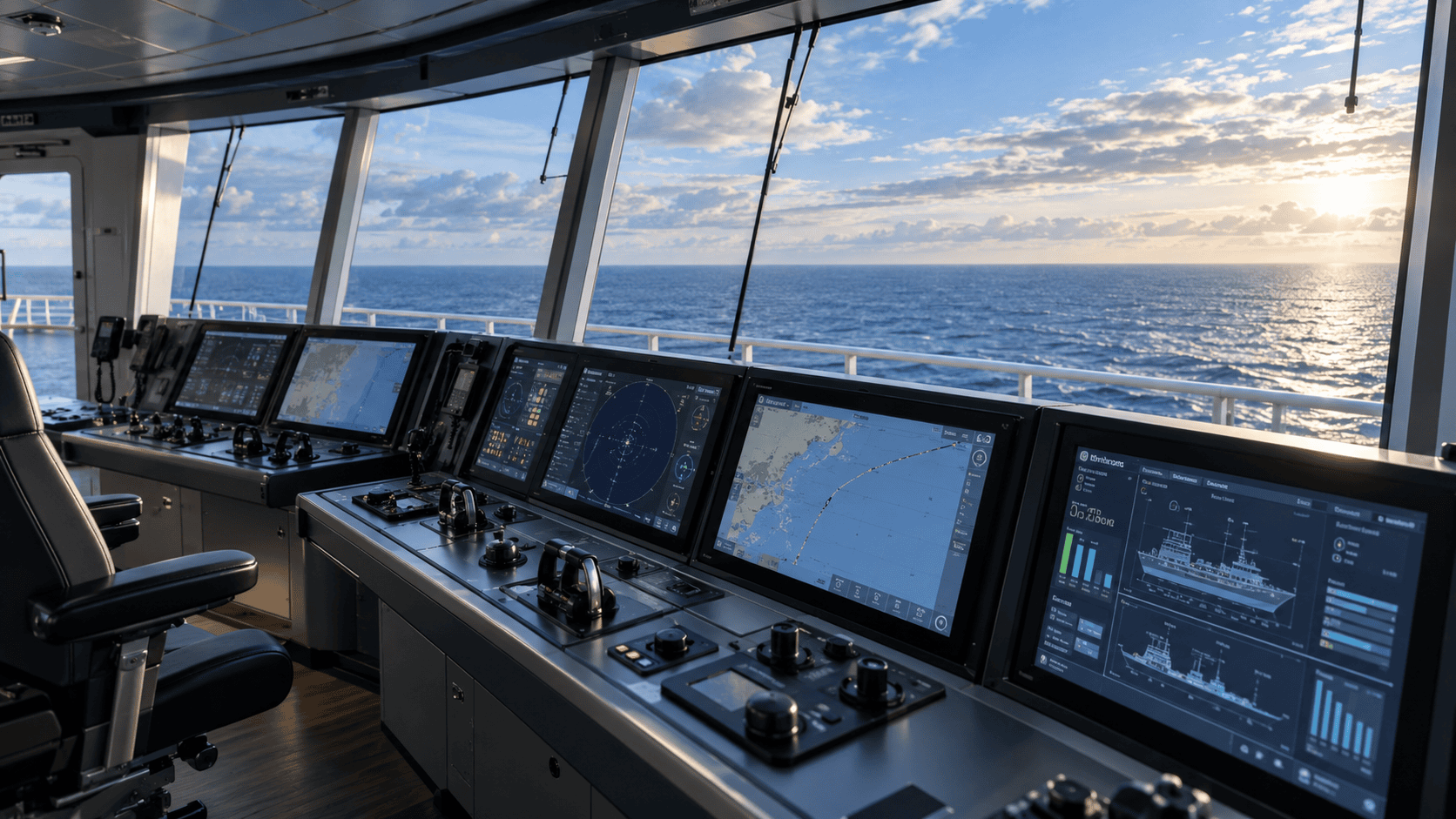
Artificial intelligence is becoming more visible across the cruise industry in 2026, but some of its most consequential applications remain out of sight. Predictive maintenance, route optimisation, onboard energy management and food forecasting are showing where AI can support day-to-day operations, while recent deployments by MSC Cruises and Virgin Voyages illustrate how selected applications are beginning to move beyond the pilot stage.
The distinction matters because cruise Artificial Intelligence is developing along several tracks at once. Virgin Voyages said in March 2026 that it had expanded from just over 50 active AI agents in October 2025 to more than 1,500 across shoreside and shipboard workflows, while MSC Cruises is taking a passenger-facing conversational assistant across its fleet. Neither development means that ships are becoming autonomous. Instead, the emerging picture is one of AI being deployed to process information, identify patterns and support decisions at increasing scale.
Writing in FCCA’s Travel & Cruise Magazine – Second Quarter 2026, Aaron Saunders draws an important distinction between the highly visible uses of artificial intelligence and those operating “behind the scenes.” Saunders identifies fuel management, predictive maintenance, food-waste forecasting, provisioning, training and security among the areas where Artificial Intelligence can support cruise operations, while stressing that complex service and maritime functions continue to depend on human expertise.
Predictive tools are moving closer to ship operations
Maintenance provides one of the clearest examples of that shift. Saunders argues that artificial intelligence can help anticipate maintenance requirements, allowing vessels to operate more efficiently and within environmental and technical requirements rather than waiting for problems to become disruptive.
A recent deployment gives that idea an operational context. In April 2026, maritime technology company Wärtsilä signed a ten-year lifecycle agreement with Margaritaville at Sea covering Paradise, Islander and the forthcoming Beachcomber. The Beachcomber agreement includes Wärtsilä’s Expert Insight solution, which combines real-time monitoring and predictive analytics to support maintenance and vessel performance.
Wärtsilä’s approach is significant because it illustrates what AI-supported maintenance currently looks like in practice. Expert Insight uses vessel data and anomaly detection to identify abnormal operating behaviour, but the process does not end with an algorithm: technical specialists assess the information and help determine what action should follow. Artificial Intelligence therefore acts as an additional diagnostic layer rather than an autonomous engineering authority.
Royal Caribbean Group has applied similar data-driven methods to routing and energy management. The company says its route-optimisation systems use machine learning and predictive analytics, processing billions of onboard data points each day to provide real-time guidance on efficient vessel operation and routing. Royal Caribbean Group has also used its in-house Data and Artificial Intelligence team to analyse hotel power consumption, identify abnormal energy use and detect deviations from expected performance.
The operational pattern emerging from these systems is relatively consistent: predict, detect, optimise and recommend. The value comes less from replacing an officer or engineer than from reducing the amount of complex data that operational teams must manually interpret before making a decision.
The floating hotel is becoming data-driven too
Cruise operations extend far beyond navigation and propulsion. A large cruise ship simultaneously operates accommodation, restaurants, kitchens, entertainment facilities and extensive technical systems, making hotel-side efficiency another important field for data-driven decision making.
Aaron Saunders highlights food operations as one of the practical areas where artificial intelligence can contribute. The FCCA article describes systems capable of predicting which dishes and beverages are likely to be consumed, helping operators improve provisioning and reduce food waste. Saunders notes that calculations historically handled manually or through extensive data entry can increasingly be carried out dynamically.
Royal Caribbean Group provides a concrete example. Its WIN on Waste programme uses artificial intelligence to analyse consumption patterns and operational data, with the aim of improving inventory and meal planning before excess food is produced. In 2025, the group also described the Food Production Management System aboard Star of the Seas as integrating inventory, food production and point-of-sale information, with Artificial Intelligence expected to help optimise those processes further.
The economics are straightforward. Overproduction generates waste and unnecessary cost, while underproduction can affect service and complicate supply management aboard a vessel carrying thousands of passengers. Food forecasting therefore shows how an environmental objective can also become an operational and logistics issue.
Cruise AI is beginning to move beyond pilots
Some of the strongest evidence of change in 2026 comes from the scale of enterprise deployment rather than from one individual maritime application.
Virgin Voyages reported more than 1,500 active AI agents in March 2026, up from approximately 50 when its Google Cloud partnership began in October 2025. The company says the agents are used across marketing, revenue, sales, crew training, commercial operations, Sailor Services and logistics, with deployments spanning shoreside and shipboard functions. Virgin Voyages also reported a 60% average reduction in content-production time and a 75% reduction in time from insight to action. Those are company-reported results and relate to the wider business rather than vessel operations alone.
MSC Cruises is scaling a different type of application. The company launched MSC Concierge in May 2026 as a conversational AI service integrated into MSC for Me. The platform supports more than 90 languages and can answer questions, make restaurant and spa reservations, book shore excursions and handle other onboard requests. MSC said its pilot involved more than 170,000 guests exchanging more than one million messages, with a reported 93% satisfaction score before fleetwide rollout.
MSC Cruises CEO Gianni Onorato presented the system as a way to combine digital assistance with crew hospitality rather than substitute one for the other. That positioning mirrors the wider pattern emerging across the industry: Artificial Intelligence is being introduced where it can remove friction or process information quickly, while human interaction remains central to service delivery.
Scaling AI still requires selection and human judgment
Cruise operators are nevertheless discovering a substantial difference between testing an AI use case and putting it into production.
In September 2025, Carnival Cruise Line CIO Sean Kenny told Fortune that the company had piloted more than 100 generative-AI projects but had only six in full production. Carnival Cruise Line established an Artificial Intelligence governance body to determine which use cases should receive funding and when a pilot was mature enough for wider deployment.
Carnival Cruise Line’s experience provides an important counterweight to headline numbers about Artificial Intelligence adoption. A cruise company can experiment with dozens of applications, but fleet-scale or enterprise deployment raises additional questions around reliability, integration, cybersecurity, data quality and return on investment.
Aaron Saunders reaches a similar conclusion from the operational side. The FCCA article notes that artificial intelligence may alert an officer to changing weather conditions, but it cannot replace the technical expertise required to bring a vessel safely into port. The same principle applies to hotel and service functions: AI can assist crew members without replicating the human judgment and interaction that their roles require.
Cruise Artificial Intelligence in 2026 is therefore becoming less about autonomous ships than about operational assistance at scale. The most mature applications are helping operators detect problems earlier, process larger volumes of data, forecast demand and improve the use of energy and resources. For cruise companies, the more important question is increasingly not whether Artificial Intelligence can be used, but which operational decisions benefit enough from it to justify deployment — and which should remain firmly human.