The future of aviation will not be defined solely by larger passenger volumes or new aircraft technologies. According to the International Civil Aviation Organization’s (ICAO) Strategic Plan 2026–2050, one of the industry’s most significant challenges will be managing an increasingly complex airspace environment.
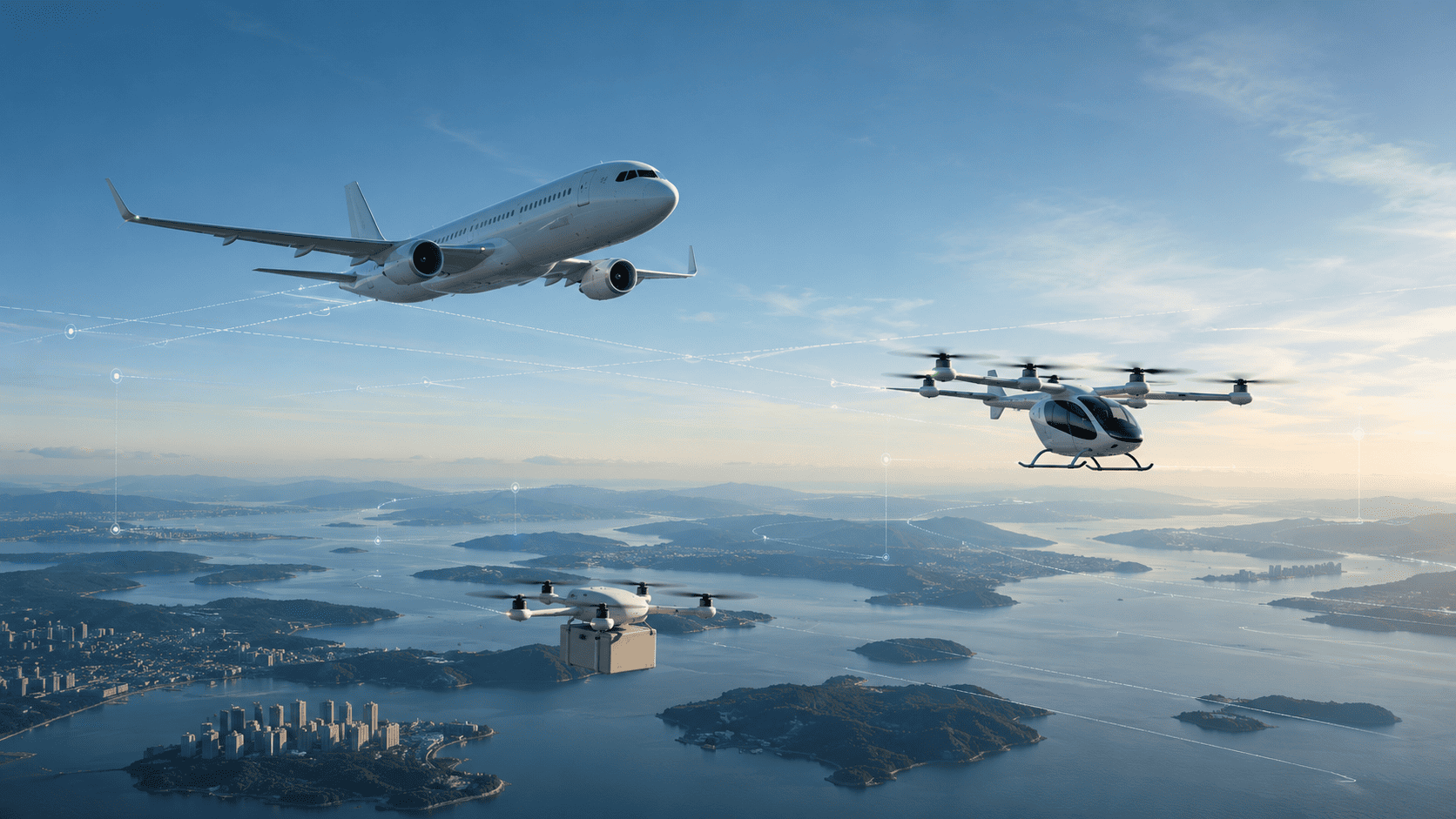
By mid-century, conventional commercial aircraft are expected to share airspace with a growing range of new users, including drones, advanced air mobility (AAM) vehicles, highly automated aircraft, high-altitude operations and commercial space transport activities. At the same time, global passenger traffic is projected to increase from 4.6 billion passengers in 2024 to 12.4 billion by 2050.
For ICAO, ensuring that these diverse operations can coexist safely and efficiently is becoming a strategic priority.
ICAO anticipates a far more complex airspace environment
Within its Strategic Plan, ICAO identifies the integration of emerging aviation technologies and new entrants into the aviation ecosystem as one of the major challenges facing international civil aviation.
The organization notes that the pace of technological innovation is accelerating rapidly and that future aviation systems will need to accommodate operational models that extend beyond traditional commercial aviation.
This evolution is expected to increase the complexity of airspace management significantly.
Historically, air traffic management systems were designed primarily around conventional aircraft operating within established airspace structures. Future systems will need to coordinate a broader range of vehicles, operating characteristics and mission profiles while maintaining the same high levels of safety and efficiency.
ICAO therefore emphasizes the need for regulatory frameworks, operational procedures and technological capabilities capable of adapting to this changing environment.
Artificial intelligence is emerging as a strategic aviation tool
Among the technologies highlighted by ICAO, artificial intelligence (AI) and advanced data capabilities are expected to play an increasingly important role in the future aviation ecosystem.
The Strategic Plan identifies AI, Big Data and digital technologies as tools that can support safer, more efficient and more sustainable aviation operations.
While the document does not prescribe specific use cases, the organization clearly signals that digital transformation will become an essential component of future aviation development.
The growing volume of operational data generated by aircraft, airports, air navigation systems and connected infrastructure is creating opportunities for more advanced decision-making, predictive capabilities and system optimization.
For aviation stakeholders, the challenge will be ensuring that technological innovation develops within internationally coordinated frameworks that maintain safety, interoperability and trust.
Drones and advanced air mobility are becoming part of the aviation system
ICAO’s strategy explicitly references the growing importance of unmanned aircraft systems (UAS), advanced air mobility platforms and highly automated aircraft.
These technologies represent a significant departure from traditional aviation operations.
Unlike conventional airline traffic operating along established routes and procedures, many future AAM and drone operations may occur at lower altitudes, in urban environments or within new categories of airspace.
The challenge is therefore not simply technological.
It involves developing rules, procedures and operational concepts that allow new entrants to integrate safely into existing aviation systems without compromising efficiency or safety.
ICAO views this integration process as a critical component of future aviation development and a key area requiring international cooperation.
Future airspace will extend beyond traditional aviation
The Strategic Plan also points to the emergence of activities that were largely absent from previous generations of aviation planning.
ICAO specifically highlights commercial space transport and high-altitude operations among the developments likely to influence future airspace management.
These activities introduce new operational requirements and coordination challenges for aviation authorities, air navigation service providers and regulators.
The evolution reflects a broader transformation occurring across the aerospace sector, where boundaries between aviation, unmanned systems and space-based operations are becoming increasingly interconnected.
For policymakers and regulators, managing this convergence will require greater coordination across sectors that have historically operated under separate frameworks.
CNS/ATM modernization becomes increasingly important
As airspace complexity increases, ICAO identifies modernization of communication, navigation, surveillance and air traffic management systems as a critical enabler of future growth.
The organization highlights the importance of advanced technologies, including satellite-based systems, digital infrastructure and modernized operational capabilities.
These systems form the foundation upon which future aviation operations will depend.
Without continued modernization, accommodating rising traffic volumes alongside new categories of airspace users could become significantly more difficult.
ICAO therefore links future aviation development to the ability of Member States and industry stakeholders to deploy and maintain increasingly sophisticated CNS/ATM capabilities.
Cybersecurity is becoming part of aviation safety
As aviation systems become more digitalized, ICAO also recognizes cybersecurity as an increasingly important consideration.
The organization identifies cyber threats among the evolving risks facing international aviation and highlights the need to strengthen resilience across digital infrastructure and operational systems.
Protecting connected aviation ecosystems will become increasingly important as data exchange, automation and digital technologies continue to expand throughout the sector.
The challenge is integration, not technology
One of the strongest messages emerging from ICAO’s Strategic Plan is that technology alone will not determine the success of future aviation systems.
Many of the technologies shaping aviation’s future already exist or are advancing rapidly. The greater challenge lies in integrating them safely, efficiently and consistently across the global aviation network.
Achieving that objective will require international standards, regulatory harmonization, technological interoperability and continued cooperation among governments, regulators, air navigation service providers and industry stakeholders.
As aviation moves toward 2050, the sector will not simply be managing more aircraft. It will be managing a far more diverse and technologically complex airspace environment than ever before. For ICAO, preparing for that reality has already become a strategic priority.