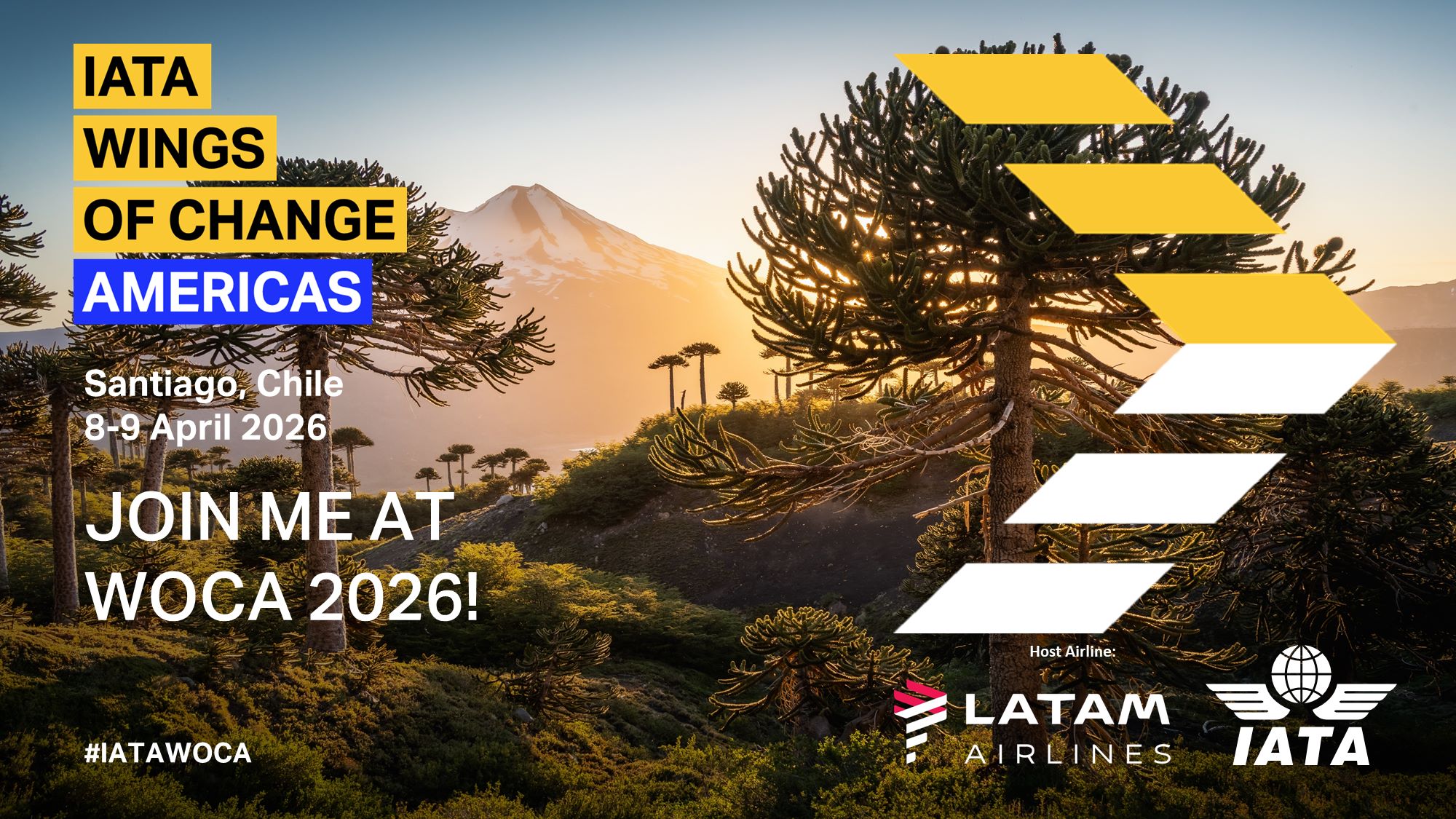
When industry leaders gather in Santiago de Chile on 8–9 April for the 16th edition of IATA’s Wings of Change Americas (WOCA), the event will represent more than a recurring regional conference. It arrives at a pivotal juncture for aviation across Latin America and the Caribbean — a moment defined by regulatory recalibration, supply chain reconfiguration, infrastructure expansion, and mounting sustainability pressures.
Hosted by LATAM Airlines Group under the theme “Beyond Borders – Aviation as a Catalyst for Economic Transformation,” WOCA 2026 reflects an industry increasingly aware that connectivity is no longer a standalone operational objective. It is an economic instrument.
Aviation as a Macroeconomic Lever
The scale of aviation’s regional footprint underscores why policy alignment has become central. According to IATA, the sector supports more than 8.3 million jobs across Latin America and the Caribbean and contributes approximately USD 240 billion to GDP (2023). Projections suggest that by 2043, these figures could nearly double to 15 million supported jobs and USD 500 billion in GDP contribution.
Such numbers frame aviation not merely as a transport service, but as an infrastructure layer underpinning trade, tourism, foreign investment, and territorial competitiveness. In emerging and geographically fragmented markets, air connectivity often functions as an equalizer — linking peripheral economies to global value chains.
WOCA’s emphasis on strategic collaboration between aviation stakeholders and government authorities signals a recognition that growth will depend less on capacity expansion alone and more on coordinated economic planning.
Policy Dialogue Returns to the Forefront
Notably, WOCA 2026 will be the first aviation industry event in Chile to welcome representatives of the country’s newly elected administration. This detail carries weight.
Across the region, aviation faces increasing regulatory complexity — from consumer protection frameworks and taxation debates to slot allocation rules and sustainability mandates. The Regulatory Roundtable at WOCA, focused on balancing consumer protection and industry viability, reflects mounting tension between affordability, competitiveness, and operational sustainability.
For airlines operating in structurally high-cost environments, regulatory coherence has become a competitiveness variable. The Santiago gathering provides a platform for recalibration — an opportunity to align public policy with long-term connectivity goals.
Infrastructure and the Race for Regional Positioning
The Airport Executive Roundtable — “Powering the Next Generation of Infrastructure in the Americas” — further reinforces a structural shift underway. Airports in Latin America and the Caribbean are no longer simply throughput facilities. They are positioning themselves as economic platforms.
Capacity expansion, modernization of terminals, digitization of passenger flows, and integration with logistics corridors are becoming central to territorial strategy. As nearshoring and supply chain diversification reshape global trade patterns, infrastructure resilience and scalability will determine which hubs capture incremental traffic.
Santiago’s selection as host city is therefore symbolic. Chile has positioned itself as one of the region’s more stable aviation markets, with a relatively mature regulatory environment and a strong flag carrier in LATAM Airlines. The event effectively places the country at the center of a regional connectivity dialogue.
Cargo Moves to the Strategic Core
One of the most telling agenda items is the dedicated focus on air cargo and logistics. Historically treated as a complementary segment, cargo now occupies a strategic position in regional development discussions.
Supply chain fragmentation, the rise of e-commerce, and industrial nearshoring across the Americas have elevated the role of efficient air freight networks. For export-oriented economies — from pharmaceuticals to high-value perishables — cargo reliability translates directly into trade competitiveness.
By integrating cargo into the core conference agenda, WOCA acknowledges that connectivity is multidimensional. Passenger flows alone do not define aviation’s economic impact.
Technology and AI: From Experimentation to Implementation
The session titled “Code, Cloud, Cabin – AI’s Triple Play in Aviation” illustrates another inflection point. Artificial intelligence is no longer confined to pilot projects or customer service chatbots. It is reshaping revenue management, predictive maintenance, demand forecasting, operational efficiency, and passenger personalization.
In markets where margins remain thin and volatility high, technological adoption can serve as a structural equalizer. Digital infrastructure may become as critical as physical runways in determining competitive advantage.
The discussion around AI at WOCA suggests that Latin American aviation is accelerating its digital transition — not as a trend, but as an operational necessity.
Sustainability Under Structural Constraints
Sustainability remains one of the most complex challenges facing the region. The Sustainability & Innovation panel will address barriers toward achieving net-zero carbon emissions — a particularly sensitive issue in emerging markets where financing constraints and uneven access to Sustainable Aviation Fuel (SAF) complicate decarbonization pathways.
For Latin America and the Caribbean, environmental responsibility intersects with economic realism. Infrastructure investment, fleet modernization, and regulatory incentives must evolve in tandem. Without coordinated frameworks, sustainability risks becoming a cost burden rather than a competitiveness driver.
A Regional Inflection Point
WOCA 2026 brings together more than 400 industry leaders, including IATA Regional Vice President Peter Cerdá and chief executives from LATAM Airlines Group, Sky Airline, Abra Group, Avianca Group, and JetSMART Airlines. The concentration of decision-making authority in one forum reflects the scale of transformation underway.
The aviation sector across the Americas stands at a structural crossroads. Connectivity is expanding, but cost pressures persist. Technology offers efficiency gains, yet implementation gaps remain. Governments recognize aviation’s economic multiplier effect, but policy fragmentation continues to create friction.
Santiago’s gathering will not resolve these tensions in two days. But it may mark a strategic alignment moment — one in which industry and public authorities recalibrate priorities around competitiveness, integration, and resilience.
In that sense, WOCA 2026 is less about an event and more about direction. The question is no longer whether aviation can drive economic transformation in Latin America and the Caribbean. The question is how effectively the region can align infrastructure, regulation, technology, and sustainability to make that transformation durable.
For a region defined by distance, fragmentation, and opportunity, that alignment could prove decisive.