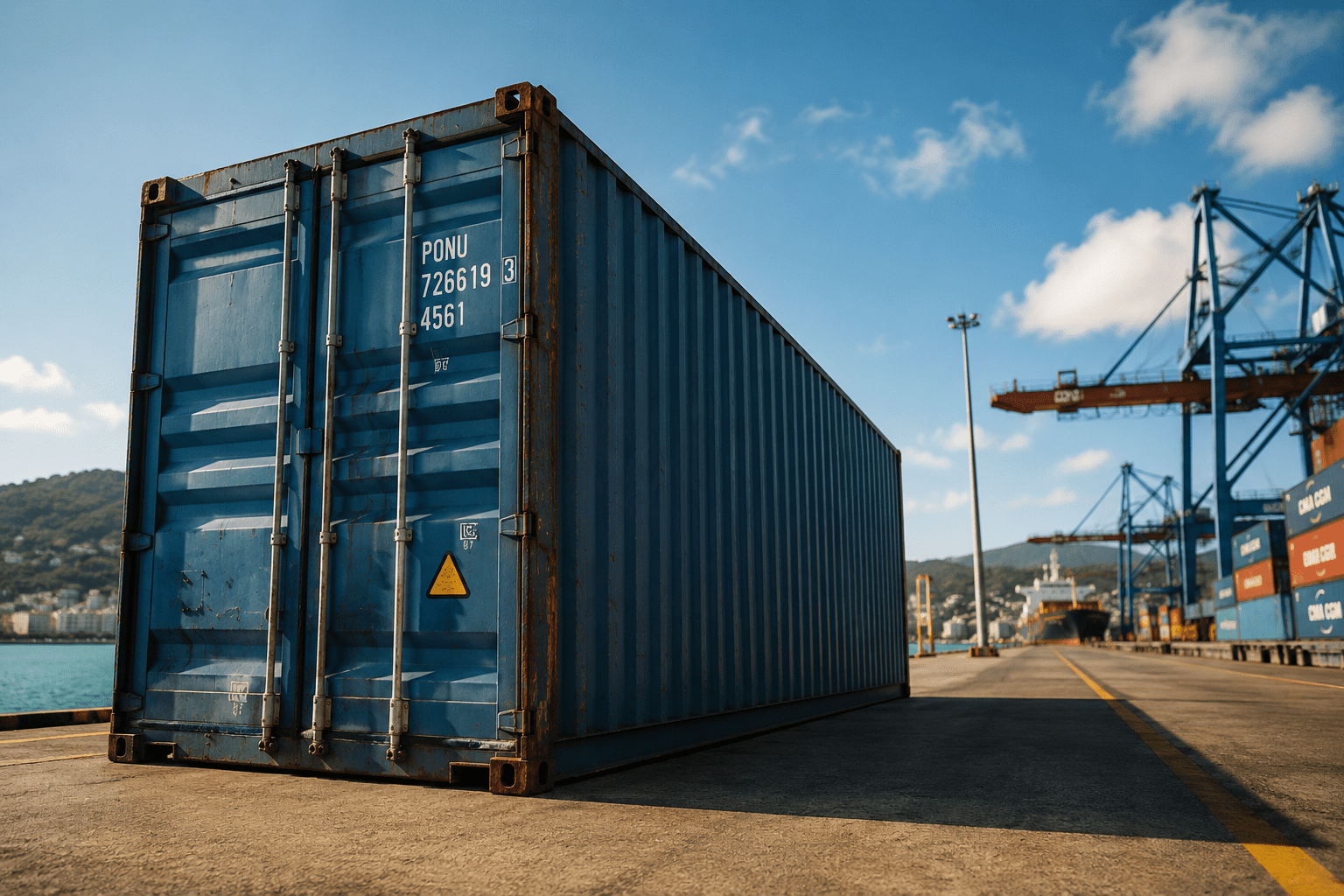
Container traffic statistics often focus on loaded cargo. Yet one of the most revealing figures in Port of Spain’s latest throughput data is not the number of full containers moving through the terminal, but the volume of empty ones.
In 2025, the Trinidadian port handled 95,049 TEUs of transshipment empty containers, compared with 86,806 TEUs of transshipment full containers. The trend has continued into 2026, with empty transshipment containers reaching 32,106 TEUs during the first four months of the year, nearly double the volume of transshipment full containers over the same period.
Far from being a secondary operational detail, these movements offer valuable insight into how Caribbean shipping networks function and how carriers manage equipment across a region characterized by fragmented markets and uneven trade flows.
Empty containers are a consequence of asymmetric trade
Unlike large manufacturing economies where import and export flows can be relatively balanced, many Caribbean markets import significantly more goods than they export in containerized form.
The result is a recurring equipment imbalance. Containers arrive loaded with consumer goods, construction materials, food products and industrial supplies, but fewer leave carrying export cargo. Shipping lines must therefore reposition empty equipment to locations where future demand exists.
The process generates substantial volumes of empty container movements across regional networks.
Port of Spain’s figures illustrate the scale of this phenomenon. In 2025, empty transshipment containers represented one of the largest traffic categories recorded at the port.
Rather than reflecting weak activity, such volumes often indicate that a port is playing an active role in regional logistics management.
Why carriers need repositioning hubs
For shipping lines, empty containers are both essential assets and operational challenges.
A container that remains in the wrong location cannot generate revenue. Equipment must therefore be continuously repositioned between import-heavy and export-heavy markets to ensure availability across service networks.
Ports capable of supporting those flows become increasingly valuable to carriers.
The Port of Spain data suggest that Trinidad and Tobago has become one of those redistribution points. Both CMA CGM and MSC recorded particularly high levels of empty container transshipment activity during 2025. CMA CGM alone handled 49,297 TEUs of transshipment empties, while MSC accounted for 41,585 TEUs.
Together, the two carriers generated more than 90,000 TEUs of empty transshipment activity, highlighting the importance of equipment management within their Caribbean operations.
A reflection of broader Caribbean shipping realities
The Caribbean shipping landscape is particularly prone to equipment imbalances.
The region is composed of numerous island economies, each generating relatively small cargo volumes compared with major global trade corridors. Shipping services often connect multiple ports within a single rotation, requiring carriers to continuously adjust container availability from one market to another.
As a result, regional logistics efficiency depends not only on moving cargo but also on moving containers themselves.
The Port of Spain statistics illustrate how transshipment hubs support that balancing process. While full containers represent the visible side of trade, empty containers often reveal the hidden logistics required to keep maritime networks functioning.
This dynamic is unlikely to disappear. Global supply chains continue to face periodic disruptions, while shipping lines seek greater efficiency in equipment utilization and vessel deployment.
More than a local traffic indicator
For port operators, empty container flows are sometimes viewed as less attractive than loaded cargo because they generate lower value per unit moved. Yet from a network perspective, they can be a sign of strategic relevance.
The latest figures suggest that Port of Spain is not simply handling cargo destined for Trinidad and Tobago. The port is also serving as a regional platform where carriers rebalance equipment, reorganize container inventories and support wider Caribbean shipping operations.
In that sense, the growing weight of empty container movements says as much about the structure of Caribbean trade as it does about the performance of a single port. Behind every repositioned container lies a broader story of supply chains, market asymmetries and the operational realities of moving goods across island economies.