The global cruise industry reached a new milestone in 2025, welcoming 37.2 million ocean-going passengers worldwide. While the sector’s post-pandemic recovery has been well documented, the latest State of the Cruise Industry Report from Cruise Lines International Association (CLIA) highlight another reality: the Caribbean continues to dominate global cruise tourism on a scale unmatched by any other destination region.
With 16.27 million passengers sailing across the Caribbean, Bahamas and Bermuda in 2025, the region accounted for 44% of all cruise passengers worldwide, reinforcing its position as the industry’s primary growth engine.
A record year for the global cruise industry
The industry’s recovery has now evolved into sustained growth. After carrying 34.6 million passengers in 2024, global ocean-going cruise traffic climbed to 37.2 million in 2025, representing year-on-year growth of 7.5%. The result not only exceeds pre-pandemic levels but also establishes a new all-time record for the sector.
The strength of demand was visible throughout the year. According to CLIA data, every quarter of 2025 set a new benchmark, with passenger volumes reaching 8.0 million in the first quarter, 8.6 million in the second, 9.2 million in the third, and 8.6 million in the fourth. The industry’s traditional seasonal pattern remained intact, with the summer quarter once again delivering the annual peak.
The long-term trajectory is equally striking. In 1985, the global cruise market served just 1.9 million passengers. Four decades later, annual volumes have grown nearly twentyfold.
The Caribbean remains the industry’s dominant destination
While global growth attracted headlines, the Caribbean strengthened its leadership position.
The region welcomed 16.27 million cruise passengers in 2025, up from 15.01 million the previous year. No other destination region comes close. By comparison, the Mediterranean attracted 5.96 million passengers, while Asia and China combined received 3.11 million.
The numbers illustrate the scale of the Caribbean’s dominance. Nearly one out of every two cruise passengers worldwide sailed in the Caribbean, Bahamas or Bermuda during 2025. The region alone handled almost three times the passenger volume of the Mediterranean and more than five times that of Asia.
For cruise operators, the Caribbean remains the industry’s most important deployment market. For destinations and port authorities, the figures confirm that the region continues to occupy a central position within global cruise networks.
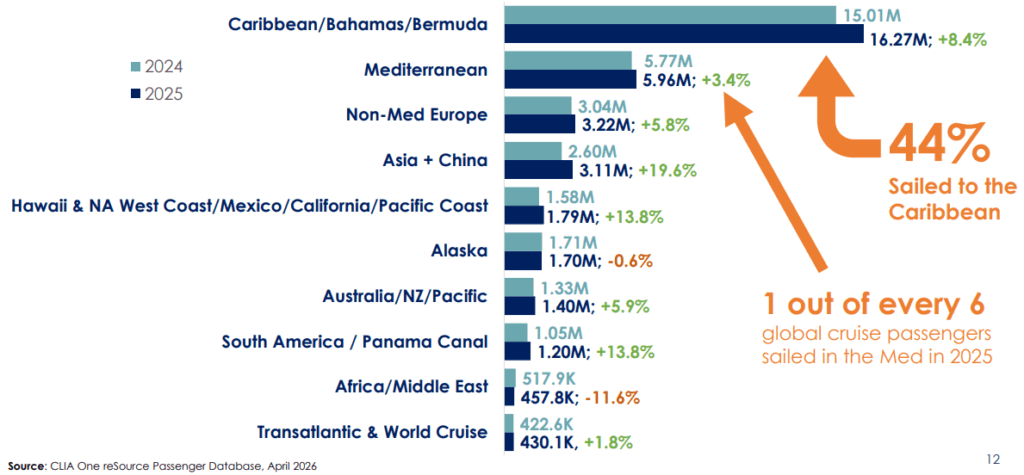
Top 10 2025 Destination Regions vs. 2024 – Source: CLIA One reSource Passenger Database, April 2026
More than one million additional passengers in a single year
The Caribbean added approximately 1.26 million passengers between 2024 and 2025, representing growth of 8.4%. This increase alone exceeds the total annual cruise traffic handled by several destination regions around the world.
Such growth has significant implications for cruise destinations. Higher passenger volumes translate into greater pressure on port infrastructure, terminal capacity, ground transportation systems and destination management strategies. At the same time, they create additional opportunities for ports, tour operators, retailers and local tourism economies.
The continued expansion also reflects the region’s enduring competitive advantages: proximity to North America, extensive port networks, year-round cruising conditions and the ability to offer multiple destinations within a single itinerary.
Growth is expected to continue through 2029
CLIA’s forecast suggests that the industry’s expansion is far from over.
Global cruise passenger volumes are projected to rise from 37.2 million in 2025 to 38.3 million in 2026, surpass 40 million in 2027, and ultimately reach 42.1 million by 2029. Although annual growth rates are expected to moderate compared with the immediate post-pandemic rebound, the overall trajectory remains firmly upward.
For the Caribbean, this outlook presents both opportunities and challenges. As the world’s leading cruise destination, the region is likely to remain a primary beneficiary of future growth. However, accommodating increasing passenger volumes will require continued investment in ports, passenger facilities, destination experiences and operational resilience.
The next phase of the industry’s development may therefore be defined less by attracting demand and more by managing it effectively.
As global cruise traffic enters another period of expansion, the Caribbean’s position appears secure. The latest CLIA figures show that the region is not simply participating in the industry’s growth story—it remains at the very centre of it.