
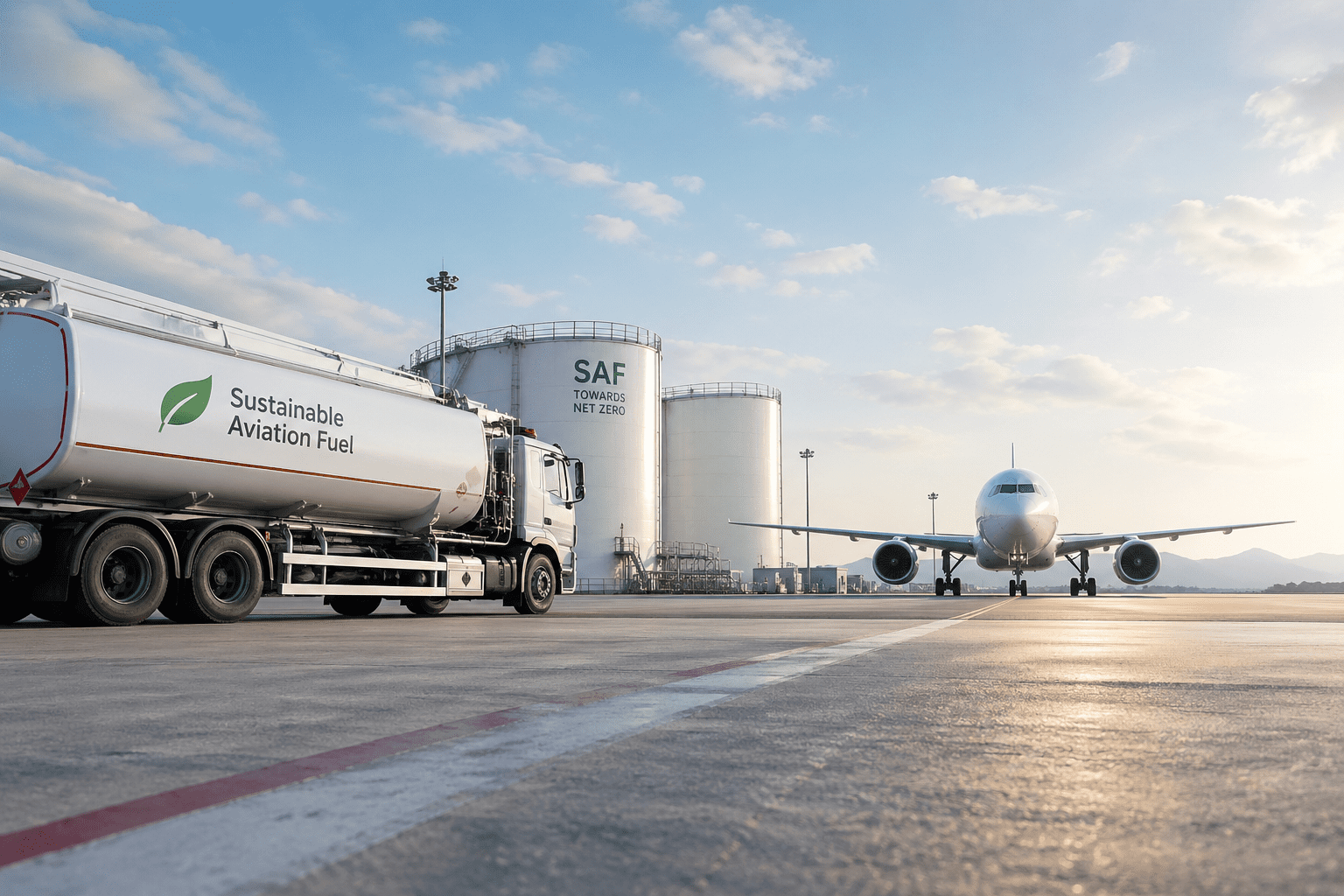
Sustainable Aviation Fuel (SAF) has become the cornerstone of aviation’s pathway to net zero emissions. Yet in Latin America and the Caribbean, its deployment raises a fundamental question: can the region scale SAF without undermining demand in a market where price sensitivity remains high and connectivity is still developing?
Recent study from the Latin American and Caribbean Air Transport Association (ALTA), developed with ICF, suggests the answer is far from straightforward. While SAF is essential to reducing long-term emissions, its economic and industrial implications could significantly reshape the region’s aviation landscape.
The cost shock redefining airline economics
SAF’s central challenge lies in its cost structure. Currently priced at three to twelve times the cost of conventional jet fuel, it introduces a step change in operating economics rather than a marginal adjustment.
At scale, this translates into a measurable impact on pricing. Modeling indicates that SAF adoption could add around $43 per departing seat by 2050, fundamentally altering airline cost bases and pricing strategies. In a region where fuel already represents a significant share of operating costs, this additional burden is not easily absorbed.
In practical terms, this shifts Sustainable Aviation Fuel from a compliance tool to a core driver of airline profitability and pricing discipline. For airlines, the implication is clear: SAF is not just a sustainability lever—it is a structural shift in unit economics.
Demand at risk: the elasticity constraint
The cost dimension becomes critical when viewed through the lens of demand elasticity. Latin American aviation markets are among the most price-sensitive globally, reflecting lower average incomes and a still-developing travel base.
Under full cost pass-through scenarios, SAF adoption could lead to a reduction in air traffic of up to 30%. This is not a marginal correction—it is a structural contraction with implications for route viability, network density, and regional connectivity.
Unlike mature markets, where premium segments and high-frequency travel can cushion price increases, Latin America’s demand base remains more fragile. Sustained fare increases risk limiting access to air travel, particularly for emerging middle-class passengers who have only recently entered the market.
This suggests that, in the regional context, decarbonization efforts are directly constrained by demand elasticity—making pricing a central variable in the transition pathway.
A supply challenge, not just a pricing issue
Beyond cost, SAF faces a second constraint: supply.
The region’s production capacity remains at an early stage. While more than 1.9 billion gallons of SAF production capacity have been announced, very few projects have reached final investment decision, highlighting the gap between ambition and execution .
Several structural factors underpin this constraint. Feedstock availability is uneven across countries, production pathways remain at varying levels of technological maturity, and SAF competes directly with other biofuels—particularly in road transport—where demand is already established and often more economically viable.
In practice, this means that SAF scarcity—not just cost—could become a defining constraint in the region’s decarbonization trajectory. The result is a supply chain under pressure, where scaling production will require not only capital, but also time, coordination, and technological progress.
Latin America’s paradox: high potential, limited readiness
This creates a paradox for the region. Latin America and the Caribbean possess significant advantages in the SAF value chain, including abundant biomass resources and strong feedstock potential. In theory, this positions the region as a future hub for SAF production, with the ability to serve both domestic and export markets.
In practice, however, the enabling environment remains uneven. Investment capacity is constrained, policy frameworks are still emerging, and industrial ecosystems are not yet fully aligned to support large-scale deployment.
The implication is clear: while the region may become a key player in the global SAF market over the long term, its short-term trajectory will likely be defined by gradual scaling rather than rapid deployment.
The policy gap: who absorbs the cost?
Closing this gap raises a critical question: who pays for Sustainable Aviation Fuel ?
In more mature markets, public policy has played a central role in supporting SAF adoption through subsidies, tax incentives, and regulatory mandates. In Latin America, however, governments face tighter fiscal constraints and competing development priorities.
Without targeted support mechanisms, the cost burden risks falling primarily on airlines and passengers. This creates a structural imbalance, where the transition to lower emissions could come at the expense of affordability and connectivity.
This highlights a critical policy gap: without coordinated financial support, SAF adoption risks being economically misaligned with regional market conditions. Bridging this gap will require a combination of targeted incentives, international financing, and policy coordination.
Strategic implications for the aviation ecosystem
For industry stakeholders, SAF is no longer a distant transition—it is already a near-term strategic variable.
Airlines in the region operate within a cost structure where fuel can account for 30% to 40% of total operating costs . Introducing SAF at a significant premium therefore directly impacts margins, pricing strategies, and route viability, particularly in price-sensitive markets.
At the same time, supply constraints remain a critical bottleneck. While more than 1.9 billion gallons of SAF production capacity have been announced, very few projects have reached final investment decision, highlighting the gap between ambition and execution .
This could ultimately lead to a reconfiguration of route networks, with airlines prioritizing higher-yield markets and reducing exposure to price-sensitive segments. It may also accelerate divergence between carriers operating under different regulatory and cost environments.
A transition that must be calibrated
SAF remains essential to aviation’s decarbonization pathway, but its deployment introduces measurable trade-offs.
Even moderate adoption levels carry significant implications. A 20% SAF blend by 2050 could reduce demand by nearly 20%, translating into substantial economic impact across the aviation ecosystem .
At the same time, SAF still represents less than 1% of global jet fuel consumption, reflecting the early stage of market development and limited production capacity. In a region characterized by high price sensitivity, rapid cost increases risk directly affecting accessibility and connectivity.
The transition is therefore unlikely to be linear. It will depend on a calibrated mix of gradual SAF deployment, operational efficiencies, and complementary mechanisms—aligned with the region’s economic realities and supported by targeted policy frameworks.
In this context, Sustainable Aviation Fuel is not just a decarbonization tool—it is becoming a structural determinant of how, and at what cost, aviation growth can be sustained in Latin America.