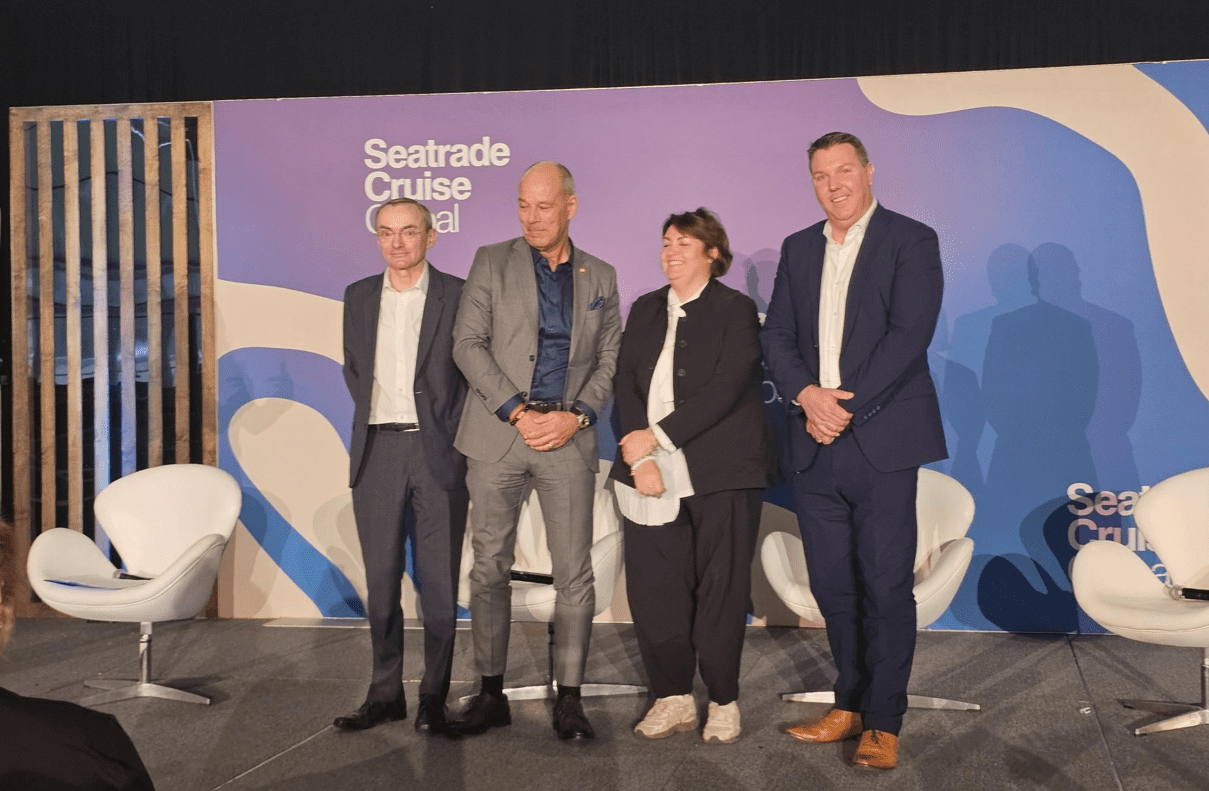
At Seatrade Cruise Global, conversations around growth and infrastructure often dominate discussions about cruise development. Yet during the session “Connecting Local Culture with Cruise: What Makes a Destination Distinct,” held on April 13 at the Sunset Vista Salon, the focus shifted toward a more fundamental question: what truly differentiates one destination from another in an increasingly standardized global cruise market?
Through a series of real-world examples, speakers highlighted how destinations are moving beyond scale and spectacle, placing greater emphasis on authenticity, community integration and a clearer sense of place. Their exchanges suggest that distinctiveness is no longer defined by what destinations offer, but by how deeply they are able to connect guests with local culture and communities.
From interchangeable stops to meaningful places
Cruise itineraries have traditionally been built around a succession of ports, often experienced in similar ways regardless of geography. As the moderator noted, many travelers are familiar with standardized excursions and structured visits that can feel interchangeable from one destination to another.
However, the discussions suggest that this model is gradually evolving. Rather than simply offering access to locations, destinations are increasingly expected to deliver experiences that reflect their identity, culture and everyday life.
This shift appears closely linked to broader changes in traveler expectations, where authenticity and connection are gaining importance alongside convenience and entertainment.
Authenticity as a product strategy
One of the clearest illustrations of this evolution comes from Gerry Larsson-Fedde, Chief Operating Officer at Hurtigruten, who described how the company integrates local culture directly into its core product.
Operating along the Norwegian coast, Hurtigruten incorporates locally sourced food, regional culinary traditions and indigenous Sami influences into the onboard experience. Approximately 80% of food products are sourced from local suppliers, with menus adapting to the regions visited throughout the journey.
As Gerry Larsson-Fedde explained, “our menus reflect where the ship currently is… as you move up the coast, the dishes change depending on the region.”
Beyond food, the company has developed initiatives such as its “open village” concept, where ships visit small communities and contribute financially to local economies, returning around $25 per guest to host communities.
These approaches suggest that authenticity is no longer treated as a marketing layer, but as an operational and commercial strategy embedded across the value chain.
Communities at the center of destination identity
The role of local communities emerged as another central theme of the discussion.
Laura Cimaglia, Vice President at MedCruise, emphasized that long-term destination development increasingly depends on what she described as a “social license to operate.” This concept reflects the need for destinations to ensure that local stakeholders — including residents, businesses and institutions — are actively engaged and supportive of cruise activity.
Her work with MedCruise highlights efforts to structure this engagement, from identifying best practices to facilitating dialogue between ports, cities and cruise lines. These initiatives also address practical challenges such as managing visitor flows, coordinating stakeholders and aligning expectations between public and private actors.
This perspective suggests that distinctiveness is not only about the experience delivered to visitors, but also about how destinations manage their relationship with the communities that host them.
Extending the experience beyond the day visit
While authenticity and community engagement are critical, the discussions also highlighted the importance of time and immersion in shaping distinctive experiences.
Simon Blacoe, Vice President of Hotel Operations at Azamara Cruises, described how the company has built its positioning around extended stays and overnight calls, allowing guests to experience destinations beyond the constraints of traditional daytime visits.
More than 50% of Azamara’s port calls involve late-night stays or overnights, enabling access to evening activities, local events and a different dimension of destination life.
The company has further developed this approach through curated experiences, including cultural performances and destination-specific programming designed to reflect local identity. These initiatives illustrate how time ashore can be used as a lever to deepen engagement and reinforce a destination’s uniqueness.
Orchestrating complexity across stakeholders
Behind these experiences lies a growing level of operational complexity.
Delivering authentic and differentiated experiences requires coordination across a wide range of actors, including ports, municipalities, tour operators, cultural institutions and local businesses. As highlighted during the session, this coordination is not always straightforward, particularly when responsibilities are distributed across different governance levels.
At the same time, sourcing locally, engaging communities and adapting experiences to each cruise destination introduce additional constraints — from supply chain variability to the need for continuous relationship management.
These dynamics suggest that distinctiveness is not only a matter of creative design, but also of execution, requiring structured collaboration and long-term commitment from all stakeholders involved.
Reading the road ahead
The discussions from this session point to a broader redefinition of what makes a cruise destination distinct.
As the industry evolves, differentiation appears increasingly rooted in the ability to connect travelers with the cultural, social and human dimensions of a place. Authenticity, community engagement and immersive experiences are no longer complementary elements — they are becoming central to destination strategy.
For cruise operators and destinations alike, this shift suggests that creating memorable experiences may depend less on adding new attractions and more on revealing what already exists — and making it accessible in meaningful ways.