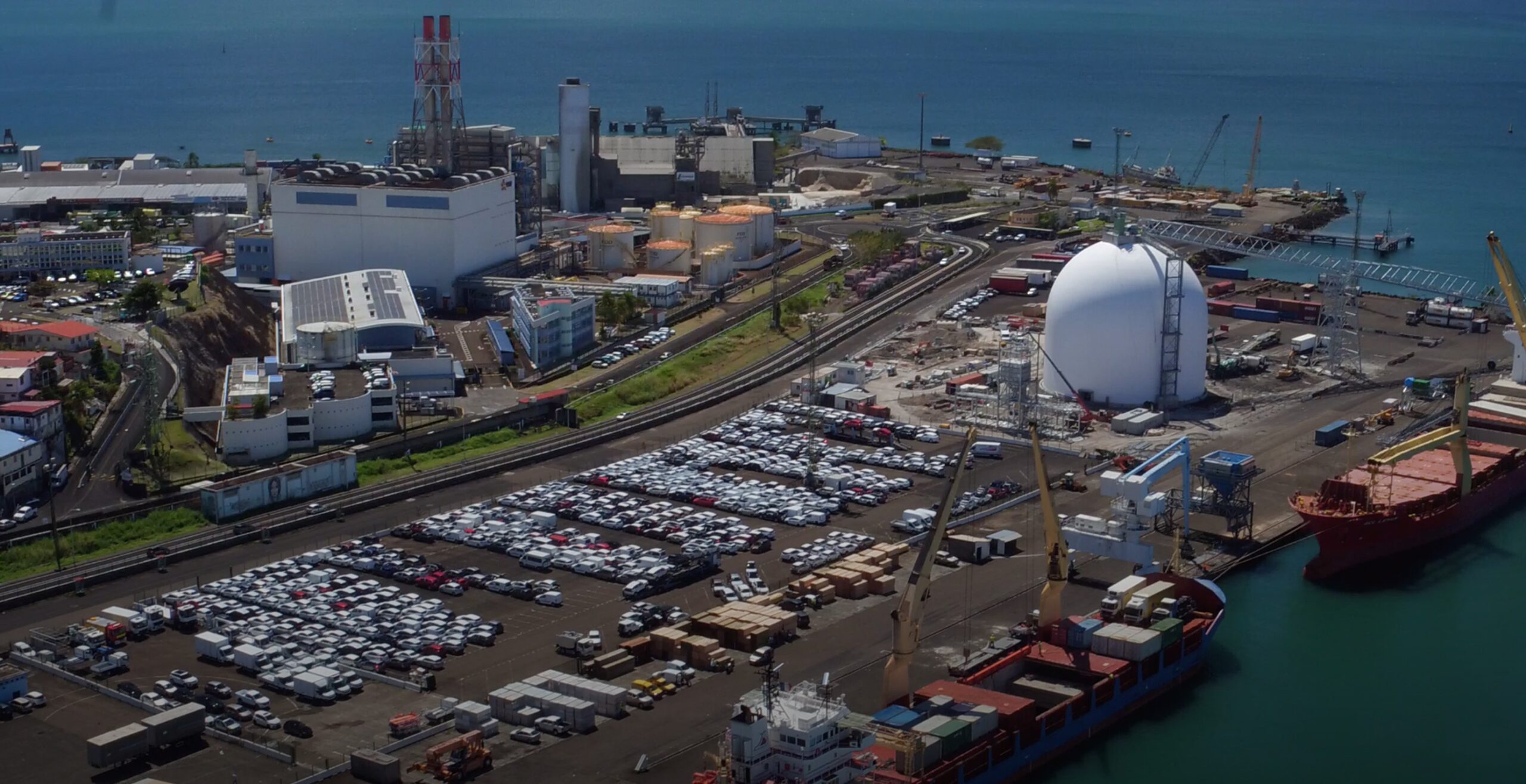
The Grand Port Maritime de la Martinique (GPMLM) has opened public consultation on its 2025–2029 Strategic Project, outlining a five-year investment framework designed to reinforce the island’s position within the Antilles–Guyane maritime corridor.
The roadmap confirms a projected investment envelope of €168.8 million over the period, with €100 million earmarked specifically for the consolidation of the Antilles Hub.
Beyond regulatory formalities, the document signals a structural repositioning: Martinique is seeking to secure and modernise its port system while strengthening its logistical footprint across the Eastern Caribbean.
Consolidating the Antilles–Guyane Hub
At the core of the strategy lies the consolidation of Martinique’s hub function. The €100 million allocation dedicated to the Antilles Hub reflects an ambition to maintain operational competitiveness and connectivity across the region.
The plan introduces a territorial logistics architecture often described as a “triangle of growth,” structured around Fort-de-France, the 70-hectare Pays Noyé development area, and the port of Le Robert. Rather than concentrating flows solely in the capital, the model seeks to distribute capacity and functions across complementary sites.
Le Robert is positioned as a future multimodal platform capable of accommodating vessels up to 110 metres in length, with a 5-metre draft and handling capacities between 3,000 and 4,000 tonnes. This suggests a calibrated expansion oriented toward regional cabotage and diversified cargo streams rather than large-scale transshipment.
The structural logic is clear: reinforce operational resilience by avoiding single-site dependency, enhance specialisation between terminals, and strengthen Martinique’s integration within intra-Caribbean maritime networks.
Re-engineering logistics and last-mile efficiency
The 2025–2029 roadmap extends beyond quay infrastructure. It reflects a broader repositioning toward supply chain optimisation.
The strategy introduces the concept of “ports secs” — inland logistics platforms designed to streamline cargo distribution and reduce congestion in core port zones. These platforms would facilitate customs handling, consolidation, and redistribution functions, addressing fragmentation within the local logistics ecosystem.
Operational optimisation of last-mile delivery also forms part of the discussion. The document references co-loading strategies and even exploratory solutions such as drone usage for short-distance transport. While still conceptual, such measures illustrate a shift in thinking: the port authority is positioning itself not merely as an infrastructure manager but as a logistics orchestrator.
In a territory characterised by coastal density and traffic concentration around Fort-de-France, the rationalisation of inland flows could prove as critical as maritime capacity expansion.
Climate adaptation and environmental integration as structural drivers
Environmental resilience is embedded within the financial architecture of the strategy. The plan allocates €8.544 million to a dedicated climate adaptation programme, targeting exposure to submersion risks, extreme weather events and rising temperature pressures.
Beyond infrastructure hardening, biodiversity protection receives explicit budgetary treatment. Multi-year allocations include funding for cetacean monitoring, coral initiatives and broader ecosystem management measures. These commitments place measurable resources behind environmental ambitions rather than framing them as declarative objectives.
Operational waste management data further illustrates ongoing structural adjustments. The port currently generates approximately two tonnes of waste per week, most of which is channelled through a structured selective sorting system implemented in 2024. The strategy envisages reinforced training and traceability measures from 2025 onward.
The overall approach reflects a governance model increasingly driven by indicators and monitoring frameworks, signalling alignment with evolving ESG expectations in maritime infrastructure financing.
Environmental oversight and governance scrutiny
The strategic project is accompanied by a formal environmental assessment and an opinion from the Martinique Regional Environmental Authority.
The authority identifies key environmental challenges linked to biodiversity preservation, natural resource management, public health and climate change. While the review does not question the strategic direction, it calls for strengthened environmental baselines, enhanced monitoring mechanisms and clearer articulation of performance indicators.
This institutional scrutiny introduces an additional layer of governance credibility. It underscores that environmental integration within port planning is no longer peripheral but subject to structured oversight.
Strategic implications for the Eastern Caribbean
Taken as a whole, the 2025–2029 roadmap reflects a dual ambition: consolidating Martinique’s hub role within the Antilles–Guyane corridor while embedding resilience and environmental governance into port expansion.
The investment scale remains moderate by global standards but significant within the Eastern Caribbean context. The diversification of sites, the development of multimodal interfaces and the optimisation of inland logistics collectively suggest an attempt to recalibrate regional positioning.
As maritime flows across the Caribbean continue to adapt to shifting trade patterns, energy transitions and climate exposure, Martinique’s strategy signals a desire not merely to maintain capacity, but to redefine operational architecture.
The coming five years will determine whether this integrated approach translates into measurable competitive reinforcement within the Eastern Caribbean shipping landscape.