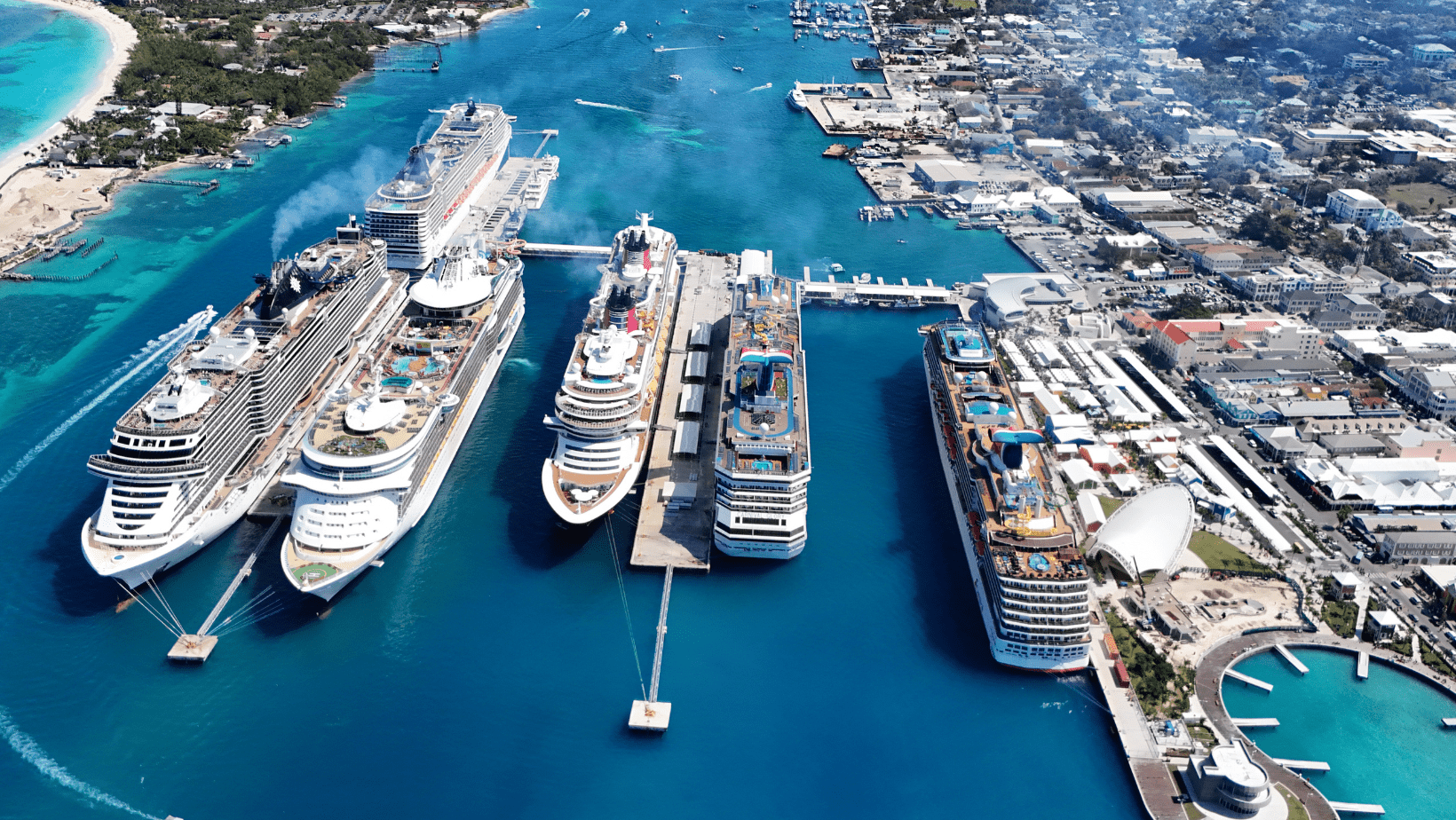
In 2025, Nassau Cruise Port reached a new milestone, welcoming an estimated 6.1 million cruise passengers across nearly 1,600 ship calls. At first glance, the figures reflect another strong year for one of the world’s busiest transit cruise ports. But beyond the headline numbers, they reveal something more structural: the central role of cruise infrastructure in shaping the economic model of island destinations.
This performance aligns with a broader national trend. The Bahamas recorded 12.5 million total visitors in 2025, a historic high and the third consecutive year of record-breaking tourism. The scale of these figures points to a system where infrastructure is not just supporting tourism — it is driving it.
A record year that confirms structural growth
The 2025 results extend a trajectory already visible in previous years. Compared to 2024, Nassau Cruise Port handled approximately 420,000 additional passengers, representing a 7.0% increase, alongside more than 130 additional cruise calls (+9.5%).
This is not a one-off rebound. It is a continuation of sustained growth, underpinned by strong cruise demand and increasing deployment by major cruise lines. The rise in both passenger volumes and vessel calls signals a dual dynamic: higher throughput and intensified port utilization.
In practical terms, Nassau is no longer simply absorbing traffic — it is operating as a high-frequency, high-volume node within the global cruise network.
Nassau as the primary gateway of the Bahamian economy
This scale reinforces Nassau Cruise Port’s role as the country’s primary entry point for international visitors. As Mike Maura, Jr., CEO & Director, emphasized:
“Welcoming more than six million cruise passengers in a single year reflects the confidence of our cruise partners, the strength of the destination, and the impact of ongoing investments to enhance the passenger experience and operational efficiency at the port.”
The statement highlights a critical point: the port is not just infrastructure, but a strategic interface between global demand and local economic activity. In island economies like The Bahamas, where accessibility is inherently constrained by geography, such infrastructure effectively defines the scale and rhythm of tourism flows.
When cruise traffic drives national tourism performance
The relationship between port activity and national tourism performance is particularly striking. With 6.1 million cruise passengers out of 12.5 million total visitors, cruise traffic represents a substantial share of overall arrivals.
At the national level, visitor numbers grew 11.4% year-over-year, exceeding pre-pandemic 2019 levels by more than 72%. This suggests not only a recovery, but a structural expansion of the tourism sector — one in which cruise plays a leading role.
In this context, the port is not simply benefiting from tourism growth; it is actively enabling and amplifying it. The correlation between cruise volumes and national performance points to a model where maritime connectivity acts as a primary growth engine.
A high-volume model built on cruise dependency
Such performance also reveals the underlying structure of the Bahamian tourism model: a high-volume system heavily reliant on cruise flows. The combination of frequent ship calls, rapid passenger turnover, and continuous demand creates a steady stream of visitors that supports local businesses, employment, and public revenues.
But this raises an implicit question. What happens when a significant share of national economic activity depends on a single mode of access?
This dependency is not necessarily a weakness, but it does create exposure — to shifts in global cruise demand, operational disruptions, or broader economic cycles. For island economies, where diversification options can be limited, the resilience of infrastructure becomes inseparable from the resilience of the economy itself.
From infrastructure to destination: the evolution of cruise ports
Nassau’s strategy reflects a broader transformation underway across the cruise industry. Ports are no longer designed solely as transit points; they are evolving into destinations in their own right.
Upcoming developments at Nassau Cruise Port — including a signature restaurant and a day club-style pool experience — illustrate this shift. These investments aim to extend visitor dwell time, increase onshore spending, and enhance the overall experience.
In doing so, the port captures a greater share of the tourism value chain. It becomes not just a gateway, but a curated environment where commercial, leisure, and cultural experiences converge.
Sustainability enters the equation
Alongside growth and development, sustainability is emerging as a strategic priority. In March 2026, Nassau Cruise Port announced a three-year partnership with the Bahamas National Trust, committing $75,000 to conservation and awareness initiatives.
A key component of this collaboration is the “Blue Green Bahamas” Visitor Awareness Initiative, designed to educate both visitors and residents about environmental protection. Through digital content, on-site messaging, and staff engagement, the program integrates sustainability directly into the passenger journey.
As Maura noted:
“As the gateway for over millions of visitors each year, we have an important role to play in helping people understand, appreciate, and maintain the natural beauty of The Bahamas.”
This reflects a broader industry shift. As passenger volumes increase, so too does the need to demonstrate responsible stewardship — not only to regulators, but to travelers themselves.
A model that defines the future of island connectivity
Nassau Cruise Port offers a clear illustration of how infrastructure, tourism, and economic development converge in island contexts. Its growth is not simply a success story; it is a case study in how connectivity shapes territorial dynamics.
By combining high-volume operations, continuous investment, and evolving passenger experiences, Nassau has positioned itself at the center of the Bahamian tourism system. At the same time, its trajectory highlights the importance of balancing growth with resilience and sustainability.
In island economies, infrastructure is never just a technical asset. It is the backbone of national prosperity — and increasingly, the foundation on which future development depends.