
Jamaica has taken a decisive step toward cleaner aviation with the launch of a Sustainable Aviation Fuels (SAF) feasibility study, marking a turning point not only for its national transport strategy but also for the broader Caribbean aviation landscape.
Announced on January 20, 2026, at the headquarters of the Jamaica Civil Aviation Authority (JCAA) in Kingston, the initiative aims to assess the country’s potential to produce and integrate sustainable aviation fuels as part of a long-term transition toward a low-carbon, climate-resilient economy.
But beyond the technical scope of the study, the move reflects something deeper: a strategic repositioning of Caribbean island economies within the future of global aviation.
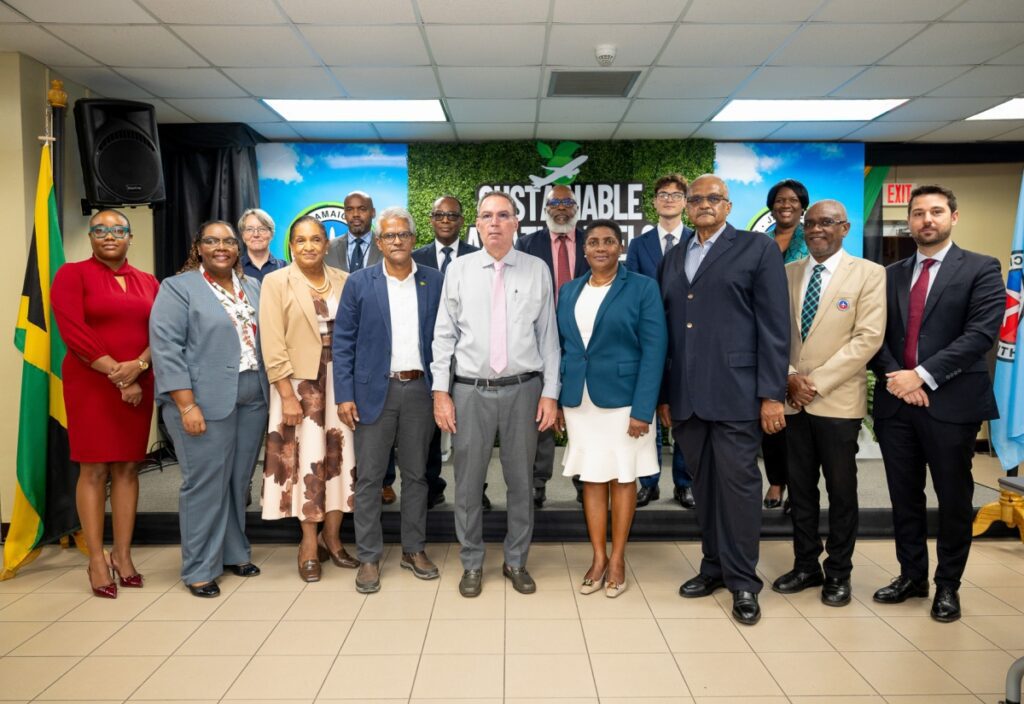
Minister of Energy, Transport and Telecommunications, Hon. Daryl Vaz (centre), shares a photo opportunity with Acting Director General of the Jamaica Civil Aviation Authority (JCAA), Nicole Morgan (fourth right), and other stakeholders during the official launch of Jamaica’s Sustainable Aviation Fuels (SAF) Feasibility Study at the JCAA headquarters in Kingston on Tuesday (January 20)
A structured approach to sustainable aviation
The feasibility study, led by ICF Consulting, will deliver Jamaica’s first comprehensive, evidence-based assessment of SAF potential. Its scope goes far beyond environmental considerations.
It will examine available feedstocks, including used cooking oil, agricultural by-products and other renewable materials, alongside existing fuel and energy infrastructure, aviation demand, export opportunities, and the broader regulatory and investment environment. Key constraints such as production scale, cost and competitiveness will also be addressed.
For policymakers, the objective is clear: build a realistic roadmap for integrating SAF into Jamaica’s aviation ecosystem while identifying viable investment pathways.
As Minister of Energy, Transport and Telecommunications Daryl Vaz stated during the launch, the initiative marks the beginning of a national conversation on clean energy and Jamaica’s role in global aviation.
Climate pressure as a catalyst for transformation
For Jamaica, the transition toward sustainable aviation is not optional. As a small island developing state, the country remains highly exposed to climate risks.
Recent events, including Hurricane Beryl in 2024 and Hurricane Melissa in 2025, have reinforced the urgency of building resilience across critical infrastructure sectors, including transport.
In this context, SAF emerges as a strategic lever. Sustainable aviation fuels can reduce lifecycle carbon emissions by up to 80%, while being fully compatible with existing aircraft and airport infrastructure. This compatibility removes a major barrier to adoption and positions SAF as one of the most immediately actionable decarbonization tools for aviation.
“The focus on sustainable aviation fuels and other clean energy solutions is, therefore, timely and strategic,” Vaz emphasized.
Beyond decarbonization: an economic opportunity
While climate considerations are central, Jamaica’s approach clearly frames SAF as an economic opportunity.
The development of a local SAF industry could unlock multiple value streams, including job creation, new green supply chains, and investment across agriculture and waste-to-energy sectors. It also offers the prospect of enhanced energy security in a region heavily dependent on imported fossil fuels.
More importantly, the study highlights export potential. By leveraging local resources and geographic positioning, Jamaica could integrate into emerging global SAF supply chains and benefit from growing demand driven by international aviation decarbonization targets.
The findings are expected to inform national decision-making, attract investment and position the country within global carbon and clean energy markets.
Jamaica as a case study of a broader regional shift
Although the initiative is national in scope, its implications extend across the Caribbean.
Air connectivity remains the backbone of island economies, with tourism-dependent markets relying heavily on aviation flows. At the same time, these economies face disproportionate exposure to climate change, creating a dual pressure to maintain connectivity while reducing environmental impact.
In this context, SAF strategy of Jamaica can be seen as a prototype. It illustrates how island states can leverage local resources—ranging from agricultural residues to waste streams—to participate in the energy transition of a global industry.
It also reflects an evolution in the role of aviation authorities. As highlighted by JCAA Acting Director General Nicole Morgan, regulators are no longer limited to oversight functions but are increasingly acting as facilitators of innovation and long-term sector transformation.
Toward a new aviation-energy paradigm
Jamaica’s initiative signals a broader shift: aviation is no longer just a transport sector—it is becoming an energy ecosystem.
For the Caribbean, this transition opens a new strategic frontier. By aligning climate objectives with industrial development and energy diversification, island economies have an opportunity to move beyond their traditional role as destinations and position themselves as active contributors to the future of aviation.
The feasibility study is only a first step. But it establishes a foundation for what could become a defining transformation for the region—one where the Caribbean is not only connected to the world, but also helps fuel its movement.