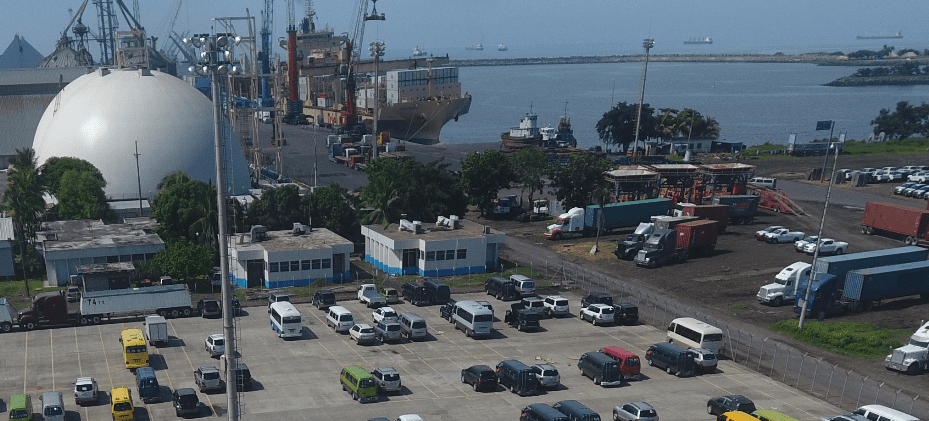
Puerto Quetzal’s latest figures do more than illustrate year-on-year performance. They reveal a port that is steadily repositioning itself — handling larger volumes, strengthening its container profile and improving operational efficiency within a progressively capacity-driven shipping environment.
As of October 2025, Empresa Portuaria Quetzal (EPQ) reports total throughput of 16.64 million metric tonnes, including offshore buoy operations. When buoy activity is excluded, core port handling stands at 13.97 million tonnes, confirming that the underlying operational base remains solid. The data suggest continuity rather than volatility. What began as post-pandemic recovery has evolved into structural consolidation.
A sustained operational baseline
The year 2024 marked a historic peak for the port, with 19.15 million tonnes handled and a record 716,640 TEUs processed. The partial data for 2025 indicate that activity has not retreated from that elevated threshold.
By October, container throughput had already reached 590,376 TEUs, maintaining strong momentum across Pacific trade corridors. Export volumes, which contracted sharply in 2023 and remained subdued in 2024, are also showing renewed dynamism. At 1.93 million tonnes by October, exports are approaching last year’s annual total, suggesting the possibility of a meaningful recovery by year-end.
Whether or not 2025 ultimately exceeds 2024’s record, the key takeaway is different: Puerto Quetzal appears to be operating within a structurally higher volume cycle.
Volume growth without traffic growth
The most telling shift is not found in aggregate tonnage alone, but in how that volume is being handled. In 2024, even as cargo volumes and TEU throughput reached historic highs, total vessel calls declined by 7%, both including and excluding buoy operations. This divergence is significant.
It reflects a combination of larger vessel deployment, higher cargo density per call and stronger berth productivity. Rather than relying on increased ship frequency, the port is integrating into more consolidated liner rotations — an operational pattern consistent with broader Pacific shipping dynamics. In effect, scale is replacing frequency as the defining metric.
Container traffic reshaping the profile
Containerisation now sits at the centre of Puerto Quetzal’s evolution. Between 2019 and 2024, EPQ’s container volumes rose from 178,917 to 301,042 units — an expansion of nearly 70% over five years. The specialised terminal, TPEC, also recorded record activity in 2024, handling 415,598 units and reinforcing its role as a strategic asset within the port ecosystem.
This sustained growth underscores deeper integration into regional and trans-Pacific supply chains. It also signals a gradual departure from a model primarily driven by traditional bulk exports. The 2025 trajectory confirms that container activity is not merely cyclical; it has become a structural growth engine.
Evolving trade composition
At the same time, the composition of cargo flows is changing. The record throughput achieved in 2024 did not stem from export expansion. Export volumes had declined sharply in 2023 before stabilising in 2024, even as overall tonnage climbed. The rebound observed in 2025 suggests rebalancing may be underway, but recent growth has clearly been shaped by import activity and containerised flows.
This pattern aligns with broader shifts in domestic demand and supply chain restructuring. It also has operational implications, influencing berth allocation strategies, yard management and long-term infrastructure planning. Puerto Quetzal’s performance therefore reflects not just higher volumes, but a redefined trade mix.
A port operating at a new structural level
Taken together, the data portray a port that is no longer defined by recovery momentum. Instead, it is consolidating a new operational scale.
Puerto Quetzal is sustaining elevated cargo volumes while deepening its container profile and strengthening operational productivity — all with fewer vessel calls than in previous years.
For Guatemala, this reinforces the port’s standing within Central America’s Pacific corridor, particularly as shipping networks become increasingly capacity-focused and efficiency-oriented. If current trends persist through the remainder of 2025, Puerto Quetzal will not simply be expanding. It will be operating at a structurally higher level — one defined less by traffic intensity and more by scale, productivity and integration.