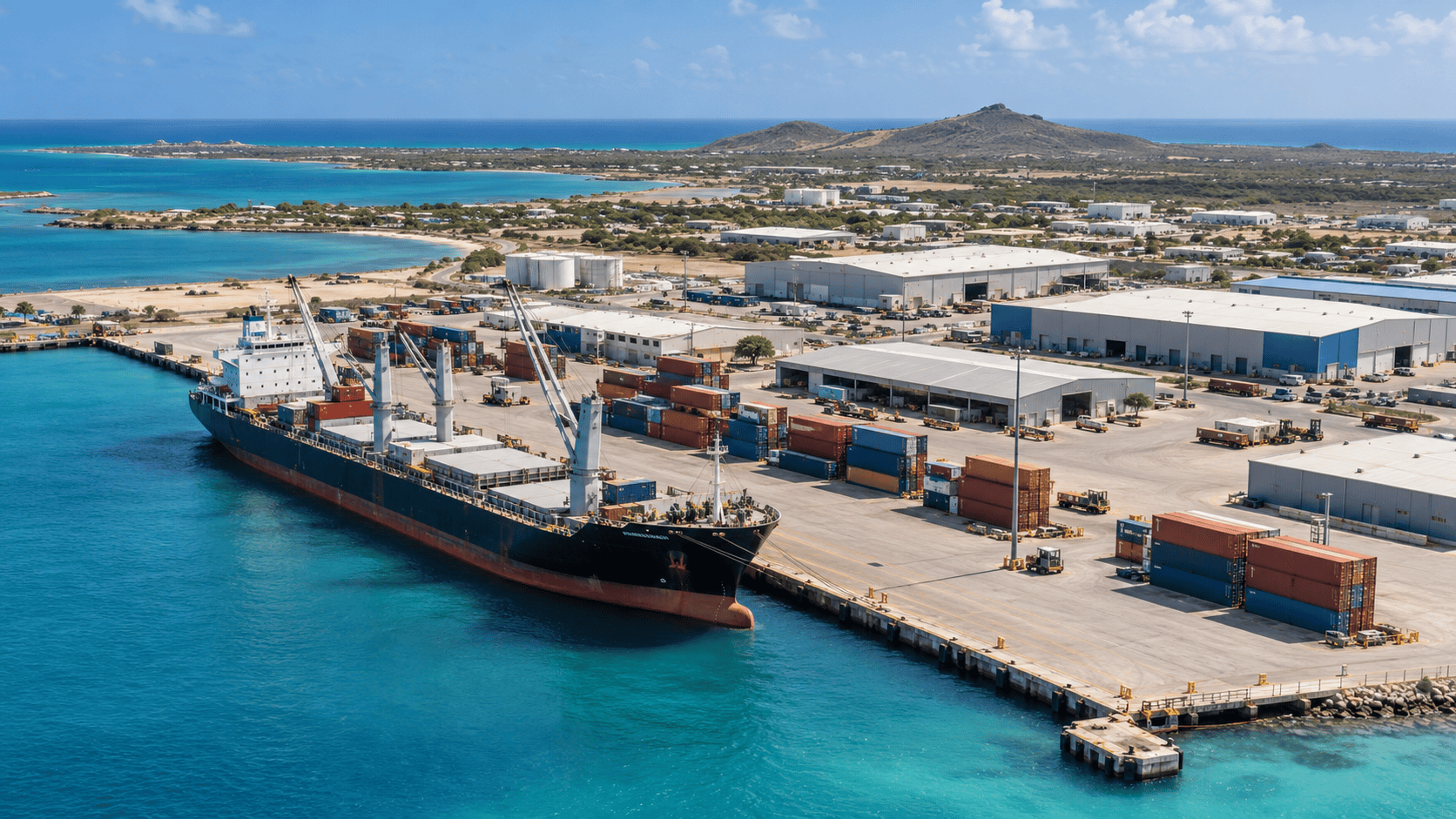
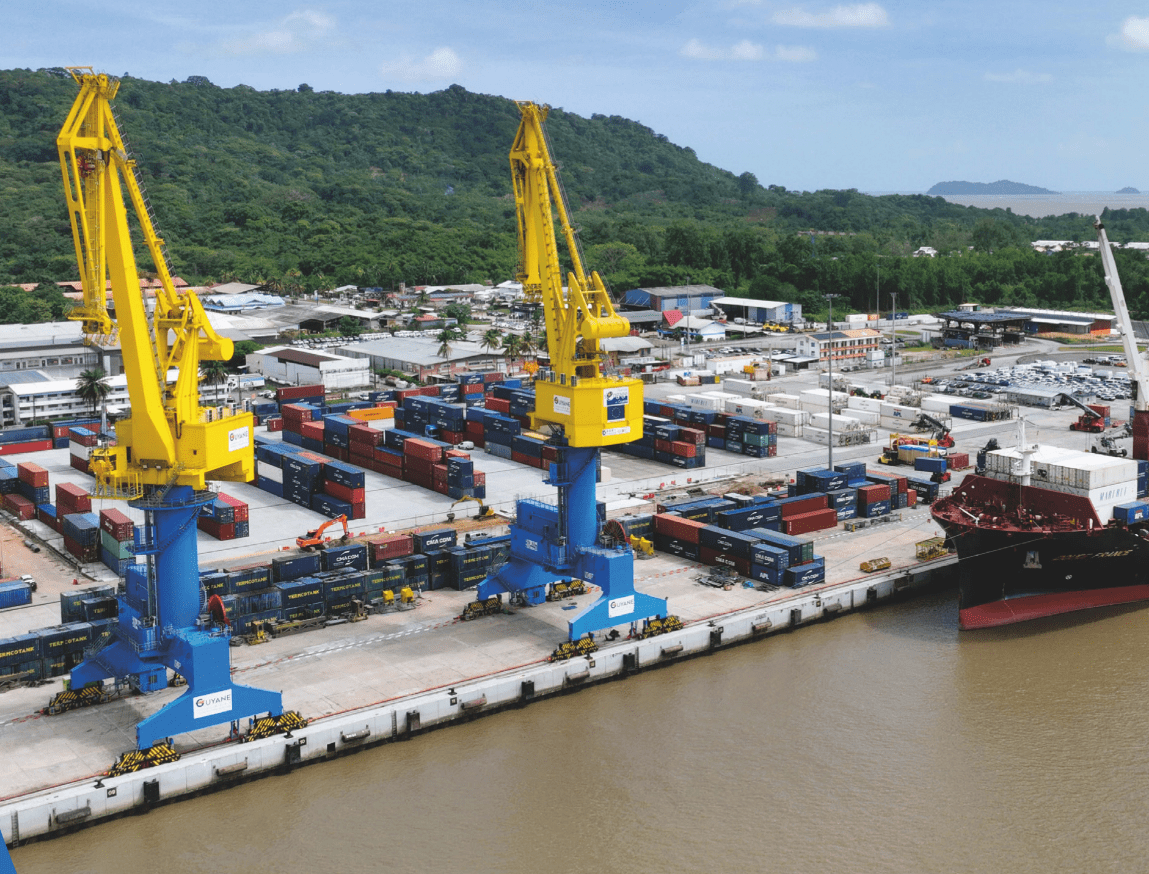
The Grand Port Maritime of French Guiana delivered in 2025 one of its strongest performances to date, handling 961,361 tonnes of cargo, marking its second-best year on record. Yet behind this apparent stability lies a structural imbalance that continues to shape the territory’s logistics model: a heavy and persistent reliance on imports.
Despite a 5.31% decline compared to 2024, the drop remains largely circumstantial. It reflects a normalization following an exceptionally high year driven by energy imports, rather than a weakening of underlying port activity.
A stable port performance despite a statistical decline
At first glance, the contraction in total tonnage may suggest a slowdown. However, the data tells a different story. The decline is primarily linked to a 50,000-ton reduction in imported petroleum products, which had reached unusually high levels the previous year.
Outside of this energy-driven correction, most segments show relative stability. The port continues to operate at a high level of activity, confirming its role as a critical logistics gateway for the territory.
This positions 2025 not as a downturn, but as a year of structural consistency following an exceptional peak.
An import-driven model with limited export capacity
A closer look at trade flows highlights a clear imbalance. Of the total cargo handled in 2025:
- 859,676 tonnes were imports
- 101,688 tonnes were exports
This gap illustrates a logistics system overwhelmingly oriented toward inbound flows. The port functions primarily as a supply hub, reflecting the broader economic structure of French Guiana, where local production and export capacity remain limited.
Such asymmetry is not uncommon in island and remote territories, but it reinforces the port’s dependency on external supply chains and global shipping dynamics.
Energy flows: a key driver of volatility
The significant drop in liquid bulk traffic (-15.55%), largely composed of petroleum products, underscores the port’s sensitivity to energy imports.
This category alone accounts for a substantial share of total volumes, meaning that fluctuations in fuel demand or supply can directly impact overall port performance. In 2025, this dependency translated into a measurable decline in tonnage.
The data highlights a broader structural reality: energy imports remain a central pillar of the port’s activity, but also a source of volatility.
Container traffic remains the system’s backbone
In contrast to bulk commodities, containerized cargo continues to provide stability.
- 110 container ship calls were recorded in 2025
- Total traffic reached 74,594 TEUs, including 42,870 full containers
- Full container volumes increased by 1.5%
This resilience confirms the strategic role of container shipping in supporting the territory’s economic flows, from consumer goods to industrial supplies.
Even in a context of irregular maritime services, the container segment acts as a buffer against fluctuations in other cargo categories.
A logistics system exposed to external constraints
Beyond volumes, the report points to a structural challenge: the irregularity of weekly container shipping services.
This issue reflects the port’s dependence on external maritime networks, where frequency, reliability and capacity are largely dictated by international shipping lines. For a territory like French Guiana, this creates operational constraints that go beyond simple volume metrics.
In this context, performance is not only a matter of throughput, but also of connectivity quality and service regularity.
A resilient platform facing structural imbalances
Overall, the 2025 data confirms the robustness of the Grand Port Maritime of French Guiana. High activity levels, stable container traffic and diversified cargo flows demonstrate the port’s operational resilience.
However, the analysis also reveals a structural reality that remains unchanged: a logistics model heavily reliant on imports, sensitive to energy flows, and dependent on external shipping networks.
Rather than signaling a downturn, 2025 highlights the dual nature of the port’s performance — a strong operational base operating within a structurally constrained economic environment.