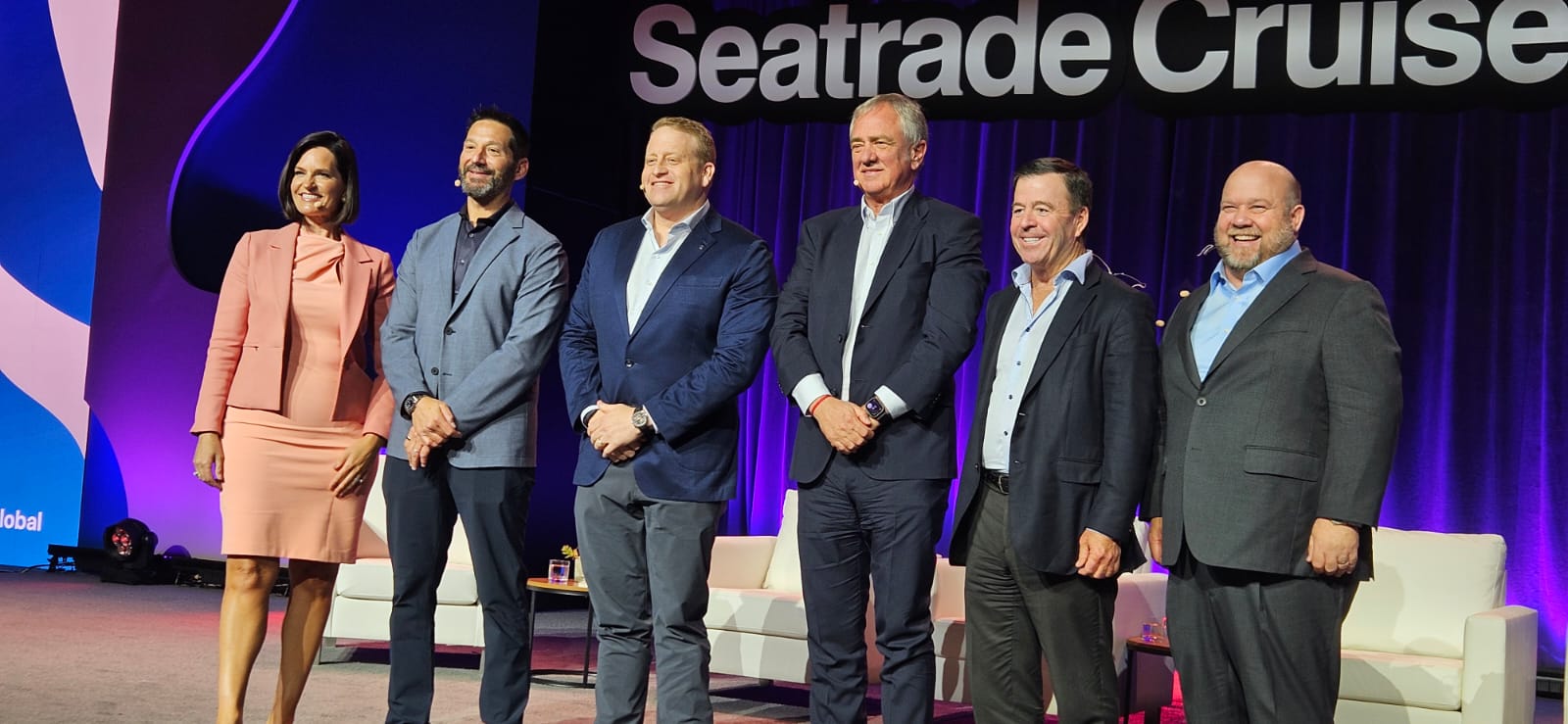
At Seatrade Cruise Global, one of the cruise sector’s flagship gatherings, senior leaders from major cruise companies and industry organizations gathered to discuss the current trajectory of the sector and the forces likely to shape its evolution over the coming years.
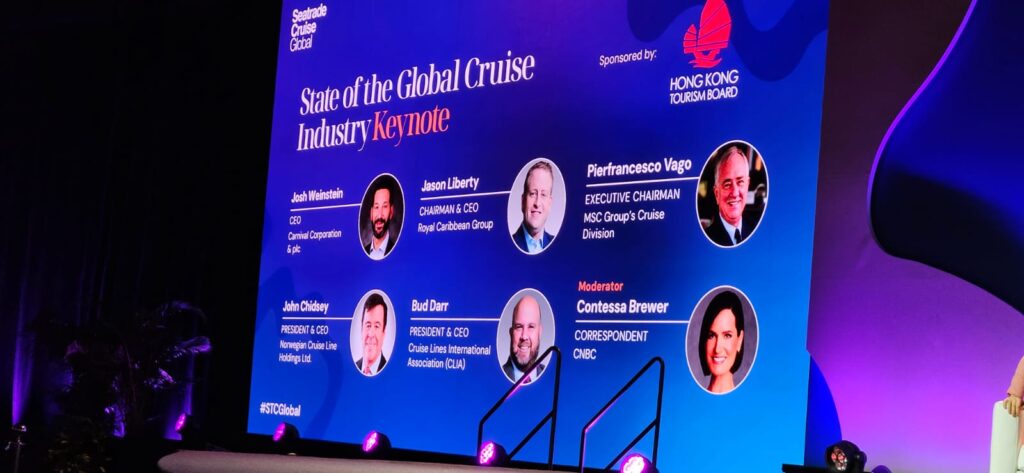
During the keynote session “The State of the Global Cruise Industry,” held on April 14 in Miami Beach, the discussion brought together several leading figures of the global cruise industry, including :
- Charles “Bud” Darr, President and CEO of Cruise Lines International Association (CLIA),
- Jason Liberty, Chairman and CEO of Royal Caribbean Group,
- Josh Weinstein, CEO of Carnival Corporation & plc,
- John Chidsey, President and CEO of Norwegian Cruise Line Holdings Ltd.,
- and Pierfrancesco Vago, Executive Chairman of the cruise division of MSC Group.
The session was moderated by Contessa Brewer, correspondent at CNBC. Their exchanges highlighted sustained demand, technological transformation and ongoing sustainability challenges as defining themes for the sector. The discussion suggested an industry that views itself as resilient and expanding, while simultaneously navigating operational, environmental and destination-management pressures.
Key messages from industry leaders
Several speakers described the current moment as a strong phase for global cruising. The industry continues to experience significant demand growth, with cruise travel increasingly positioned as a mainstream vacation option rather than a niche segment.
One of the most striking figures discussed during the session relates to passenger growth. Industry representatives indicated that global cruise passenger volumes reached approximately 37.2 million guests in 2025, with projections suggesting that around 40 million passengers could be sailing annually by the end of the decade. This trajectory reflects a continued expansion of the sector’s global customer base.
Executives also highlighted the evolving demographics of cruise travelers. According to remarks during the session, a growing share of passengers are new-to-cruise customers, with a notable proportion under the age of forty. This shift suggests that the industry is reaching audiences beyond its traditional customer segments.
Demand trends were repeatedly described as robust, with industry leaders emphasizing the sector’s capacity to adapt to shocks. Over the past two decades, cruising has navigated multiple disruptions — including financial crises, geopolitical tensions, and the COVID-19 pandemic. Despite these challenges, speakers suggested that the sector has demonstrated a notable ability to adjust operations and maintain long-term growth.
Operational resilience was frequently linked to the industry’s integrated business model. Cruise companies manage ships, onboard services, itineraries, and often destination experiences within a single ecosystem. This structure allows operators to adjust itineraries, redeploy ships, or shift market focus relatively quickly when circumstances change.
Emerging dynamics across the discussions
Beyond demand growth, several broader dynamics emerged across the panel discussions.
First, executives highlighted the growing role of technology and data in shaping the passenger experience. Cruise companies are increasingly investing in digital systems, sensors, and data analytics to optimize both onboard operations and customer journeys. These investments are intended to reduce friction throughout the travel experience, from booking and embarkation to onboard services and excursions.
The discussion suggested that personalization is becoming an increasingly central objective. Cruise operators are exploring how data and emerging technologies can allow them to anticipate passenger preferences, streamline services, and create more tailored experiences during voyages.
Second, sustainability and energy transition remain central strategic challenges for the industry. While cruise companies have invested heavily in new ship technologies and operational efficiency, speakers indicated that the availability of alternative fuels remains a critical constraint. Biofuels, LNG derivatives, and synthetic fuels were discussed as potential pathways, but the broader maritime fuel ecosystem — including production and infrastructure — still appears to be developing.
Executives suggested that decarbonization efforts will depend not only on technological innovation aboard ships but also on the development of fuel supply chains and supportive regulatory frameworks.
Third, the relationship between cruise tourism and destinations continues to evolve. The panel addressed concerns related to overtourism, a topic increasingly discussed in major coastal cities and tourism hubs. Industry representatives emphasized that cruise operations are planned years in advance and can therefore contribute to more structured tourism flows compared with other forms of travel.
Some speakers also noted that cruise companies are expanding investments in private destinations and purpose-built facilities, which can help diversify passenger flows and reduce pressure on historic city centers.
Taken together, these dynamics suggest a sector simultaneously expanding its market reach while seeking new ways to manage operational complexity, environmental expectations, and destination relationships.
Implications for Latin America & the Caribbean
For Latin America and the Caribbean, these discussions carry particular relevance.
The Caribbean remains one of the most established cruise regions in the world, and the continued growth in passenger demand suggests that the region is likely to remain central to global cruise itineraries. As cruise companies expand fleets and explore new markets, Caribbean destinations could benefit from sustained traffic and investment in port infrastructure.
At the same time, the discussions around destination management highlight the importance of long-term planning between cruise operators, ports, and local authorities. Cruise schedules are often determined several years in advance, offering destinations an opportunity to coordinate visitor flows, improve infrastructure, and align tourism strategies with broader economic objectives.
Investment in port facilities and passenger experience infrastructure may also become increasingly important. As cruise companies focus on delivering seamless travel experiences, ports that offer efficient logistics, modern terminals, and integrated tourism services could become more competitive within cruise itineraries.
The conversation around private destinations may also influence regional dynamics. Cruise companies have increasingly invested in proprietary islands or destination developments, particularly in the Caribbean. While these projects can enhance the cruise experience, they may also reshape how passengers interact with traditional ports of call.
For policymakers and port authorities across the region, these evolving strategies suggest the need to carefully balance economic opportunity with sustainable tourism planning.

Voices & perspectives
Throughout the session, several statements captured the overall tone of the discussion.
Charles “Bud” Darr, President and CEO of the Cruise Lines International Association (CLIA), characterized the current moment as particularly strong for the sector, stating that “the state of the cruise industry is excellent,” while emphasizing sustained demand and positive long-term prospects for global cruise travel.
Passenger growth was also highlighted as a key indicator of industry momentum. According to remarks during the keynote, “37.2 million guests traveled worldwide last year,” reflecting a continued upward trajectory for cruise travel.
Josh Weinstein, CEO of Carnival Corporation & plc, also stressed the industry’s adaptability, noting that the cruise sector has repeatedly demonstrated its ability to “adapt, pivot and persevere” in the face of economic or geopolitical uncertainty.
Another theme emphasized during the panel relates to the passenger experience. As cruise companies adopt new technologies and digital tools, one executive suggested that customers increasingly expect “frictionless experiences” and more personalized services throughout their journey.
Destination management was also discussed extensively. Speakers noted that cruise tourism represents only a relatively small share of total visitor flows in many destinations, yet remains highly visible. This dynamic, they suggested, makes cooperation with local authorities and communities particularly important.
Reading the road ahead
The discussions at Seatrade Cruise Global suggest that the cruise industry is entering a new phase of growth while navigating an increasingly complex operating environment.
Strong demand, expanding passenger demographics, and technological innovation appear to be reinforcing the sector’s momentum. At the same time, sustainability requirements, fuel transition challenges, and evolving destination relationships will likely shape how cruise companies operate in the coming decade.
For regions such as Latin America and the Caribbean — where cruise tourism plays a significant economic role — these developments point to both opportunity and responsibility. As the industry grows, collaboration between cruise operators, ports, and destinations may become increasingly central to ensuring that expansion remains both economically beneficial and operationally sustainable.
These discussions suggest a sector that remains confident about its long-term prospects while acknowledging that the path ahead will require continued adaptation and partnership across the maritime ecosystem.