
Caribbean Airlift Economics : The CTO Air Connectivity Summit did not simply revisit route attraction mechanics. It revealed a deeper transition in how Caribbean destinations are beginning to frame airlift: not as a tactical tourism tool, but as a component of economic architecture.
If the ministerial session exposed fragmentation and fiscal misalignment, the operational panels exposed something equally structural — the region’s gradual shift from incentive dependency toward demand discipline and governance alignment.
This is not cosmetic evolution.
It is a strategic inflection point.
Airlift as Economic Infrastructure
One of the clearest signals came early in the discussions:
“In the Caribbean, aviation is not simply transportation infrastructure, it is economic infrastructure.”
— Stacey Liburd, CEO, Grenada Tourism Authority
This framing changes everything.
In small island economies where tourism accounts for a significant share of GDP and over 90% of stayover arrivals depend on air access, route decisions directly influence:
- employment levels
- hotel performance
- fiscal revenues
- investor confidence
- and infrastructure returns
Airlift is not capacity management.
It is macroeconomic policy.
Yield Strategy: Beyond the Luxury Narrative
Another strategic fault line emerged around yield.
For years, Caribbean positioning strategies have leaned heavily into luxury branding. But the summit introduced a more nuanced economic lens.
Dr. Ernest Hilaire challenged the automatic equation between luxury travelers and national benefit:
“This notion that once you’re a luxury traveler… automatically the destination benefits from it, that’s not necessarily true.”
— Dr. Ernest Hilaire, Deputy Prime Minister and Minister of Tourism, Commerce, Investment, Creative Industries and Culture, Saint Lucia
The implication is structural.
High-spend visitors concentrated within vertically integrated resorts may generate less local economic circulation than mid-tier travelers who distribute spending across restaurants, excursions and small enterprises.
Yield, therefore, cannot be assessed solely at fare class or room rate level.
It must be evaluated at ecosystem level.
For airlines and investors, this reframes demand modeling entirely.
From Incentive Dependence to Demand Architecture
The debate around Minimum Revenue Guarantees (MRGs) reflected this broader maturation.
Rather than celebrating incentives as necessary tools, speakers questioned their structural sustainability.
As Collin James observed:
“Minimum revenue guarantees put the entire risk on the destination.”
— Colin James, Chief Executive Officer, Antigua and Barbuda Tourism Authority
In thin markets exposed to seasonality and external shocks, concentrating risk on public balance sheets creates fiscal vulnerability.
This does not mean incentives disappear.
It means they must be subordinated to demand architecture.
Dr. Hilaire summarized the direction clearly:
“If you’re going to build a sustainable tourism industry, it cannot be based on incentives. The demand has to be one which is organically grown.”
— Dr. Ernest Hilaire
Organic demand requires:
- event programming
- sports and cultural calendars
- diaspora engagement
- conference alignment
- coordinated marketing windows
It is engineered, not improvised.
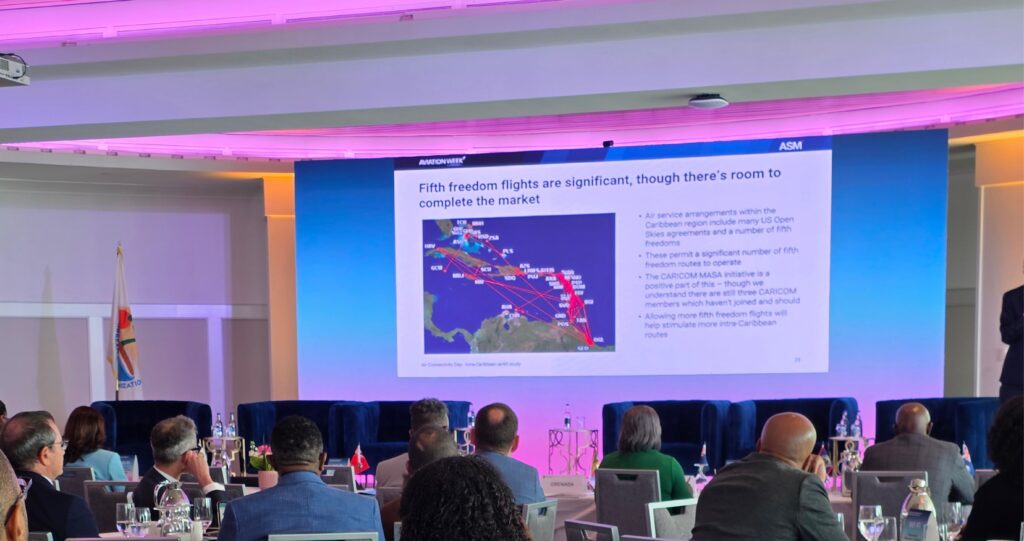
Data Discipline as Negotiation Currency
Another recurring theme was data credibility.
Airlines do not respond to aspiration.
They respond to evidence.
As emphasized during negotiations:
“It’s important to have data… so that when you come to an airline and you’re negotiating, you’re not going off of emotion.”
— Colin James
Origin-destination analysis, seasonal forecasting, diaspora segmentation and compression modeling are becoming central to Caribbean route discussions.
This marks a shift from promotional negotiation to performance negotiation.
Governance: The Silent Determinant
The structural shift also extends to airport management.
Dr. Rafael Echevarne introduced a governance dimension often overlooked in tourism discourse:
“Airports… no matter if you are public or private, these are businesses.”
— Dr. Rafael Echevarne, Director General, ACI-LAC
Professional continuity, written strategy and realistic positioning were identified as prerequisites for airline confidence.
Political volatility undermines predictability.
Predictability underpins capital allocation.
For investors and operators, governance stability is not administrative detail — it is risk mitigation.
Runway-to-Resort Alignment
The commercial layer reinforces this alignment imperative.
As Tim Morrison explained:
“If we have more demand, more airlift, we will increase our occupancies… once you drive compression, you drive ADR.”
— Tim Morrison, General Manager, Hamilton Princess & Beach Club
Yet compression without reliability damages brand perception.
A study referenced during the session indicated that 80% of travelers reconsider destinations following disruptive travel experiences.
Operational efficiency, digital identity, border fluidity and airport experience now directly influence yield sustainability.
The airport is no longer neutral infrastructure.
It is a strategic gateway asset.
A Regional Maturity Threshold
Taken together, the summit revealed a structural evolution.
From:
- fragmented competition
- incentive escalation
- symbolic coordination
Toward:
- risk awareness
- data discipline
- governance alignment
- demand engineering
- ecosystem integration
The conversation is no longer about “adding routes.” It is about designing an economic model capable of sustaining connectivity. That distinction matters.
Because in small island economies, airlift is not an operational variable.
It is a national growth lever.
And the Caribbean appears to be entering a phase where that reality is being acknowledged — publicly and strategically.