Across the Caribbean, air connectivity remains a structural challenge shaped by geography. While major hubs tend to dominate investment strategies and industry attention, a critical part of the network operates at a different scale — through secondary airports. The recent runway upgrade at J.F. Mitchell Airport in Bequia offers a clear illustration of how these smaller infrastructures quietly sustain regional connectivity.
Bequia: a local airport with regional implications
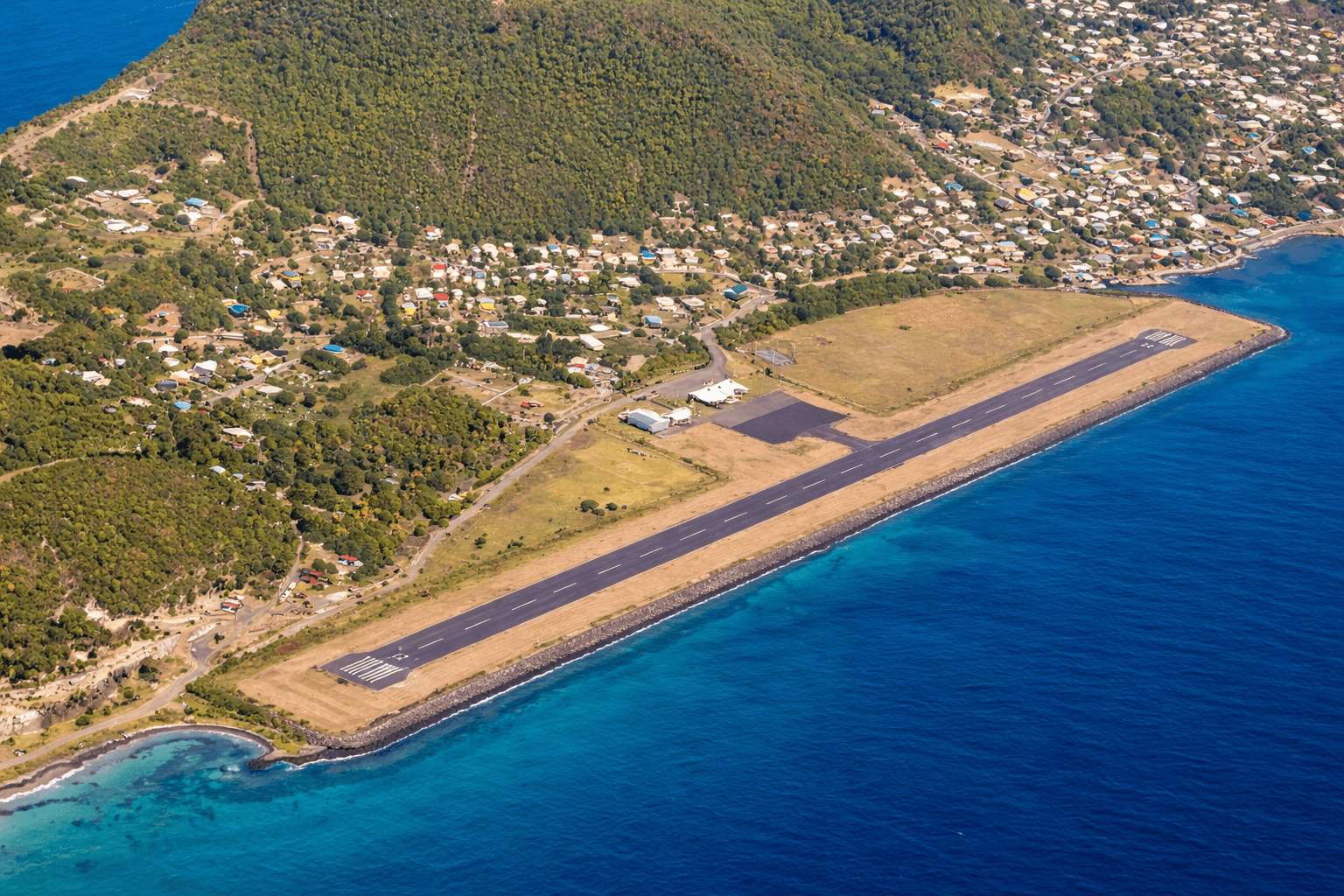
On March 10, 2026, the Government of Saint Vincent and the Grenadines announced the completion of runway upgrade works at J.F. Mitchell Airport on the island of Bequia. The airport had been closed for 11 days in February to allow for routine maintenance and targeted technical repairs.
At first glance, the project appears limited in scope — no expansion, no major structural transformation. Yet for Bequia, this airport plays a vital role. It supports inter-island mobility, facilitates tourism flows, and contributes directly to the island’s economic activity.
Prime Minister Dr. Godwin Friday highlighted the importance of the project, stating:
“I am delighted that we have been able to deliver much-needed upgrades to the J.F. Mitchell Airport and the people of Bequia.”
Beyond the statement, the operational reality is clear: maintaining infrastructure reliability is essential to preserving connectivity in island environments.
A structurally fragmented regional network
The Caribbean’s geography inherently fragments its transport systems. With islands spread across vast distances and limited alternatives to air travel, aviation remains the backbone of regional mobility — even for short-haul routes.
In this context, secondary airports are far more than local facilities. They function as critical nodes within a dispersed network, enabling both inter-island connections and access to larger regional and international gateways.
Without these airports, entire territories risk becoming partially disconnected. Caribbean air connectivity does not rely solely on major hubs — it depends on a dense network of smaller entry points that ensure continuity.
A two-tier system: hubs and secondary infrastructure
The Bequia runway upgrade is part of a broader national infrastructure strategy. Alongside this project, expansion and remedial works at Argyle International Airport — the country’s main gateway — have already been approved.
This reflects a two-tier system:
- major hubs handling international traffic and long-haul connectivity;
- secondary airports ensuring local distribution and territorial coverage.
The relationship between the two is not optional — it is structural. Without efficient secondary infrastructure, the reach and effectiveness of primary hubs remain limited.
Small-scale projects, strategic impact
With just 11 days of closure and works limited to maintenance and technical repairs, the Bequia project highlights a broader reality: not all strategic infrastructure investments are large-scale or high-profile.
These types of interventions often go unnoticed. Yet they have an immediate impact on operational safety, service reliability and network resilience.
In island contexts, where every connection point matters, so-called “secondary” infrastructure becomes critical. It directly influences accessibility, tourism development and local economic dynamics.
Connectivity built from the ground up
Beyond Bequia, the government has signaled its intention to continue investing in infrastructure, with additional projects expected in the near future.
The challenge is not simply to upgrade individual assets, but to strengthen an interconnected system where each component plays a role.
In the Caribbean, connectivity is not defined solely by major airports. It is built — and sustained — through a network of smaller infrastructures that ensure territorial continuity and economic integration.